
When you pick up a prescription, you probably don’t think about who made it or how much it cost to produce. But behind every pill - whether it’s a brand-name drug or its generic version - there’s a complex web of labor, regulation, and economics that determines its price. The biggest difference? Labor cost isn’t what you think it is.
Why generic drugs cost so much less
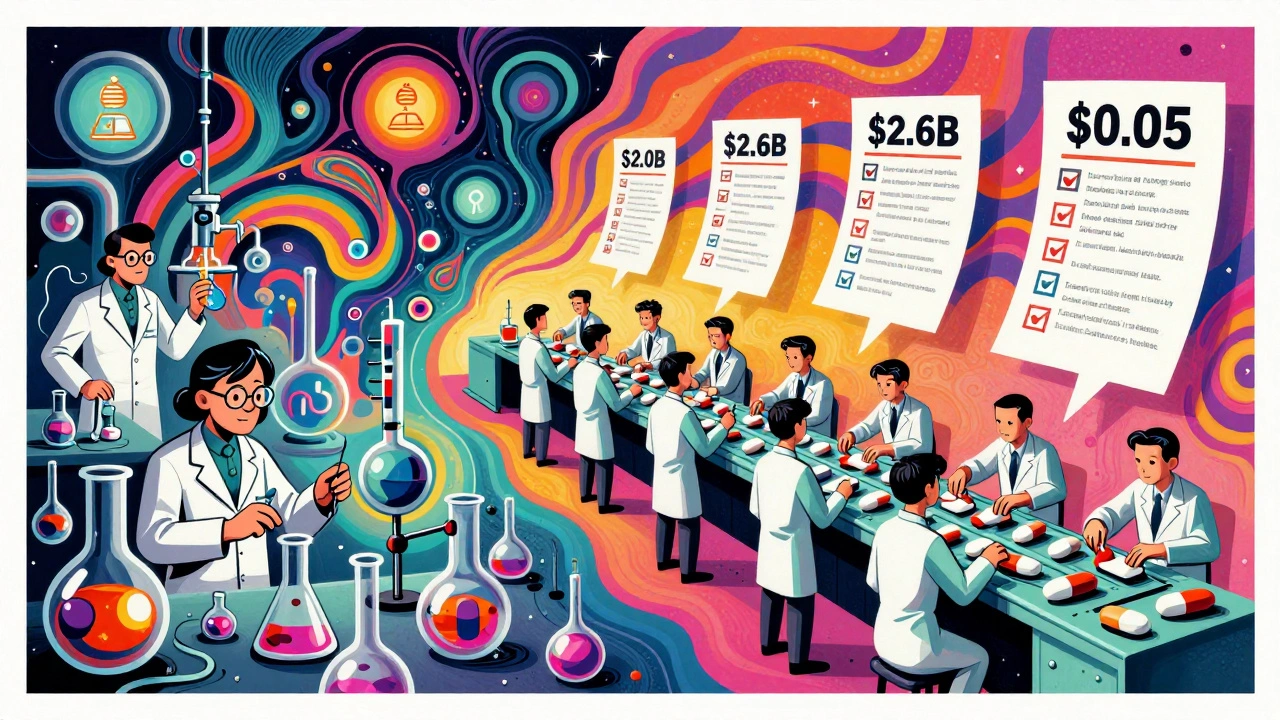
Generic drugs aren’t cheaper because they’re made worse. They’re cheaper because they don’t have to reinvent the wheel. Brand-name drugs start with a massive investment: years of research, clinical trials, patent filings, and regulatory hurdles. The FDA estimates it takes about $2.6 billion and 10 to 15 years to bring a new drug to market. That cost doesn’t disappear - it gets baked into the price. When the patent expires, generics step in. They don’t pay for any of that. So what’s left? Manufacturing. And labor is a big part of that.For brand-name drugs, labor makes up 30% to 40% of total production costs during early manufacturing. That’s because the process is complex, often done in smaller batches, and requires highly specialized staff - chemists, process engineers, quality control specialists - all working under strict FDA guidelines to ensure consistency. Every step is documented, reviewed, and validated. It’s expensive.
Generic manufacturers? They’re running on a different playbook. Their labor costs are typically 15% to 25% of total production. Why? Scale. When you’re making millions of tablets a day, not thousands, you don’t need as many people per unit. A single production line for a generic drug can churn out 100 times more pills than a brand-name line. That drives down labor cost per pill dramatically. According to BCG’s 2019 analysis, generic manufacturers cut unit costs by 27% every time production volume doubles. Brand manufacturers? Only 17%. That’s the power of volume.
The hidden labor cost: compliance and quality control
Don’t be fooled - generic manufacturers aren’t cutting corners on labor. They’re just spending it differently. Quality control alone accounts for over 20% of total production costs for generics. That’s not just running a machine. That’s lab technicians testing every batch of raw material. That’s inspectors checking for contamination. That’s document specialists tracking every step of every batch so the FDA can trace a single pill back to the exact hour it was made.For a medium-sized generic company with 20 to 500 employees, just staying compliant with FDA rules costs about $184,000 a year. Add in the $1.9 million annual cost of running a quality program and another $320,000 for each new drug application, and you’re looking at serious labor investment. But here’s the twist: this labor isn’t about innovation. It’s about repetition. The same tests, the same forms, the same procedures - done over and over, with fewer errors because the process is standardized. That’s efficiency.
Brand-name companies also do this, but they’re doing it on top of R&D. Their QC teams aren’t just checking for consistency - they’re helping design new processes, validate novel delivery systems, and adapt to new formulations. That’s higher-skill, higher-cost labor. Generic companies? They’re doing the same checks, but on a proven formula. Less creativity. More consistency. Lower cost per hour of labor.
Where the work happens: global labor arbitrage
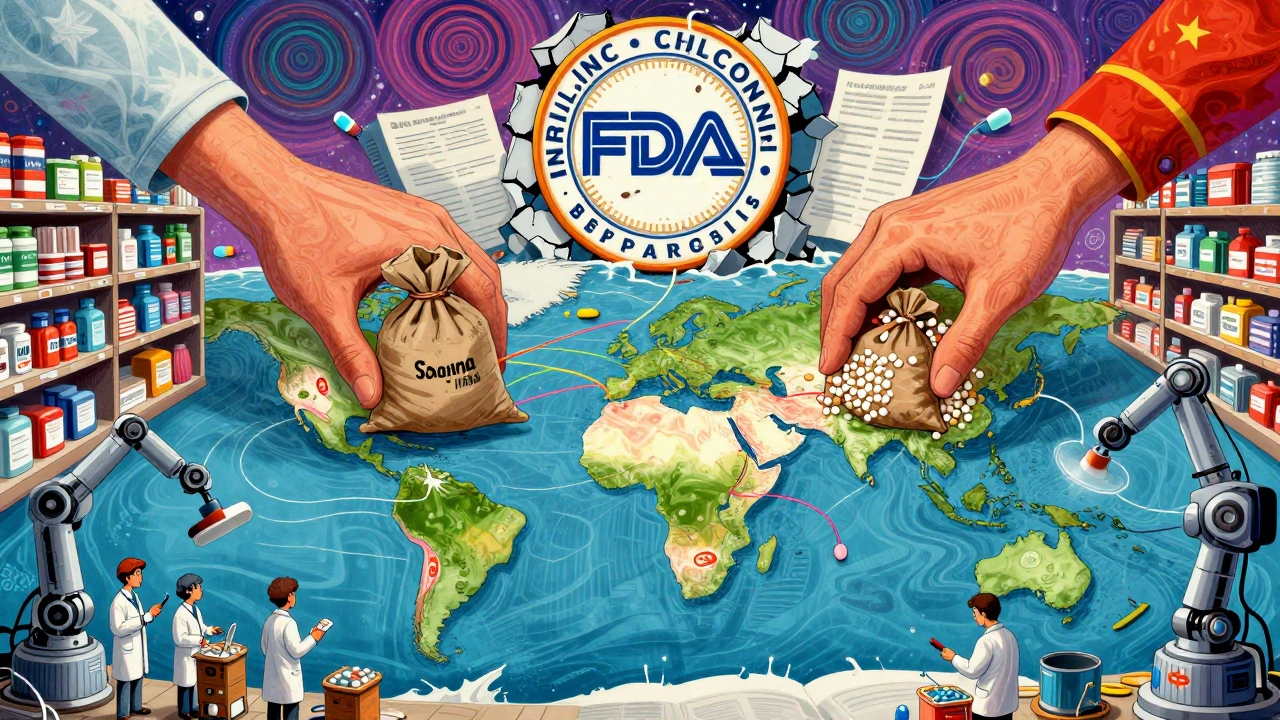
You might think all drug manufacturing happens in the U.S. It doesn’t. Around 80% of the active pharmaceutical ingredients (APIs) used in U.S. generics come from India and China. And labor there is dramatically cheaper - about 42% less than in U.S. facilities, according to Prosperous America’s 2023 analysis.This isn’t about being more efficient. It’s about lower wages, fewer regulations, and massive scale. A factory in India can hire 100 quality control technicians for the same cost as hiring 20 in Ohio. That difference shows up in your pharmacy bill. But it’s not just about wages. The HHS Office of the Assistant Secretary for Planning and Evaluation points out that these cost advantages come with trade-offs: lax environmental standards, weaker worker protections, and government subsidies that keep prices artificially low.
That’s why some U.S. lawmakers are pushing to bring more production home. But for now, the math is clear: if you want low-cost generics, you’re relying on global labor markets. And that’s a big reason why nine out of ten prescriptions filled in the U.S. are for generics - they’re affordable because they’re made where labor is cheap.
Outsourcing labor: the rise of contract manufacturers
More and more generic companies are outsourcing production entirely. Instead of owning factories and hiring staff, they hire contract manufacturing organizations (CMOs). In the biosimilar space, 42% of production costs go to CMOs - up from 28% for traditional generics. This shift turns fixed labor costs into variable ones. If demand drops, you don’t lay off workers - you just order fewer batches.This model gives generic manufacturers flexibility. They can scale up quickly when a new drug hits the market. They can shift production to the cheapest CMO without restructuring their own teams. It’s smart business. But it also means the people making your pills might be in a different country, working for a company you’ve never heard of. The brand on the bottle doesn’t tell you who actually made it.
Why brand-name drugs still cost 80% more
Here’s the brutal truth: brand-name drugs cost 80% to 85% more than generics - even though the active ingredient is identical. The difference isn’t in the pill. It’s in the marketing, the patents, the distribution deals, and the need to recoup R&D. UH Hospitals found that brand-name drugs make up 75% of total prescription spending, even though they account for only 10% of prescriptions filled.That means you’re paying for someone else’s research. You’re paying for TV ads. You’re paying for sales reps visiting doctors. You’re paying for legal teams defending patents. And you’re paying for the fact that, for a while, there’s no competition. Once generics enter the market, prices drop fast. The FDA says just a few generic competitors can slash prices by 50% or more.
But here’s the catch: that price drop puts pressure on generic manufacturers. To stay profitable, they have to keep cutting costs. That means squeezing labor. Fewer staff. Less training. Faster QC cycles. The FDA has warned that this pressure could lead to supply shortages - not because factories shut down, but because companies cut too deep on quality control labor to stay competitive.
Who wins? Who loses?
Patients win. The healthcare system wins. Insurance companies win. Everyone who pays for prescriptions benefits from the lower labor and production costs of generics.But the people making the drugs? Their situation is mixed. In India and China, workers may earn less but have steady jobs. In the U.S., some manufacturing jobs have disappeared - replaced by automation or moved overseas. Meanwhile, brand-name companies still employ highly skilled scientists and engineers, but those jobs are fewer and more specialized.
The real loser? Transparency. You don’t know who made your pill. You don’t know how many people worked on it. You don’t know if the QC team was overworked, underpaid, or undertrained. The system works - it keeps drugs affordable. But it hides the human cost behind the price tag.
What’s next for labor in drug manufacturing?
The trend is clear: automation, outsourcing, and scale will keep driving down labor costs in generic manufacturing. But there’s a limit. If companies cut labor too much, quality suffers. And when quality fails, patients pay the price - through recalls, shortages, or unsafe drugs.The future belongs to manufacturers who invest smartly in labor - not by hiring more people, but by training them better. Companies that reduce errors, speed up testing, and build reliable systems will win. The FDA has noted that manufacturers who focus on prevention - training, planning, process design - end up with lower total costs, even if they spend more upfront on staff.
So the next time you grab a generic, remember: it’s not cheaper because it’s made by robots or in a basement. It’s cheaper because it’s made at scale, with smart labor, in places where costs are lower - and because competition forces everyone to do more with less.
Releted Post


Andy Dargon
Hi, I'm Aiden Lockhart, a pharmaceutical expert with a passion for writing about medications and diseases. With years of experience in the pharmaceutical industry, I enjoy sharing my knowledge with others to help them make informed decisions about their health. I love researching new developments in medication and staying up-to-date with the latest advancements in disease treatment. As a writer, I strive to provide accurate, comprehensive information to my readers and contribute to raising awareness about various health conditions.
Really well put. I never realized how much of the cost difference comes down to scale and repetition rather than quality. It’s wild to think that the same exact molecule can cost 80% less just because someone else figured out how to make it efficiently.
Also, the part about QC being 20% of generic costs? That blew my mind. People think generics are sketchy, but they’re actually under more regulatory scrutiny per unit than most of us realize.
Oh sweet jesus, so this is why Big Pharma screams ‘national security’ every time someone mentions bringing manufacturing back? It’s not about safety-it’s about keeping the profit machine greased with slave wages overseas.
And don’t get me started on how ‘FDA-approved’ means ‘we followed the paperwork while the workers in Hyderabad coughed through their masks.’ I’m not anti-generic-I’m anti-exploitation. And yes, I’m mad.
Thank you for this. As a Canadian, I’ve always wondered why our generics are cheaper than the U.S. version-even though we pay more for everything else. It’s not just healthcare policy-it’s labor policy. And the fact that the U.S. outsources 80% of APIs while pretending it’s about ‘efficiency’? That’s a moral blind spot wrapped in economic jargon.
This is one of the clearest breakdowns I’ve seen on pharmaceutical economics. The distinction between innovation labor and repetitive labor is critical-and often misunderstood. Brand-name companies pay for discovery; generics pay for precision. One is creative, the other is meticulous. Both are valuable. Neither should be vilified.
Also, the CMO shift is fascinating: it’s essentially the pharmaceutical equivalent of Uberizing manufacturing. Flexible, scalable, and deeply opaque.
Ugh. So let me get this straight: we’re okay with poisoning Indian workers and polluting rivers so Americans can save $10 on their blood pressure meds? Brilliant. Just brilliant.
And don’t give me that ‘they’re happy to have jobs’ nonsense. That’s the same excuse used for sweatshops in the 90s. We’re not heroes-we’re hypocrites. And we’re all complicit.
How quaint. You assume the ‘labor’ in generics is somehow ‘efficient’-but what you’re really describing is the systematic devaluation of human labor on a global scale. The FDA doesn’t regulate wages. The market does. And the market has decided that human life in India is worth less than a bottle of aspirin.
And yet, you celebrate this as ‘smart business.’ I find it morally repugnant.
One might argue that the entire pharmaceutical industrial complex is a Rube Goldberg machine of rent-seeking behavior, wherein the value of human biology is extracted, commodified, and then re-sold as a social good-while the actual laborers who enable this transaction remain invisible, underpaid, and statistically irrelevant to the balance sheet.
Thus, the ‘generic’ is not a product-it is an epistemological erasure.
So you’re telling me my $4 generic blood pressure pill was made by someone earning $2/hour? Cool. I’ll take it. But yeah, that’s messed up. 😑
There’s something poetic about how the cheapest drugs are the most human-made
They’re not made by machines, not really
They’re made by hands that never see the bottle
By eyes that check the same test for the 10,000th time
By silence that doesn’t make headlines
And yet we call it ‘efficiency’
When really it’s just invisibility
USA FIRST! 🇺🇸 We pay more for everything else-why the hell are we letting China and India make our medicine?! This is a national security crisis. Bring the factories home or I’m boycotting all generics. 🤬
Ha. So now you’re all shocked that people in India work for pennies to make your pills? We’ve been making them for decades. You bought the patents, then acted like we were stealing your medicine when we made it cheaper.
Now you want us to pay more? Fine. But then your $4 pill becomes $40. And you’ll cry again.
Meanwhile, I’m still here, testing your batch. And yes-I’m still smiling. 😊