
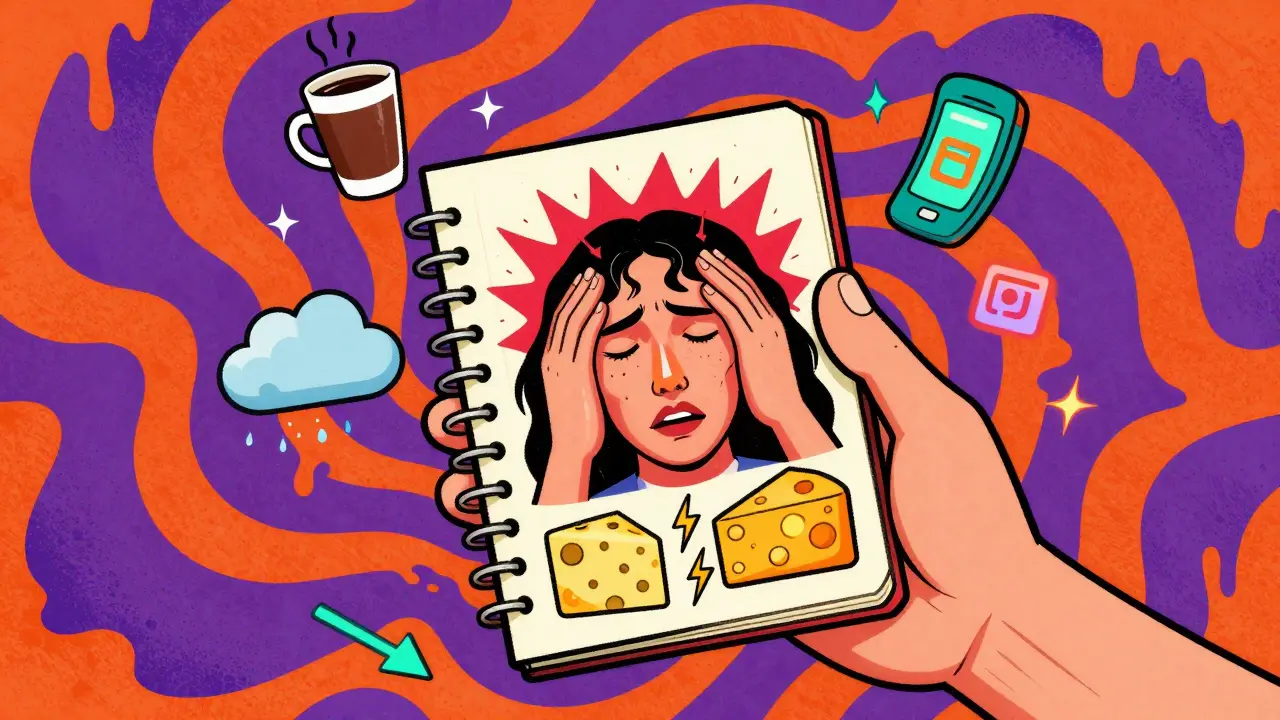
Daily Symptom Tracker: Identify Your Triggers
How to Use This Tracker
Follow the ABC model to log your symptoms systematically. This helps identify patterns and triggers over time.
- A (Antecedent): What happened right before the symptom?
- B (Behavior): What happened? Be specific about the symptom.
- C (Consequence): What happened after the symptom?
Your Track Record
When you start noticing strange symptoms-headaches after eating cheese, fatigue every Thursday afternoon, or anxiety spikes after scrolling through social media-it’s easy to blame luck, stress, or bad timing. But what if those moments aren’t random? What if they’re clues? Documenting side effects isn’t just for people with chronic illnesses. It’s a simple, powerful way to turn guesswork into control.
Why Tracking Side Effects Works
Most people don’t realize how much their daily life affects how they feel. A poor night’s sleep might not just make you tired-it could trigger a migraine. A new medication might not cause nausea right away, but after three days of eating spicy food, it might. Without tracking, these connections stay hidden.
Research shows that people who track their symptoms consistently are 40-60% more likely to reduce their frequency and intensity. In one study of 12,500 migraine sufferers, those who kept detailed logs identified at least one major trigger within three months. That’s not magic. That’s data.
The goal isn’t to obsess. It’s to find patterns. Once you know what triggers your symptoms, you can avoid, adjust, or prepare. You stop reacting-you start responding.
The ABC Model: Your Simple Tracking System
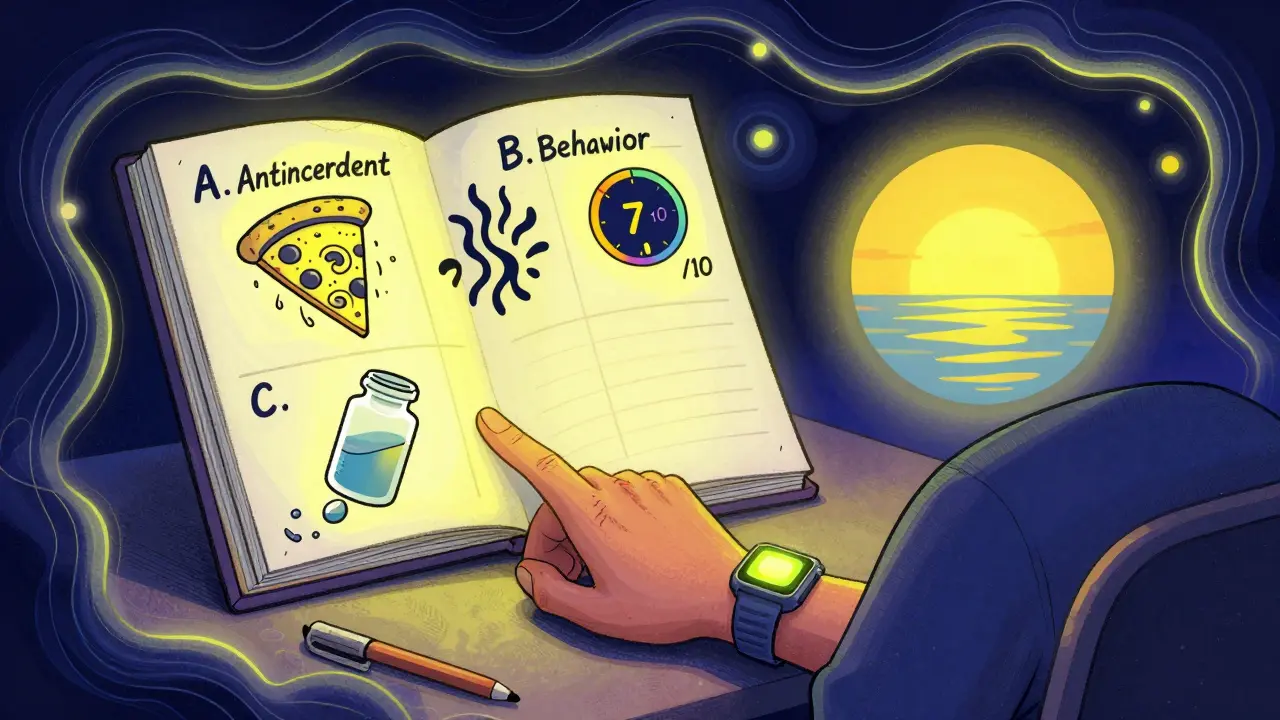
The most reliable method for tracking side effects is the ABC model: Antecedent, Behavior, Consequence. It sounds complicated, but it’s just three questions you ask yourself every time something happens.
- A (Antecedent): What happened right before the symptom? (e.g., ate pizza, slept 5 hours, argued with a coworker)
- B (Behavior): What happened? Be specific. Not just "headache," but "throbbing pain behind left eye, started at 3:15 p.m., rated 7/10 intensity"
- C (Consequence): What happened after? (e.g., took ibuprofen, slept for two hours, felt better by 8 p.m.)
Studies show this method is 37% more effective than freeform journaling, especially for identifying triggers in conditions like migraines, anxiety, and chronic pain. The key? Do it every time. Even if you think it’s "not important." That’s how patterns emerge.
What to Track: The Essential Details
You don’t need to record everything. But missing key details means missing the connection. Here’s what actually matters:
- Date and time: Use 15-minute precision. A headache at 6:00 p.m. vs. 10:00 p.m. might have different causes.
- Symptom intensity: Rate it 0-10. Zero is no symptom. Ten is unbearable.
- Duration: How long did it last? 10 minutes? 8 hours?
- Medications and dosages: Not just "took painkiller," but "took 600mg ibuprofen at 2:30 p.m."
- Sleep: How many hours? How well? (e.g., "slept 6h, woke up 3x")
- Diet: What did you eat or drink? Include timing. Coffee at 7 a.m. vs. 4 p.m. matters.
- Stress level: Rate it 1-5. Was it a calm day or a meltdown?
- Environment: Weather? Loud noises? Bright lights? New perfume? These are silent triggers.
One woman in San Diego tracked her joint pain for six weeks. She noticed it always flared after eating tomatoes. She stopped eating them. Within a month, her pain dropped by 70%. She never connected the two until she started writing it down.
Paper vs. Apps: Which One Works Better?
There’s no one-size-fits-all tool. The best tracker is the one you’ll actually use.
Paper journals (like MedShadow’s symptom tracker) are simple, cheap, and reliable. They don’t die on battery, don’t need Wi-Fi, and 91% of users keep using them after 30 days. They’re perfect for older adults or anyone who finds tech overwhelming. The catch? You have to remember to write. No reminders. No auto-logging.
Digital apps like Wave or MigraineBuddy automate parts of the process. They sync with your phone’s health data-sleep, heart rate, even temperature. MigraineBuddy’s 2024 update even uses Apple Watch temperature sensors to catch early migraine signs. These tools find patterns faster. One study showed users identified triggers 28% quicker than with paper.
But here’s the catch: 43% of app users quit after two months. Why? Too many screens. Too many buttons. Too much setup. If you’re not tech-savvy, or you’re already overwhelmed by notifications, an app might add stress-not relieve it.
Best advice? Start with paper. If you stick with it for 30 days, then try an app. Don’t let perfection stop progress.
How Long Should You Track?
Some people think they need to track for months. You don’t. Most patterns show up in 14-30 days.
Research from Magnetaba shows 87% of successful trigger identifications happened after at least two weeks of consistent logging. That’s not a lot. Just five to seven minutes a night. Write down what happened today. No need to analyze yet. Just record.
After 30 days, take 20 minutes to look back. Look for repeats:
- Do headaches always follow nights with less than 6 hours of sleep?
- Does anxiety spike after drinking alcohol-even one glass?
- Do joint pains flare up every time the weather drops below 50°F?
You don’t need fancy software to spot these. A quick scan of your notes is enough.
What to Do Once You Find a Trigger
Finding a trigger is just the first step. Now you have power.
Let’s say you notice your anxiety spikes every time you check work emails after 7 p.m. You can:
- Turn off notifications after 7 p.m.
- Move email checking to mornings only.
- Replace evening scrolling with a walk or music.
Or if you discover that aged cheese triggers your migraines, you can:
- Swap cheddar for fresh mozzarella.
- Ask restaurants to skip blue cheese on your salad.
- Keep a backup pain reliever on hand when you know you’ll be eating out.
Don’t wait for your doctor to tell you what to do. You already have the data. Use it.
When Tracking Makes Things Worse
Tracking isn’t magic. It can backfire.
For some people-especially those with anxiety disorders-tracking can turn into hypervigilance. Instead of noticing patterns, they start noticing everything. Every twinge becomes a threat. Every skipped meal feels dangerous. One Harvard study found that 12-15% of anxious patients actually got worse from over-tracking.
Signs you’re doing it wrong:
- You’re checking your body every 10 minutes.
- You’re avoiding things you used to enjoy because you’re scared they’ll trigger something.
- You feel more anxious after logging than before.
If this sounds familiar, pause. Take a break. Talk to a therapist. Tracking should help you feel more in control-not less.

Real Results from Real People
On Reddit’s r/Migraine community, 68% of users who tracked for 90+ days found at least one major trigger. The top three? Aged cheese, red wine, and lack of sleep.
In a survey of 3,200 chronic illness patients, 74% who tracked reduced their medication use by at least 25%. Why? Because they avoided triggers instead of relying on pills.
One man in Texas tracked his fibromyalgia pain for six weeks. He realized it spiked every time he sat in his office chair for more than 90 minutes. He bought a standing desk. His pain dropped by half.
These aren’t outliers. They’re people who stopped guessing and started learning.
What’s Next for Side Effect Tracking?
The future is getting smarter. The FDA just cleared a new digital symptom tracker for use in clinical trials. Apple Watch now detects temperature changes that signal migraine onset before you even feel it. AI tools are being tested to predict flare-ups 48 hours ahead-with 63% accuracy.
But here’s the truth: none of that matters if you don’t start now. You don’t need AI. You don’t need a fancy app. You just need a notebook and five minutes a day.
Healthcare systems are starting to integrate patient tracking data into electronic records. Doctors are asking for it. But you don’t need to wait for them to catch up. You can start today.
Frequently Asked Questions
Do I need to track every single day?
You don’t need to track every single day, but consistency matters more than perfection. Missing a day here and there won’t ruin your progress. What matters is building a habit. Try to track at least 5 days a week for the first 30 days. After that, you can reduce frequency once you’ve identified patterns.
What if I don’t see any patterns after 30 days?
It’s possible you’re missing something. Review your entries-are you being specific enough? Instead of "felt bad," write "felt dizzy, nauseous, and had a headache after lunch." Also, consider extending your tracking to 45-60 days. Some triggers are seasonal, tied to hormonal cycles, or linked to long-term stress. Don’t give up too soon.
Can I use a notes app on my phone instead of a journal?
Yes, but make sure it’s simple. Avoid apps with too many features. Just use the Notes app or a basic text file. The goal isn’t to build a database-it’s to record what happened. If you’re spending more time formatting than writing, you’re making it harder than it needs to be.
Should I show my tracker to my doctor?
Absolutely. A detailed tracker gives your doctor a clear picture of your symptoms over time, not just what you remember from your last appointment. Studies show patients who bring tracking data to appointments have 29% better treatment outcomes. Bring your journal or export your app data as a PDF.
Is tracking side effects only for people with chronic conditions?
No. Anyone who wants to understand how their body responds to food, stress, sleep, or medications can benefit. Even if you don’t have a diagnosed condition, tracking can help you feel better. Maybe you’re always tired on Mondays. Maybe you get stomach cramps after coffee. These aren’t "normal"-they’re signals. Tracking helps you listen.
Start Today, Not Tomorrow
You don’t need a diagnosis to start tracking. You don’t need a fancy app. You don’t need to be perfect. You just need to begin.
Grab a notebook. Write down what happened today. Not tomorrow. Today.
One entry. One day. That’s all it takes to start seeing the invisible connections between your life and how you feel. And once you see them, you can change them.
Releted Post

Andy Dargon
Hi, I'm Aiden Lockhart, a pharmaceutical expert with a passion for writing about medications and diseases. With years of experience in the pharmaceutical industry, I enjoy sharing my knowledge with others to help them make informed decisions about their health. I love researching new developments in medication and staying up-to-date with the latest advancements in disease treatment. As a writer, I strive to provide accurate, comprehensive information to my readers and contribute to raising awareness about various health conditions.
I started tracking my headaches after cheese and it blew my mind. Turns out it’s not the cheese-it’s the wine I drink with it. Who knew?
Simple is best. I use a notebook and write one line before bed: what I ate, how I slept, how I felt. No fancy apps. Just truth. It works.
My niece has anxiety and she’s been doing this for two weeks-she already noticed her panic spikes after energy drinks. Small change, big difference.
It’s fascinating how society pathologizes bodily awareness while simultaneously ignoring the most rudimentary forms of self-observation. The ABC model isn’t merely a tool-it’s an epistemological act of reclaiming agency from the medical-industrial complex.
Most patients are conditioned to defer to authority, to wait for validation from a white coat before they believe their own experience. Yet here we are: a 37% efficacy advantage over freeform journaling, and still, clinicians rarely mention it.
The real revolution isn’t in the apps-it’s in the refusal to outsource your phenomenology to someone who sees you for 12 minutes every six months. Your body isn’t a black box. It’s a text. And you’re the only one who can read it properly.
Oh, please. Another ‘track your vibes’ wellness cult article. You’re telling me I need to write down ‘I ate avocado at 1:30 p.m.’ to avoid a headache? That’s not data-that’s obsessive-compulsive nonsense.
And don’t get me started on the ‘paper journals are better’ nonsense. In 2024? You’re advocating for analog solutions because you’re afraid of technology? That’s not mindfulness-that’s Luddism wrapped in a $12 Moleskine.
Also, ‘one woman in San Diego’? That’s a case study, not evidence. Where’s the peer-reviewed study? The sample size? The control group? This reads like a Medium post written by someone who just read one TED Talk.
There is a quiet, almost sacred act in recording the body’s whispers before they become screams. We live in an age of noise-of algorithms that predict our desires before we know them-yet we are utterly deaf to the subtle, persistent murmurs of our own physiology.
Tracking is not a technique. It is an act of reverence. A daily liturgy of attention. To note the time, the taste, the temperature, the trembling-is to say: ‘I am here. I am listening. I am not a victim of circumstance, but a participant in a dialogue with my flesh.’
The migraine sufferer who logs her pain after cheddar? She is not merely avoiding a trigger. She is rewriting her relationship with time, with food, with the invisible architecture of her own being.
And yet-this is not for everyone. For some, the pen becomes a scalpel, turning awareness into self-flagellation. The line between insight and obsession is thin as a nerve. We must tread gently.
Let this not be another productivity hack. Let it be a return to the body’s original language: slow, patient, and deeply, unapologetically human.
I was skeptical, but I tried it for 30 days. I had no idea my afternoon crashes were tied to skipping breakfast. Now I eat yogurt and almonds at 8 a.m. and I’m actually functional by noon.
It’s not magic. It’s just… paying attention. And it’s changed everything.
i trid this for a few weeks and it really helped me notice my back pain got worse after sitting too long at my desk. i got a standing desk and it’s been a game changer.
also, i dont write every day but i try to do it 4-5 times a week. its not perfect but its better than nothing. thanks for the reminder to keep it simple.
Thank you for this thoughtful, grounded guide. The emphasis on consistency over perfection is crucial-many abandon tracking because they miss a day and feel they’ve failed.
I’ve seen patients transform their health simply by recording one detail they previously ignored: sleep quality, hydration timing, or even the weather. The data doesn’t lie, but it does require patience.
To those who feel overwhelmed: start with just two variables. Sleep and one symptom. That’s enough to begin seeing patterns. Progress, not perfection.
And to those who criticize the analog approach: the goal is sustainability, not sophistication. If a notebook gets you to track for 90 days, it’s more effective than a 47-feature app abandoned after two weeks.
This isn’t about technology. It’s about reclaiming agency. Well done.