
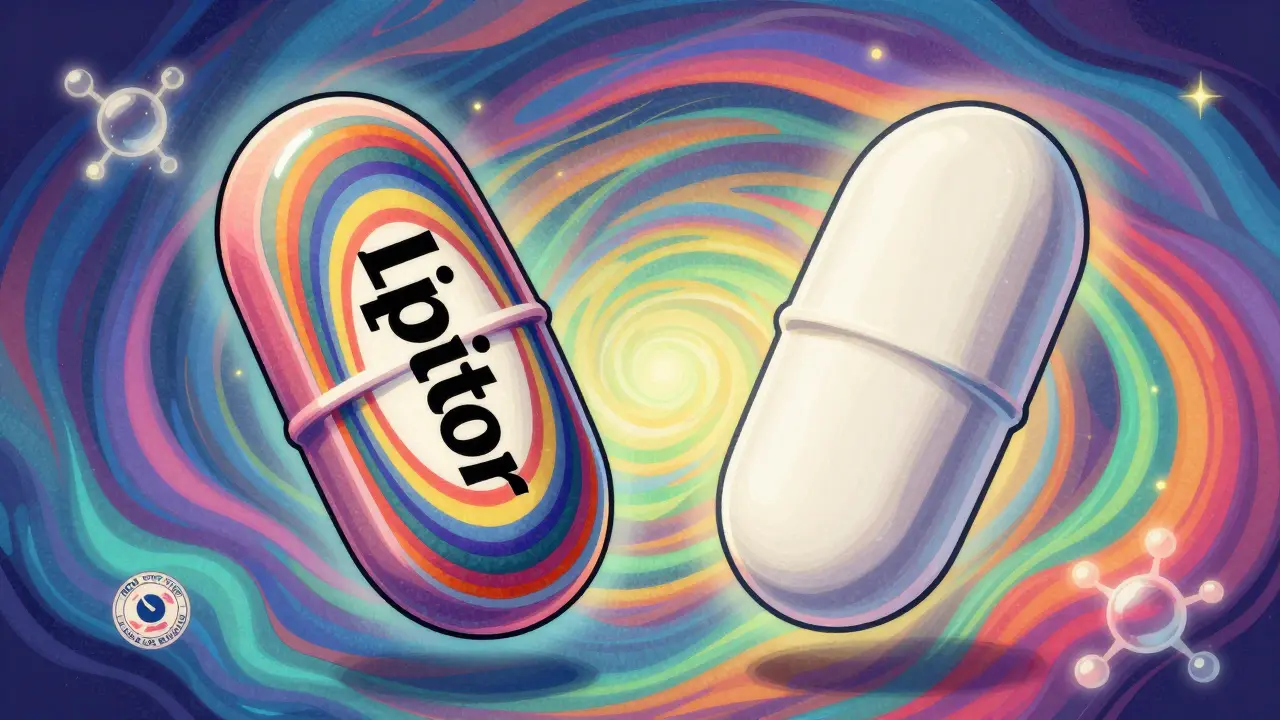
When you pick up a prescription, you might see two pills that look completely different-one with a fancy brand name, another with plain packaging. You might think the cheaper one is weaker, less safe, or just a knockoff. But what if I told you that some of those cheap pills are exactly the same as the brand-name drug you’ve been taking for years? That’s the reality of authorized generics.
What Exactly Is an Authorized Generic?
An authorized generic is not a copy. It’s not a look-alike. It’s not even made by a different company trying to mimic the original. It’s the exact same pill, capsule, or liquid-same active ingredient, same fillers, same coating, same size, same color-that you get from the brand-name manufacturer, just sold without the brand name on the label.
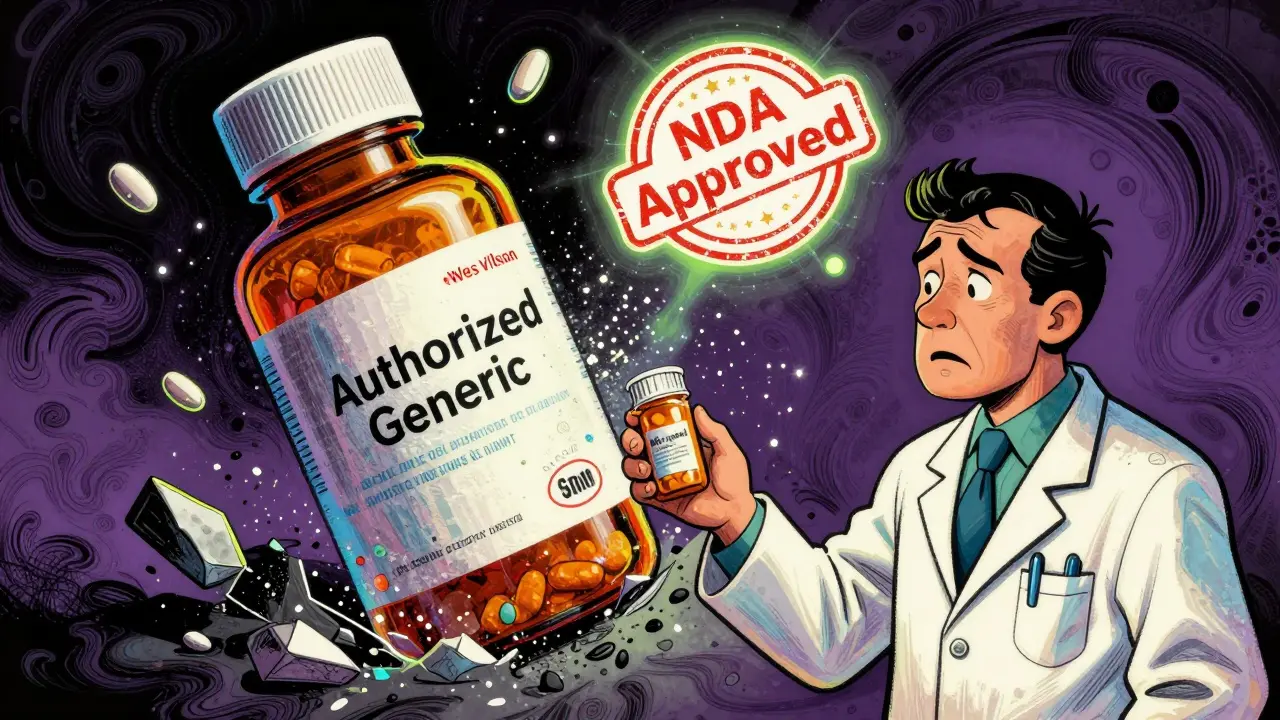
Here’s how it works: The same factory that makes your brand-name drug, say, Lipitor or Xyzal, also produces identical versions under a different label. These versions are sold under the original drug’s FDA approval (called an NDA), so they skip the whole generic approval process. That means there’s no guesswork about whether the ingredients match. They’re carbon copies.
The FDA defines them clearly: “An authorized generic is an approved brand name drug that is marketed without the brand name on its label.” Other than the label, it’s the same product. No exceptions.
How Are Authorized Generics Different From Regular Generics?
This is where things get confusing-and why so many patients worry unnecessarily.
Regular generic drugs must prove they’re bioequivalent to the brand. That means they have the same active ingredient, strength, and dosage form, but they’re allowed to use different inactive ingredients. That’s the fillers, dyes, preservatives, and binders. And while most of the time that doesn’t matter, for some people-especially those with allergies, sensitivities, or digestive issues-it can.
Take a common example: A brand-name version of a thyroid medication might use cornstarch as a filler. A traditional generic might use wheat starch instead. For someone with celiac disease, that tiny difference could cause real problems. An authorized generic? Same cornstarch. Same everything.
Regular generics go through the ANDA process (Abbreviated New Drug Application). Authorized generics don’t. They’re already approved under the brand’s NDA. That’s why they’re not listed in the FDA’s Orange Book like other generics. They don’t need to be.
Why Do Brand Companies Sell Authorized Generics?
It sounds counterintuitive. Why would a drug company that just spent billions developing a drug turn around and sell a cheaper version of it?
The answer is competition. When a brand drug’s patent expires, other companies can make generics. That drives prices down-sometimes by 80% or more. But brand manufacturers don’t want to lose all their revenue. So they launch their own authorized generic. It’s a smart move: they keep a slice of the market, often at a price lower than the brand but higher than the traditional generic.
For example, if your brand-name drug costs $150 a month, the traditional generic might be $15. The authorized generic? Maybe $50. It’s not as cheap as the generic, but it’s still cheaper than the brand. And for patients who had bad reactions to other generics, it’s a safe alternative.
According to the FDA, there were 152 authorized generic products across 55 different drugs as of 2021. And that number keeps growing, especially in areas like high-blood pressure meds, antidepressants, and asthma inhalers-drugs where small changes in formulation can affect how patients feel.
Are Authorized Generics Safe? Do They Work the Same?
Yes. Absolutely.
The FDA says it plainly: “An authorized generic is therapeutically equivalent to the brand name drug because it is exactly the same drug.” No wiggle room. No loopholes.
A 2018 study in the National Center for Biotechnology Information looked at over 5,000 patients switching from brand to generic or authorized generic. The results? No meaningful difference in hospital visits, emergency room trips, or whether people stopped taking their meds. One small difference: authorized generics had slightly higher ER visits than traditional generics. But researchers couldn’t explain why-it might have been due to other factors like patient behavior or access to care, not the drug itself.
Doctors and pharmacists who specialize in chronic conditions often recommend authorized generics for patients who’ve had issues with traditional generics. One allergist in San Diego told me about a patient who switched from brand-name Xyzal to a traditional generic and developed a rash. Switched to the authorized generic? The rash vanished. Same drug. Same inactive ingredients. No mystery.
Even the American Academy of Allergy, Asthma & Immunology confirms: authorized generics are the only generic option that guarantees identical inactive ingredients. For people with sensitivities, that’s not a luxury-it’s a necessity.
Why Don’t More People Know About Them?
Because the system is confusing.
Pharmacists are trained to substitute generics unless the doctor says “dispense as written” (DAW). But they don’t always distinguish between a traditional generic and an authorized generic. To most patients, it’s just “generic.”
And when you walk into the pharmacy and see your $150 brand pill replaced by a $50 pill with no name on it, your first thought isn’t, “Great, this is the exact same thing.” It’s, “Did they give me the wrong medicine?”
Pharmacists report that about 30% of patients question the switch to an authorized generic-even though it’s identical. That’s not because the drug is risky. It’s because nobody explained it.
Insurance companies don’t help either. They often put authorized generics on the same tier as traditional generics, even though they’re made by the brand company. That means you might pay less for the authorized generic than the brand-but you might pay more than you would for a regular generic. It’s a pricing gray zone.

How to Get an Authorized Generic
It’s not hard. You just have to ask.
- Check your prescription label. Does it say the brand name? If yes, ask your pharmacist: “Is there an authorized generic for this?”
- Use tools like GoodRx or SingleCare. They often list authorized generics separately from traditional generics.
- Ask your doctor to write “DAW” on the prescription if you want to avoid substitution entirely-or if you specifically want the authorized version.
- Call your insurance company. Ask: “Is the authorized generic covered under my plan, and at what cost?”
Some pharmacies automatically substitute authorized generics if they’re cheaper than the brand. Others don’t. It depends on the pharmacy’s contract with your insurer. Don’t assume. Ask.
When Should You Avoid Authorized Generics?
You shouldn’t avoid them. They’re safe. They’re effective. They’re identical.
But here’s the catch: they’re not always the cheapest option. If a traditional generic is available and you’ve never had a reaction to it, stick with it. It’s just as safe for most people-and often cheaper.
Only choose the authorized generic if:
- You’ve had a bad reaction to a traditional generic (rash, stomach upset, no effect)
- You have a known sensitivity to certain fillers or dyes
- You want the absolute same formulation you’ve been on for years
- Your doctor recommends it
For the vast majority of people, traditional generics are perfectly fine. But for those who need certainty, authorized generics are the gold standard.
What’s Next for Authorized Generics?
The FDA is starting to pay closer attention to pricing. Right now, some authorized generics are priced only 15-20% below the brand-far less than the 80-85% discount you’d expect from a regular generic. That’s led to criticism that brand companies are using authorized generics to slow down competition instead of lowering prices.
There’s talk in Congress about limiting this practice. The Affordable Prescriptions for Patients Act of 2023 includes provisions to make it harder for brand companies to launch authorized generics just to block cheaper alternatives.
But for now, they’re legal. They’re approved. And they’re identical.
Industry analysts predict authorized generics will hold 5-7% of the generic drug market through 2028. That’s not huge-but for the people who rely on them, it’s everything.
Bottom line: If you’ve been paying full price for a brand drug because you’re afraid of generics, you might be overpaying-and unnecessarily. Ask about the authorized version. You might be surprised how much you save-and how little changes.
Releted Post

Andy Dargon
Hi, I'm Aiden Lockhart, a pharmaceutical expert with a passion for writing about medications and diseases. With years of experience in the pharmaceutical industry, I enjoy sharing my knowledge with others to help them make informed decisions about their health. I love researching new developments in medication and staying up-to-date with the latest advancements in disease treatment. As a writer, I strive to provide accurate, comprehensive information to my readers and contribute to raising awareness about various health conditions.
It’s wild how we’ve been conditioned to equate brand with quality. In India, we see this all the time-people pay double for the same medicine just because the packaging has a fancy logo. The real injustice isn’t the price difference-it’s the lack of education. If people knew these pills are identical, they’d save enough to feed a family for a month.
An authorized generic is pharmacologically indistinguishable from its branded counterpart under FDA 21 CFR 314.92. The NDA holder manufactures both, ensuring bioequivalence at the molecular level. Inactive ingredients are identical-no variability in excipients, dissolution profiles, or manufacturing processes. This is critical for narrow-therapeutic-index drugs like levothyroxine or warfarin, where even minor deviations can trigger adverse events.
I used to be terrified of generics until my pharmacist explained this. My anxiety med switched from brand to authorized generic and I didn’t even notice. No side effects, no weird feelings. I was just saving $100 a month. Why do we make this so complicated? It’s the same pill. Same factory. Same everything. Just less marketing.
Big Pharma is laughing all the way to the bank. They make the brand, then slap a different label on it and sell it for half price to keep you hooked. They don’t want real competition-they want you to think you’re getting a ‘premium’ version. It’s a scam dressed up as a choice. Don’t fall for it. If it’s the same damn pill, why are you paying $50 instead of $15?
Authorized generics represent the only true equivalence class in the generic drug space. Unlike ANDA products which may vary in inactive components, authorized generics share the exact formulation profile of the reference listed drug. This is particularly relevant for patients with multiple chemical sensitivities or autoimmune conditions where excipient variability can trigger clinical deterioration. Pharmacists should proactively disclose authorized generic availability at point of dispensing.
I’ve been on the same blood pressure med for ten years. Switched to the authorized generic last year. Zero issues. My doctor didn’t even mention it. I just noticed my copay dropped. Sometimes the simplest solution is the one no one talks about.
Think of it like buying a car. The brand version is the same model with leather seats and a logo on the hood. The authorized generic is the exact same car, just without the badge. You still get the same engine, same safety features, same reliability. You’re not sacrificing anything. You’re just paying less for the branding.
The FDA’s Orange Book omission is a regulatory blind spot. Authorized generics bypass ANDA scrutiny entirely because they’re covered under the original NDA. That means they’re not subject to bioequivalence testing, because they don’t need to be-they’re the original. This creates a paradox: the most identical product is the least documented in public databases. Patients deserve transparency, not bureaucratic obfuscation.
So you're telling me I've been overpaying for years because I'm too dumb to ask if my pill has a label? Congrats, I'm the idiot who paid $150 for a pill that costs $15. Thanks for the enlightenment, Dr. Wikipedia.
In India we have a saying: if the medicine works, why does the name matter? But here in the U.S., people pay for the logo like it's a status symbol. I worked in a pharmacy in Delhi where the same drug came in three brands-two Indian, one American. The American one cost ten times more. Same chemical structure. Same tablet press. Same shelf life. People still bought the American one because they thought it was ‘stronger’. This isn’t science. This is colonial psychology.
My mom took the authorized generic for her antidepressant and said it felt more stable than the brand. I didn’t believe her until I checked the label. Same manufacturer. Same lot number. Just no fancy name. Sometimes the truth is boring. And that’s okay.
Of course the FDA says it’s identical. They’re paid by the same industry that profits from this gray-market trick. Authorized generics are a loophole designed to delay true generic competition. The real problem isn’t patient confusion-it’s corporate greed disguised as innovation. Stop celebrating this as a win. It’s a bait-and-switch.
There’s an epistemological gap here. We treat pharmaceuticals as if they’re purely chemical entities, but their identity is socially constructed. The brand name isn’t just packaging-it’s a narrative of trust, history, and perceived efficacy. An authorized generic shatters that narrative, forcing patients to confront the uncomfortable truth: their healing was never tied to the logo. That’s why so many resist it. It’s not about safety. It’s about meaning.