
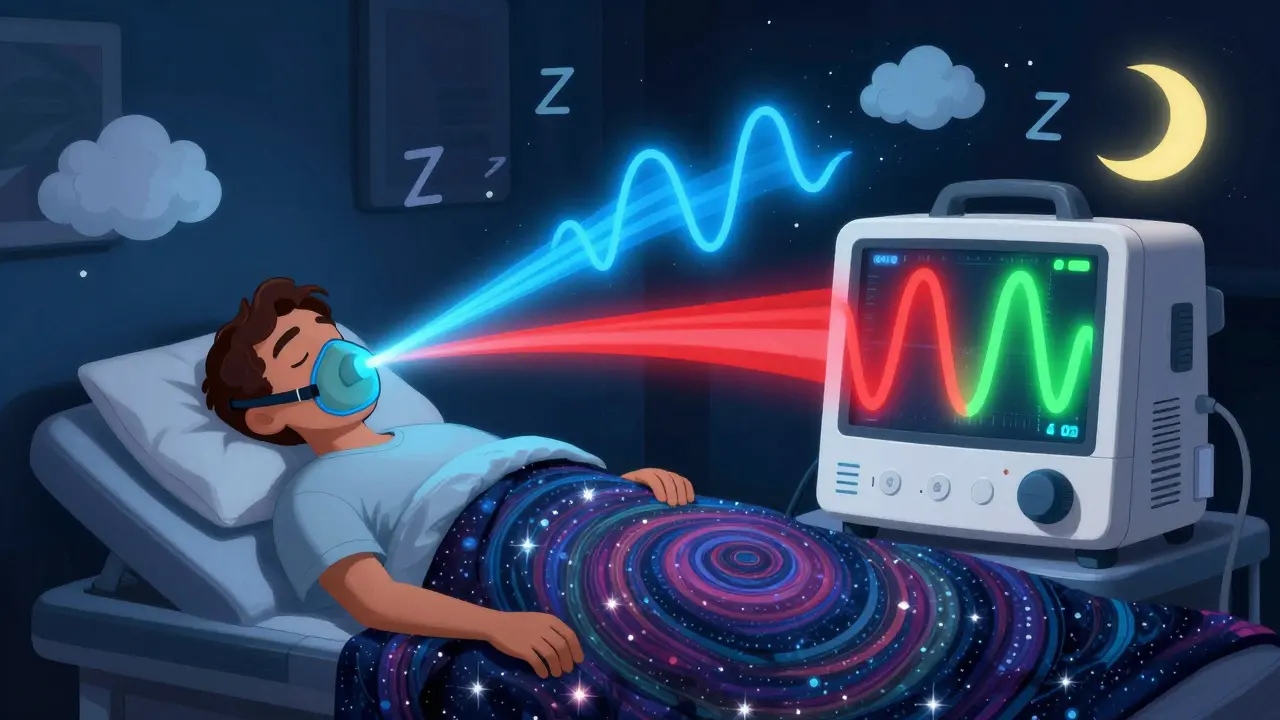
What CPAP and BiPAP Actually Do
Both CPAP and BiPAP machines help you breathe better while you sleep. They push air through a mask to keep your airway open so you don’t stop breathing during the night. This is critical for people with sleep apnea, where the throat muscles relax too much and block airflow. Without treatment, this leads to loud snoring, gasping for air, and poor sleep that leaves you tired all day.
CPAP stands for Continuous Positive Airway Pressure. It delivers one steady pressure all night-whether you’re breathing in or out. BiPAP, short for Bilevel Positive Airway Pressure, gives you two different pressures: a higher one when you inhale and a lower one when you exhale. That difference might sound small, but for many people, it makes breathing feel a lot more natural.
How the Pressure Works
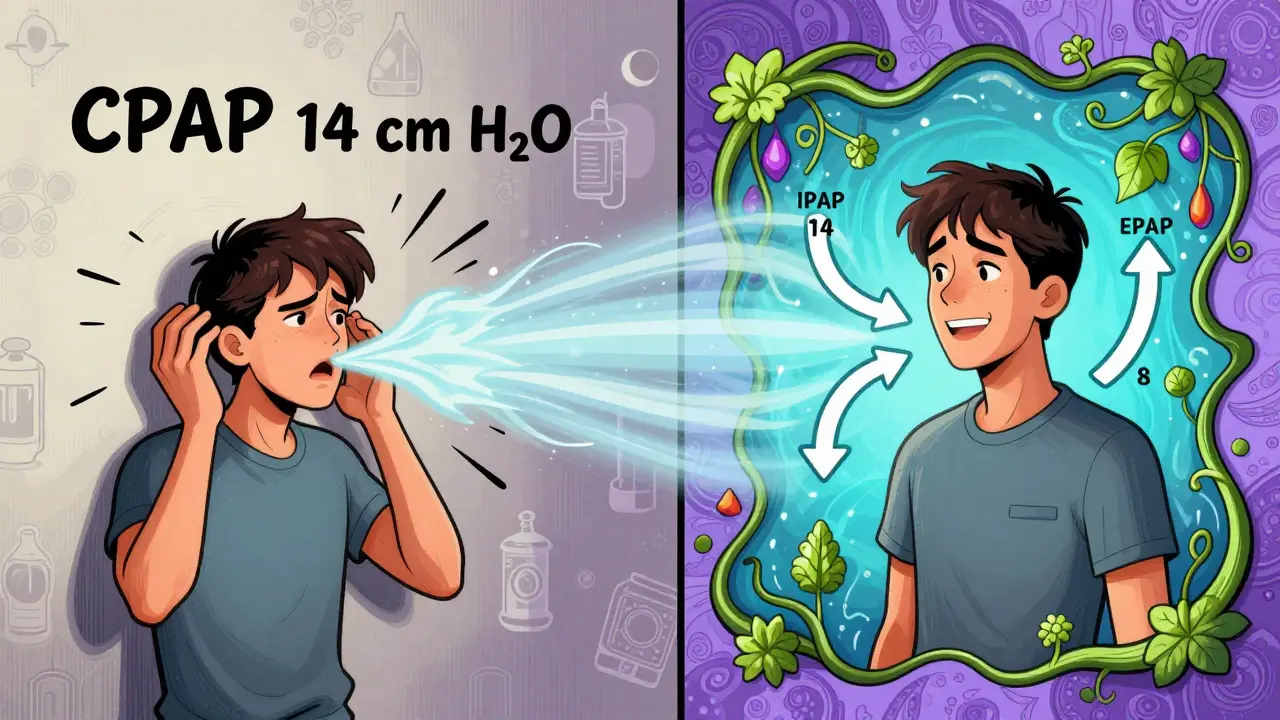
CPAP machines typically run between 4 and 20 cm H₂O of pressure. That’s the same pressure whether you’re pulling air in or pushing it out. For someone who needs 14 cm H₂O to keep their airway open, that’s 14 cm H₂O all night. It can feel like breathing against a wall when you exhale, especially at higher pressures.
BiPAP machines, on the other hand, set two numbers: IPAP (inhalation pressure) and EPAP (exhalation pressure). For example, a setting of 14/8 means 14 cm H₂O when you breathe in and 8 cm H₂O when you breathe out. That 6 cm difference reduces the effort of exhaling by about 30-40%, according to a 2022 study in the Journal of Clinical Sleep Medicine. That’s why many people who struggle with CPAP switch to BiPAP-they finally feel like they can breathe without fighting the machine.
Who Gets CPAP and Who Gets BiPAP
Most people with obstructive sleep apnea (OSA) start with CPAP. In fact, about 85-90% of OSA patients are treated with CPAP because it’s effective, simple, and cheaper. The American Academy of Sleep Medicine recommends it as the first-line treatment for simple OSA.
BiPAP isn’t usually the first choice. It’s reserved for specific cases where CPAP doesn’t work well. These include:
- People who need high CPAP pressure (15 cm H₂O or more) and can’t tolerate exhaling against it
- Those with COPD and high carbon dioxide levels (hypercapnia)
- Patients with central sleep apnea, where the brain doesn’t signal the lungs to breathe
- People with obesity hypoventilation syndrome (BMI over 30 with daytime oxygen issues)
- Those with neuromuscular diseases like ALS or muscular dystrophy
A 2023 review in the Chest Journal found BiPAP helps reduce breathing effort by 15-20% in patients with COPD and sleep apnea overlap-but offers no real advantage for pure OSA. That’s why doctors don’t just hand out BiPAP machines to everyone.
Cost and Insurance Coverage
CPAP machines cost between $500 and $1,200. A basic ResMed AirSense 10 runs around $899. BiPAP machines are more expensive, usually $800 to $1,800. The Philips DreamStation BiPAP Auto, for example, sells for $1,499.
Insurance coverage is a big factor. Medicare and most private insurers will cover CPAP without much hassle if your sleep study confirms OSA. But for BiPAP, they usually require proof that CPAP didn’t work. In the U.S., Medicare’s rule (L33984, updated January 2023) says you must fail CPAP therapy-meaning you couldn’t use at least 15 cm H₂O for 4 hours a night for 30 straight days-before they’ll approve BiPAP.
That’s not just a paperwork hurdle. It’s based on real data: BiPAP doesn’t improve adherence or sleep quality for most OSA patients, according to a 2021 Cochrane review of 1,872 people. So insurers won’t pay extra unless there’s a clear medical reason.
Real User Experiences
On forums like Reddit’s r/CPAP, users often share stories about switching from CPAP to BiPAP. One user, u/SleepWarrior2022, wrote in August 2023: “BiPAP at 14/8 felt like breathing normally. CPAP at 14 felt like choking.” That’s a common theme among people who need high pressure.
But BiPAP isn’t easy. A 2023 survey by Sleep Review Magazine found 34% of BiPAP users struggled with machine settings, compared to just 18% of CPAP users. Some report the machine doesn’t sync right with their breathing-causing “cycling issues” where it delivers the wrong pressure at the wrong time. That’s frustrating and can make sleep worse.
CPAP users, by contrast, tend to rate ease of use higher. In a 2023 American Sleep Association poll, 71% of CPAP users said “ease of use” was excellent. Only 58% of BiPAP users said the same. Simplicity matters. If you don’t have to think about settings, you’re more likely to use it every night.
How Long It Takes to Adjust
Most people need 2 to 4 weeks to get used to CPAP. You might feel claustrophobic at first, or your nose might get dry. Those issues usually fade with time and proper mask fit.
BiPAP often takes longer-3 to 6 weeks-because there’s more to learn. You’re not just wearing a mask; you’re learning how a machine with two pressures works. Some models have backup breaths, ramp features, and timed cycles. If your doctor sets the wrong mode (like S/T instead of S), it can feel like the machine is fighting you.
That’s why specialists recommend working with a respiratory therapist for BiPAP setup. For CPAP, many people learn everything from the manual or a quick video. For BiPAP, you often need hands-on help.
Market Trends and Future Tech
The global sleep therapy market was worth $7.8 billion in 2022. CPAP made up 68% of that. BiPAP was 22%. But BiPAP is growing faster-9.2% per year through 2030, compared to CPAP’s 6.8%. Why? Because more people are living longer with complex conditions like COPD, heart failure, and obesity.
New machines are getting smarter. ResMed’s AirCurve 10 VAuto, released in May 2023, uses AI to adjust pressure automatically based on your breathing patterns. Philips’ DreamStation 3, announced in August 2023, even tracks your blood oxygen levels in real time.
But here’s the catch: a 2023 analysis in Health Affairs found that prescribing BiPAP for simple OSA costs the U.S. healthcare system $420 million a year. That’s money wasted on devices that don’t improve outcomes. The goal isn’t to use the fanciest machine-it’s to use the right one.
What Your Doctor Should Check Before Choosing
Your sleep study results are the key. If your AHI (Apnea-Hypopnea Index) is above 30 and you need pressure over 15 cm H₂O, BiPAP might help you stick with treatment. If you have COPD, heart failure, or neurological issues, BiPAP is often the better choice.
But if you have simple OSA-no other major health problems-and CPAP pressure is under 15 cm H₂O, stick with CPAP. It’s cheaper, simpler, and just as effective.
Ask your doctor:
- What’s my exact diagnosis? (OSA, central apnea, overlap syndrome?)
- What pressure do I need? Is it over 15 cm H₂O?
- Do I have COPD, heart failure, or another condition that affects breathing?
- Have I tried CPAP? Did I fail because of discomfort, not lack of effectiveness?
Final Takeaway
CPAP is the standard for most people with sleep apnea. It works. It’s affordable. It’s proven.
BiPAP isn’t better-it’s different. It’s for people who can’t handle the constant pressure of CPAP, or who have other breathing problems. It’s not a magic upgrade. It’s a targeted tool.
If you’re struggling with CPAP, don’t assume BiPAP is the answer. Talk to your sleep specialist. Get the right diagnosis. Test the right machine. The goal isn’t to find the most advanced device-it’s to find the one that lets you sleep well, every night.
Releted Post

Andy Dargon
Hi, I'm Aiden Lockhart, a pharmaceutical expert with a passion for writing about medications and diseases. With years of experience in the pharmaceutical industry, I enjoy sharing my knowledge with others to help them make informed decisions about their health. I love researching new developments in medication and staying up-to-date with the latest advancements in disease treatment. As a writer, I strive to provide accurate, comprehensive information to my readers and contribute to raising awareness about various health conditions.
CPAP works. Stop overcomplicating it.
I switched from CPAP to BiPAP after hitting 16 cm H₂O and it changed my life. The exhale difference isn't just nice-it's necessary. Took me 5 weeks to adjust, but now I sleep 7 hours straight. No more morning headaches.
Just make sure your therapist sets the right mode. I got S/T by accident at first and felt like I was drowning.
Fellow BiPAP user here. The 14/8 setting is magic if you're on high pressure. I was at 18 on CPAP and couldn't breathe out. BiPAP felt like someone finally turned off the fan in my face.
Also, don't skip the mask fit. A bad seal ruins everything, no matter what machine you're on.
Of course BiPAP is better. It's more advanced. Why settle for a 2010s relic when you can have AI-adjusting pressure with real-time SpO2 tracking? If you're still using a basic CPAP, you're not optimizing your health-you're just being cheap.
Wait... so you're telling me the government won't pay for BiPAP unless you 'fail' CPAP? That's not a medical guideline-that's a corporate loophole. Big Med is pushing CPAP because it's cheaper. They don't care if you gasp all night. They care about margins. You're being gaslit by your insurer.
In the UK, we don't have this nonsense. If your AHI is over 30 and you're struggling, you get BiPAP on the NHS without jumping through hoops. Americans are so obsessed with ‘cost efficiency’ they forget people need to breathe. This is why your healthcare system is a joke.
Let's be real: 85% of OSA patients are on CPAP because it's the only thing proven to reduce mortality. BiPAP studies show zero improvement in long-term outcomes for pure OSA. The Cochrane review of 1,872 patients is clear. The only people who benefit are those with comorbidities. Everyone else is just chasing a placebo effect wrapped in a fancy price tag.
I used to hate my CPAP. I’d wake up at 3 a.m. sweating, feeling like I was fighting a hurricane in my lungs. Then I tried BiPAP at 14/8... and I cried. Not because it was painful. Because I finally felt like I could breathe again. Like I wasn't a machine. Like I was human.
It took 45 days. I almost quit. But I didn't. And now? I sleep like a baby. My wife says I stopped snoring so hard she had to move to the guest room. Best decision I ever made.
If you're new to this, don't panic. CPAP is not a failure. It's a tool. BiPAP isn't the upgrade-it's the specialized tool for specific jobs. If you're not gasping, not dizzy, and sleeping through the night? Stick with CPAP. Save your money. Don't let marketing make you feel like you're missing out.
And if you're struggling? Talk to a respiratory therapist. Not Reddit. Not Amazon reviews. A real person who's seen 500 masks and 2000 sleep studies.
I started on CPAP at 12 cm and it was fine. Then my doctor upped it to 17 after my AHI spiked. I couldn't exhale. Felt like my chest was caved in. Switched to BiPAP at 17/9 and it was like someone removed a brick from my lungs. Took me 6 weeks to get used to the settings, but now I'm sleeping 8 hours. No more naps at my desk. Thank you, science.
BiPAP users are just weak. If you can't handle 15 cm H₂O, maybe you're not trying hard enough. Or maybe you're fat. Or both. CPAP is the gold standard. If you can't use it, fix your lifestyle-not your machine.
The data is clear: BiPAP improves adherence only in patients with COPD overlap or neuromuscular disease. For isolated OSA, no statistically significant difference in sleep quality or daytime alertness. The cost differential is over $600 per unit. Healthcare systems are not obligated to fund luxury sleep accessories.
I've used both. CPAP was fine until I developed mild COPD. Then BiPAP saved me. The exhale relief isn't just comfort-it's physiological. Lower EPAP reduces air trapping. That's not marketing. That's pulmonology. If you're on CPAP and have a history of lung disease, ask your doctor about BiPAP. Don't wait until you're gasping.
It is imperative to emphasize that adherence remains the most critical factor in therapeutic success, regardless of device modality. A patient who utilizes a CPAP device for 5.5 hours per night demonstrates superior clinical outcomes compared to one who utilizes a BiPAP device for 2.5 hours per night. Therefore, simplicity and tolerability must be prioritized over technological sophistication.
BiPAP is the future. 😎🔥 AI adjusts pressure. Real-time oxygen tracking. Bluetooth sync. My machine even texts me if I miss a night. CPAP? That’s like using a rotary phone in 2024. 🤦♂️ #SleepTech #BiPAPorBust