
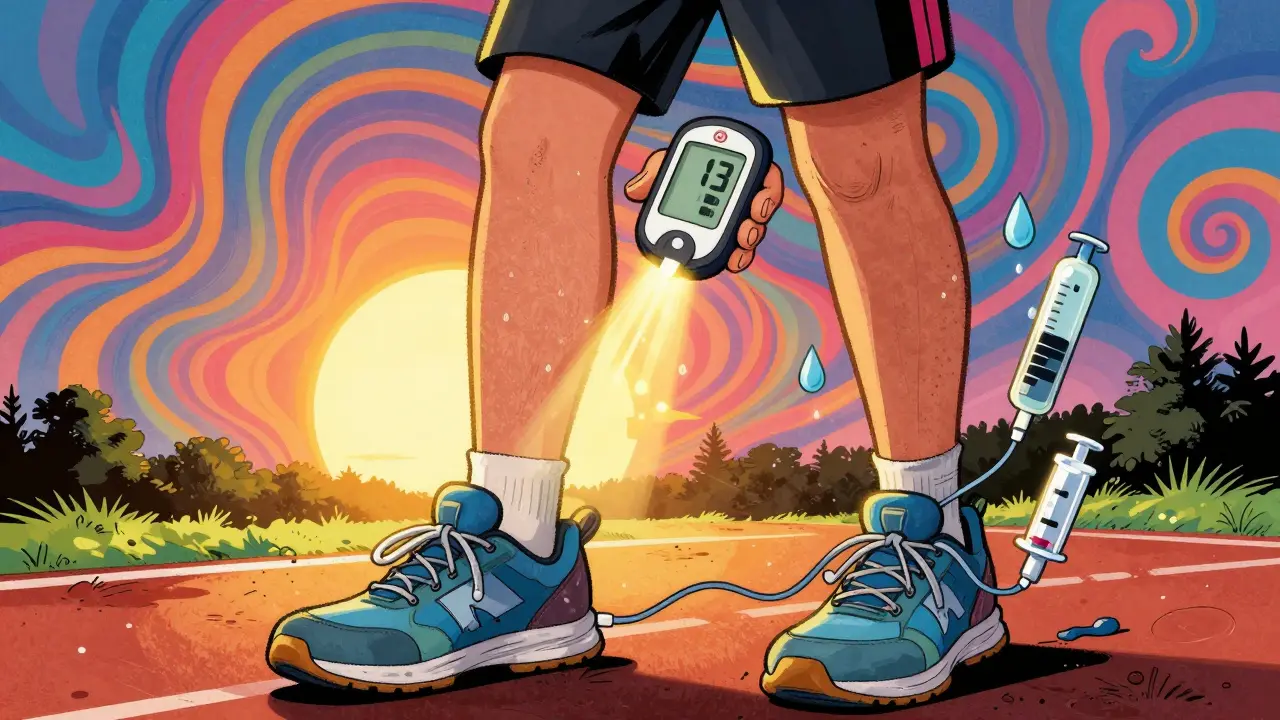
Working out with diabetes doesn’t have to mean avoiding movement because you’re scared of crashing. But if you’ve ever felt dizzy, sweaty, or shaky halfway through a run-or woke up in the middle of the night with a low glucose reading after a good day at the gym-you know the fear is real. About 50% of people with type 1 diabetes avoid exercise simply because they’re afraid of hypoglycemia. The good news? You can train safely. It’s not about stopping movement. It’s about understanding how your body responds and adjusting before you even lace up your shoes.
Why Exercise Drops Your Blood Sugar
When you move, your muscles need fuel. They don’t always wait for insulin to tell them to take glucose from your blood. During activity, your muscles grab glucose directly from your bloodstream-no insulin required. That’s great for lowering blood sugar, but it’s also why your levels can plummet, especially if you’ve taken insulin recently. And it doesn’t stop when you stop exercising. Your body stays more sensitive to insulin for up to 72 hours after a workout. That means a 30-minute bike ride today could cause a low tomorrow morning.Check Your Numbers Before You Start
Don’t guess. Check. The American Diabetes Association says to test your blood sugar 15 to 30 minutes before you start moving. Here’s what to do based on your reading:- Below 90 mg/dL: Eat 0.5 to 1.0 gram of carbs per kilogram of body weight. For a 70 kg (154 lb) person, that’s 35 to 70 grams of carbs-think two bananas or a large granola bar.
- 90-150 mg/dL: Still eat 15-20 grams of fast-acting carbs. A juice box, 4 glucose tablets, or half a banana will do.
- Above 150 mg/dL: You’re probably safe to start, but keep monitoring. Some experts, like Dr. Anne Peters, actually recommend starting at 150-180 mg/dL for high-intensity workouts to buffer against sudden drops.
And never skip rechecking after 15 minutes if you ate carbs. Glucose doesn’t rise instantly. If you’re still under 100 mg/dL after 15 minutes, eat another 15 grams.
Timing Matters More Than You Think
If you’re on insulin, when you exercise can make or break your day. Avoid working out during peak insulin action. For most people, that’s 1-3 hours after a bolus. If you take long-acting insulin, your risk is lower, but not zero. The key is consistency. Try to exercise at the same time every day. That helps your body predict what’s coming. If you usually run at 6 p.m., your body learns to adjust. If you switch to 8 a.m. one day, your glucose might surprise you.Also, check your insulin-on-board (IOB). If you have 1.2 units of insulin still active, your body may treat it like 2-3 units during exercise. That’s a recipe for a crash. Use your pump or app to calculate IOB. If it’s over 1 unit, consider reducing your pre-workout bolus by 25-50% or delaying your meal.
Not All Workouts Are Created Equal
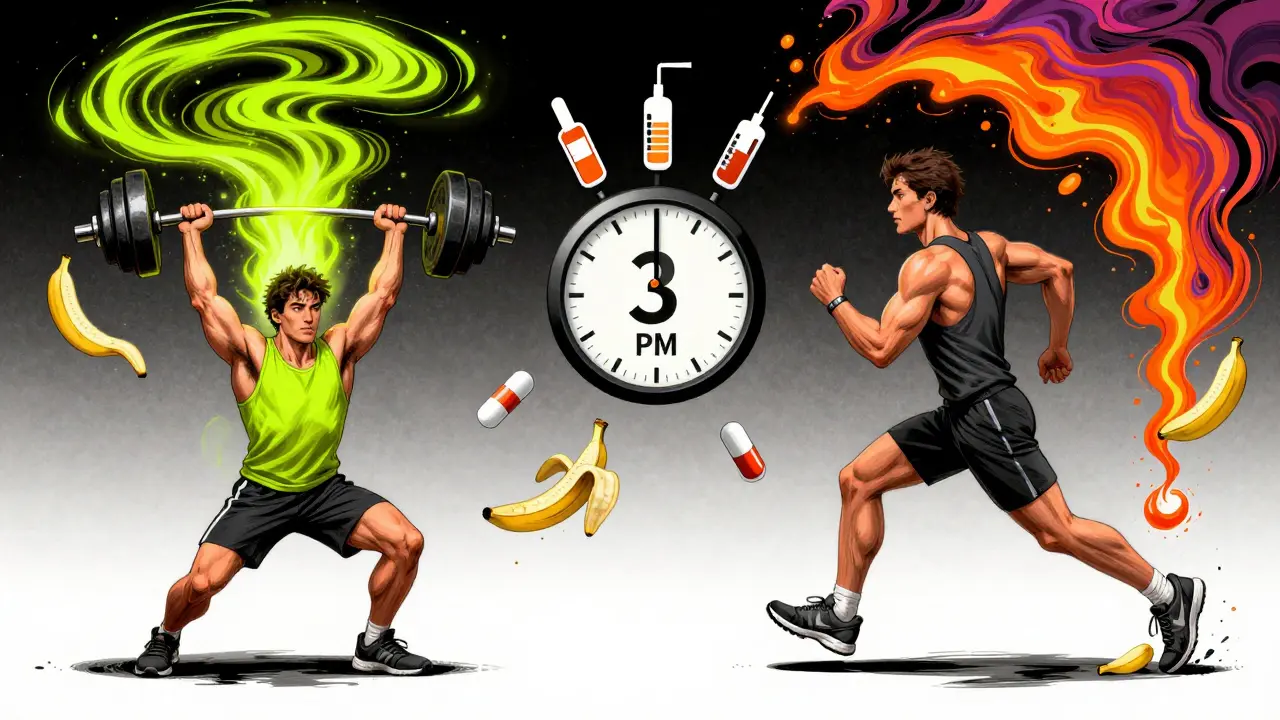
Aerobic exercise-like jogging, cycling, or swimming-tends to steadily lower blood sugar. But anaerobic exercise? It can actually raise it. A 10-second all-out sprint before your run can block a drop. One study showed that adding a short sprint before aerobic activity cut hypoglycemia episodes by more than half.Resistance training-lifting weights-is your secret weapon. Doing 45 minutes of strength work before cardio dropped glucose decline from 166 mg/dL to 124 mg/dL in one trial. That’s a 42-point difference. Even better? Circuit training with short rest periods can be risky if you go too long, but traditional strength sets with 60-90 seconds between them? Very stable.
High-intensity interval training (HIIT) is another win. Five to 15 seconds of all-out effort followed by rest keeps glucose from falling too far. One user on Reddit said: “I do 10 seconds of sprinting on the bike before my walk. My lows went from four times a week to once every two weeks.”
What Happens After You Finish?
The biggest trap? Thinking it’s over when you stop. Delayed hypoglycemia hits 6 to 12 hours after exercise-and sometimes overnight. That’s why 42% of people with type 1 diabetes report at least one severe low at night after a workout.Here’s how to stop it:
- Check your glucose before bed. If it’s below 120 mg/dL, eat a snack with 15 grams of carbs plus protein. Think peanut butter on toast, cheese with an apple, or a small bowl of Greek yogurt with berries.
- Set an alarm if you’re at high risk. A 2 a.m. check can save your night.
- If you use a CGM, look for trends. If your glucose drops 30+ points in the two hours after exercise, plan for a bedtime snack every time.

Technology Can Help-But It’s Not Magic
CGMs are game-changers. Sixty-eight percent of people with type 1 who use them check their glucose before exercise, compared to just 42% of those without. Dexcom’s G7 has an “exercise mode” that lowers alert thresholds by 20 mg/dL during activity so you get warnings earlier.Even smarter? Insulin pumps with predictive tech. The Tandem t:slim X2 pump, approved in March 2023, uses machine learning to predict glucose drops based on your past workouts. It automatically reduces insulin delivery before and during activity. In trials, it cut hypoglycemia by 37% during exercise.
And the future? Closed-loop systems that deliver glucagon during exercise are being tested. Early results show a 52% reduction in lows. These tools won’t replace your knowledge-but they’ll make it easier to stay safe.
What to Do When Things Go Wrong
Even with all the planning, lows happen. Here’s your quick action plan:- Stop exercising immediately.
- Check your glucose. If it’s under 70 mg/dL, consume 15 grams of fast-acting carbs.
- Wait 15 minutes. Recheck.
- If still low, repeat. Don’t start again until you’re above 100 mg/dL.
- If you’re confused, dizzy, or can’t treat yourself-get help. Glucagon kits are for emergencies.
And remember: your body changes. The same workout that gave you a low last week might not today. Stress, sleep, hormones, even the weather can shift your response. That’s why tracking matters. Write down what you did, what you ate, your insulin doses, and your glucose trends. After a few weeks, patterns emerge.
The Bottom Line
You don’t have to choose between health and safety. Exercise is one of the most powerful tools you have for managing diabetes. It improves insulin sensitivity, reduces heart risk, and boosts your mood. But it demands attention. Start small. Test often. Learn your body’s signals. Use carbs, timing, and resistance training as your tools. And don’t be afraid to use tech to help you stay ahead of the drop.It takes 3 to 6 months to get good at this. You’ll have setbacks. But every time you move safely, you’re proving to yourself that diabetes doesn’t get to decide your limits.
Can I exercise if my blood sugar is below 70 mg/dL?
No. If your blood sugar is below 70 mg/dL, treat it first with 15 grams of fast-acting carbs like glucose tablets, juice, or candy. Wait 15 minutes and recheck. Only start exercising once your glucose is above 100 mg/dL. Exercising while low can cause your levels to drop further, leading to confusion, loss of coordination, or even seizures.
Do I need to eat carbs before every workout?
Not always. If your blood sugar is above 150 mg/dL and you’re doing light to moderate activity, you may not need extra carbs. But if you’re on insulin, have a history of lows, or are doing anything longer than 30 minutes, it’s safer to have 15-20 grams of carbs before starting. The goal is to prevent lows, not just react to them.
Is strength training safer than cardio for people with diabetes?
Yes, generally. Resistance training-like lifting weights or using resistance bands-tends to stabilize or even raise blood sugar during the session, especially when done before aerobic exercise. A 2018 study showed that doing 45 minutes of strength training before 45 minutes of cycling reduced glucose drops by nearly half. It’s one of the most effective ways to prevent exercise-induced lows.
Why do I get low at night after working out in the afternoon?
After exercise, your muscles keep pulling glucose from your blood to refill their stores-even while you sleep. This effect can last up to 72 hours. If you exercised in the afternoon, your body is still working to recover overnight. That’s why checking your glucose before bed and eating a small carb-and-protein snack (like peanut butter on toast) can prevent nighttime lows.
Should I reduce my insulin before exercise?
Yes, if you use insulin. For pump users, lowering your basal rate by 50-75% starting 60-90 minutes before exercise is often effective. For those on multiple daily injections, reducing your pre-workout bolus by 25-50% helps. But don’t guess-use your insulin-on-board reading and adjust based on your past experiences. Always talk to your healthcare provider before making long-term changes.
Can I use a continuous glucose monitor (CGM) to prevent lows?
Absolutely. CGMs give you real-time trends and alerts. Many models, like the Dexcom G7, have an exercise mode that lowers alert thresholds during activity so you’re warned earlier. Studies show CGM users check their glucose before exercise twice as often as non-users, leading to fewer lows. Use the trend arrow-not just the number-to predict where your glucose is heading.
What’s the best time of day to exercise with diabetes?
There’s no single best time, but consistency matters most. Try to exercise at the same time each day so your body learns the pattern. Avoid working out during peak insulin action (usually 1-3 hours after a meal bolus). Many people find morning workouts before breakfast are more stable, but afternoon or evening workouts work too-if you adjust insulin and carbs accordingly.
How long should I wait after eating before exercising?
Wait at least 60-90 minutes after a meal or bolus to let insulin peak and settle. If you’re eating carbs specifically for exercise, eat them 30-45 minutes before starting. That gives your body time to absorb them without overlapping with insulin peaks. Always check your glucose before you begin, even if you timed your meal perfectly.
Releted Post

Andy Dargon
Hi, I'm Aiden Lockhart, a pharmaceutical expert with a passion for writing about medications and diseases. With years of experience in the pharmaceutical industry, I enjoy sharing my knowledge with others to help them make informed decisions about their health. I love researching new developments in medication and staying up-to-date with the latest advancements in disease treatment. As a writer, I strive to provide accurate, comprehensive information to my readers and contribute to raising awareness about various health conditions.
Been managing type 1 for 12 years and this is the most practical guide I’ve read. No fluff, just actionable steps. I’ve been doing the pre-workout sprint trick for months now - game changer. My lows dropped from daily to once every two weeks. Just don’t forget to recheck after 15 minutes. Too many people eat and assume it’s done.
Interesting that the article mentions Dexcom’s exercise mode, but doesn’t address how unreliable CGMs can be during intense activity. I’ve had readings lag by 20+ minutes during HIIT. Relying on them without a backup meter is asking for trouble. Also, the 72-hour insulin sensitivity claim? Overstated. It’s usually 24-48 for most people. Don’t treat this like gospel.
Man, I used to treat exercise like a battle I had to win - carb up, insulin down, panic when the glucose arrow pointed down. Then I stopped fighting it and started listening. Now I treat my body like a partner, not an enemy. Strength before cardio? That’s my new ritual. I do 45 minutes of squats and deadlifts before any cardio. My numbers don’t just stay stable - they sometimes creep up a little. And the best part? I actually enjoy it now. No more dread. Just movement. Also, peanut butter toast before bed? Chef’s kiss. My overnight lows vanished. Don’t overthink it. Just move, monitor, and mess around till it fits you.
So let me get this straight - we’re now treating diabetes like a video game where you buff your stats with protein toast and 10-second sprints? I mean, I get it. But honestly, if your entire workout plan hinges on avoiding a low, aren’t you still letting diabetes run the show? Maybe the real win is not needing all these hacks. Just saying.
This is a well-structured and clinically sound overview of exercise management in type 1 diabetes. The emphasis on pre-exercise glucose assessment, insulin-on-board calculation, and post-exercise monitoring aligns with current ADA guidelines. I would recommend supplementing this with individualized consultation with a certified diabetes care and education specialist to tailor strategies based on metabolic variability.
Wow, someone actually wrote a post that doesn’t sound like a pharmaceutical ad. Who knew? Still, the part about ‘closed-loop systems delivering glucagon’? That’s the future, sure. But right now, most of us are still using pumps from 2018 and wondering why our alarms go off at 3 a.m. for no reason. Tech helps. But it doesn’t fix bad habits.
Y’all in the West think you’re so advanced with your CGMs and insulin pumps - but in Nigeria, we don’t even have consistent electricity to charge them. We manage with rice, beans, and prayer. You think you’re struggling? Try walking 5km to the clinic just to get test strips. This guide is nice for the privileged. But let’s not pretend everyone lives in your bubble.
😔Start small. That’s it. Don’t try to do everything at once. If you’ve never exercised before, walk for 10 minutes. Check your sugar. Walk another 10. Do it again tomorrow. Build the habit. The carbs, the timing, the tech - all of it matters, but only if you show up. Just move. Even a little. You got this.
This made me feel seen. I used to skip workouts because I was so scared of crashing. Now I do my strength routine before walks and always have a banana in my gym bag. And yeah, I set that 2 a.m. alarm sometimes. It’s weird, but it saves me. Thank you for writing this - it’s the kind of stuff I wish I’d found years ago.
Why are you all so obsessed with carbs? Just eat less and stop being lazy. If you can’t handle a workout without a banana, maybe you shouldn’t be doing it. Also, why do you need an alarm at 2 a.m.? Just sleep. You’re overcomplicating everything.
You people are so dependent on technology. Back in my village, we didn’t have CGMs. We ate balanced meals, walked daily, and trusted God. Now you need apps, pumps, and 15-gram snacks just to go for a jog. This isn’t progress. It’s weakness disguised as innovation.
Listen - if you’re still scared to move because of a number on a screen, you’re letting diabetes win. I’ve had lows. I’ve crashed on the treadmill. But I kept going. I learned my body. I adjusted. I used the tools. And now? I run marathons. You don’t need perfection. You need persistence. And if you’re reading this and still sitting on the couch - get up. Just get up. One step. Then another. You’re stronger than your fear.
In Japan, we say ‘ichi-go ichi-e’ - one time, one meeting. Every workout is a new moment. Don’t treat it like a formula. Watch your body. Adjust. Repeat. Simple.