
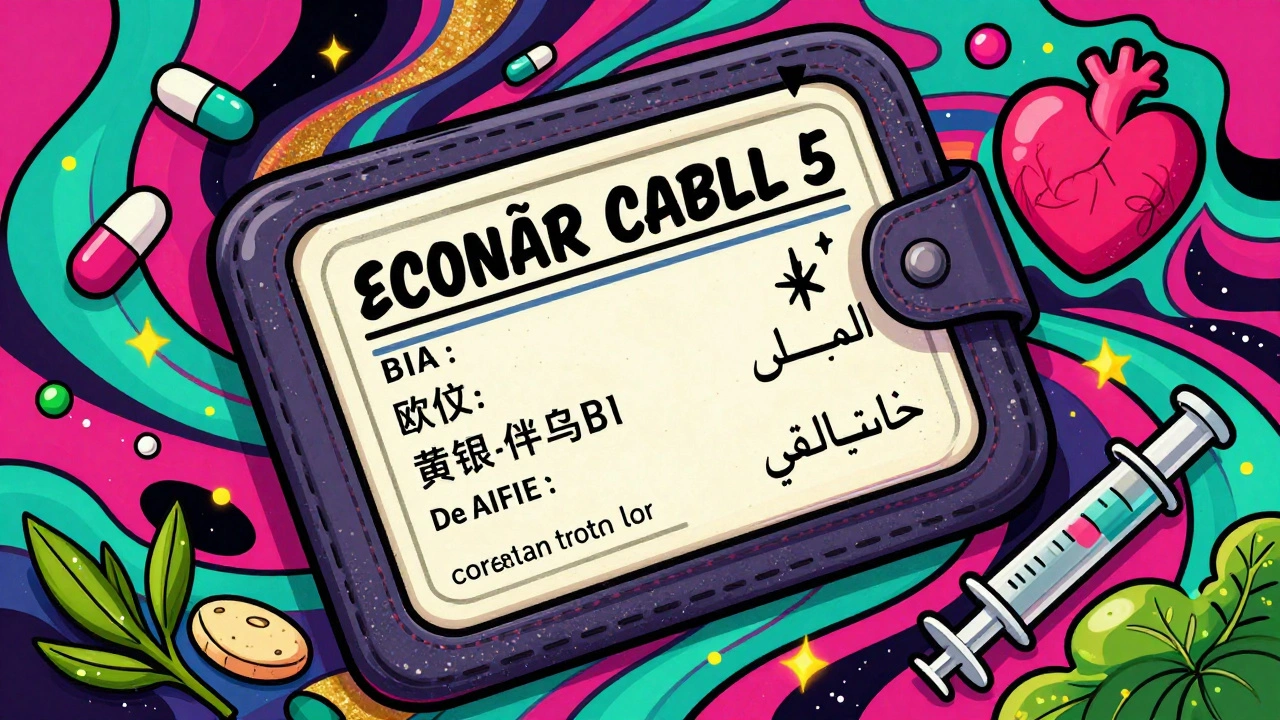
When you’re traveling abroad and something goes wrong-dizziness, chest pain, a bad reaction-you don’t have time to explain your medications in broken English. You might not even be able to speak. That’s when a multilingual medication list becomes your lifeline.
Every year, thousands of travelers end up in emergency rooms abroad because staff can’t understand what they’re taking. A simple mistake-mixing up a blood pressure pill with a heart rhythm drug-can be deadly. The good news? You can prevent this with a clear, printed, or digital list in the languages you’ll need. And it’s easier than you think.
What Goes on a Multilingual Medication List?
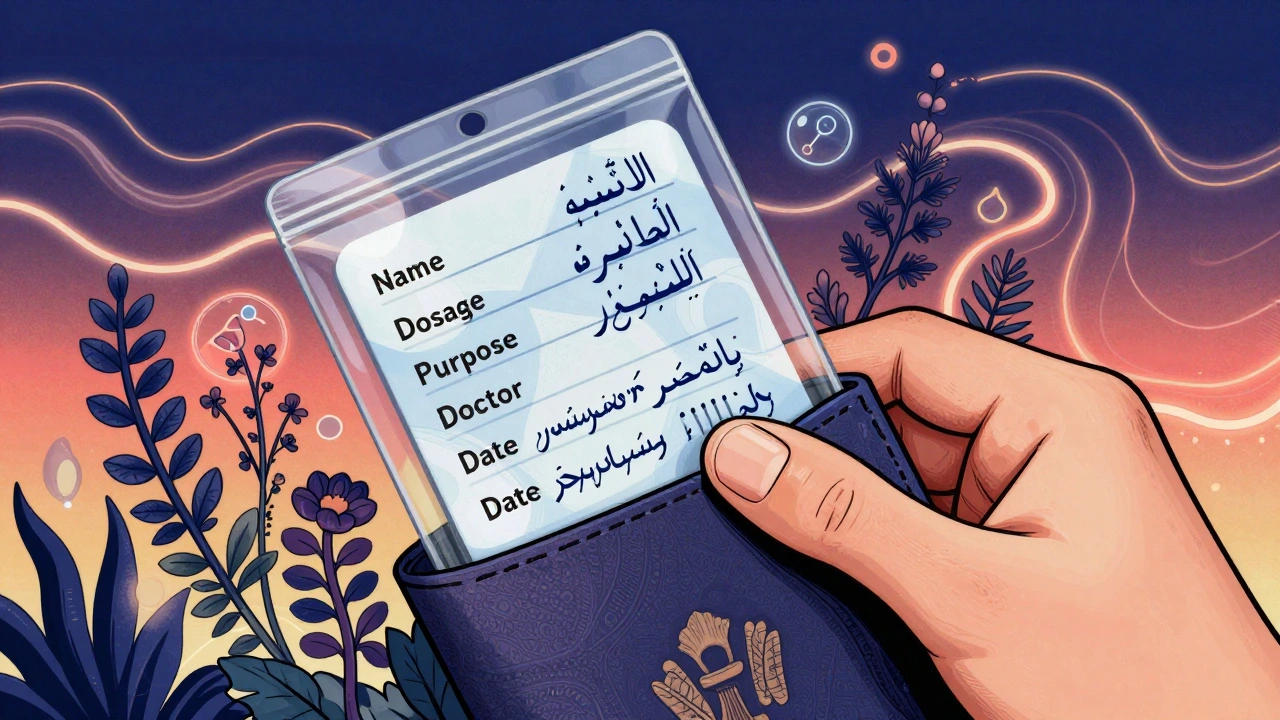
It’s not just a list of names. A useful emergency medication list includes six key details for every drug:
- Medication name (brand and generic, if different)
- Dosage (e.g., 10 mg, 500 mg)
- Frequency (e.g., once daily, every 8 hours)
- Purpose (e.g., "for high blood pressure," "for diabetes")
- Prescribing doctor (name and clinic)
- Start date (when you began taking it)
Don’t forget supplements, herbal remedies, or over-the-counter pills. Many people take turmeric for inflammation or melatonin for sleep. In an emergency, those matter too. A 2020 study in JAMA Internal Medicine found patients using complete lists had 28% fewer medication errors during hospital admissions.
Which Languages Should You Include?
You don’t need to translate into every language on Earth. Focus on the ones you’ll actually use.
- If you’re traveling to Spain, Mexico, or parts of the U.S. with large Spanish-speaking communities, Spanish is essential.
- Visiting China? Include Chinese (Simplified). If you’re going to Taiwan or Hong Kong, add Traditional Chinese.
- Traveling to Vietnam, Cambodia, or Laos? Vietnamese and Khmer are critical.
- Heading to the Middle East? Arabic is a must.
- Going to Russia or Ukraine? Russian covers most of Eastern Europe.
- For Southeast Asia, Tagalog (Philippines) and Bengali (Bangladesh, parts of India) are high-priority.
The British Red Cross Emergency Multilingual Phrasebook includes 36 languages, and the National Library of Medicine’s MedlinePlus offers drug safety info in over 40 languages-including Amharic, Hmong, and Oromo-for refugee populations. Use these as your starting point.
Where to Get Reliable Translations
Don’t rely on Google Translate alone. Medical terms can be mistranslated. A word like "tablet" might become "pill" or "capsule," and that’s enough to cause confusion.
Use trusted sources:
- Tennessee Pharmacists Association (TPA) Universal Medication List - Free, printable PDFs in 10 languages: English, Spanish, Chinese, Vietnamese, Korean, Arabic, Russian, Somali, Nepali, and French. Used in hospitals across the U.S.
- NPS MedicineWise App - Available on iOS and Android. Lets you enter your meds, then export a list in 11 languages including Hindi, Punjabi, and Persian. Includes dose reminders.
- MedlinePlus - Run by the U.S. government. Offers printable medication guides in 40+ languages. Search for "medication list" + your language.
- British Red Cross Phrasebook - Not a medication list, but perfect for emergencies. Contains phrases like "I am taking..." and "I am allergic to..." in 36 languages. Print and carry it with your list.
Many of these are free. No app downloads or subscriptions needed. Just print them out.
How to Use It in an Emergency
Having the list isn’t enough. You need to make sure it’s used.
- Carry it physically. Keep it in your wallet, passport holder, or emergency card holder. Don’t rely on your phone dying.
- Use a laminated card. Waterproof and tear-resistant. You can fit it in your pocket.
- Take a photo. Save a clear picture of your list on your phone. Set it as your lock screen wallpaper so first responders can see it without unlocking your phone.
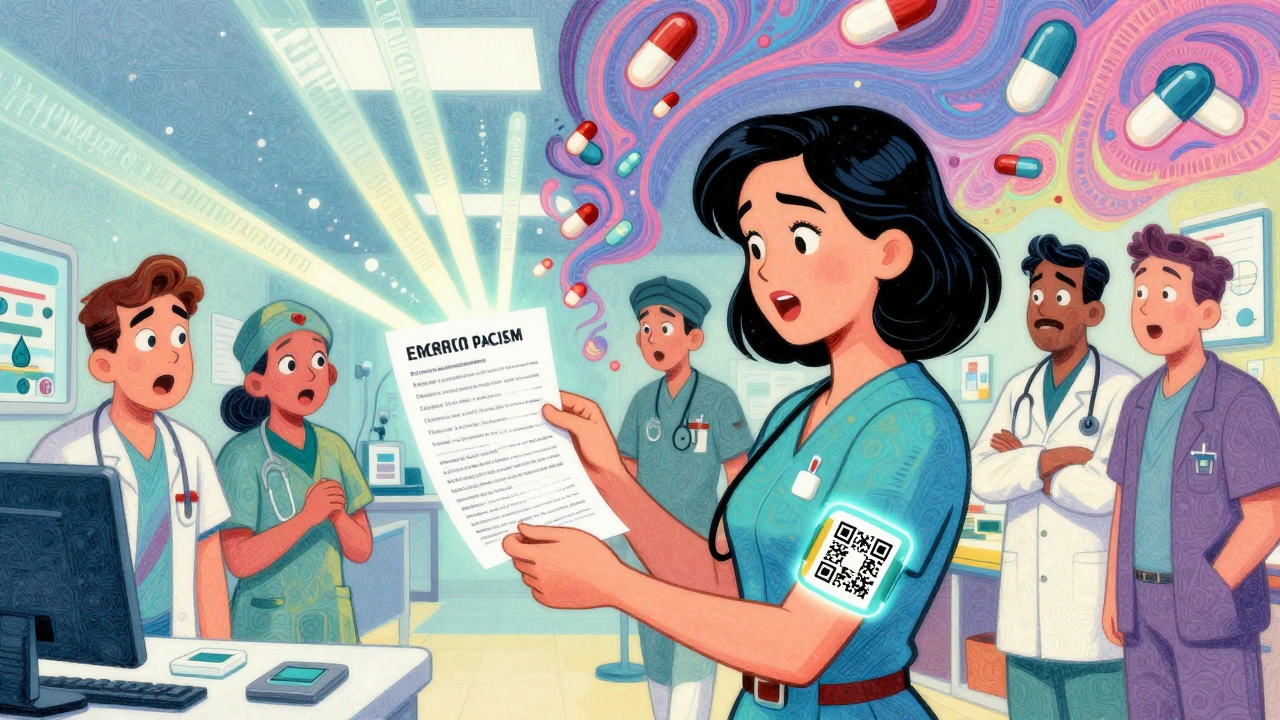
- Wear a medical ID. Some bracelets or necklaces let you engrave "Medication list in wallet" with a QR code that links to your digital version.
In 2023, a woman in Chicago had a severe allergic reaction. The ER staff didn’t speak her language. But she had her Spanish-language UML card. They saw "penicillin allergy" right away and avoided giving her a deadly drug. Her primary care doctor had given her the list during a routine visit.
Common Mistakes to Avoid
Even with a list, people make errors:
- Using outdated info. If you started a new drug last week, update your list. 78% of medication errors happen during care transitions.
- Leaving out supplements. Ginkgo biloba, garlic pills, or fish oil can interact with blood thinners. Include them.
- Using informal translations. A friend translating "metformin" as "sugar pill" won’t help. Use official medical terms.
- Forgetting cultural context. In some cultures, "tea" means herbal remedies. If you take chamomile daily, write it as "chamomile tea, 1 cup nightly." Don’t assume "tea" is understood.
A 2022 study found 43% of translated instructions still contained culturally confusing terms. For example, "take with food" might mean "with rice" in Asia, but "with breakfast" in the U.S.
Digital vs. Paper: Which Is Better?
Both have their place.
Printed list: Works even when your phone is dead, lost, or broken. Hospitals and clinics can read it immediately. Best for older adults or those without smartphones.
Digital list: The NPS MedicineWise app lets you update meds on the go, set reminders, and share the list via email or QR code. It’s great for frequent travelers. But you need a working phone and battery.
Best practice? Carry both. Print a copy. Save a digital version on your phone. Add it to your Apple Wallet or Google Pay as a digital card.
Who Should Have One?
You don’t have to be a senior or have a chronic illness to need this.
- Anyone taking 3+ medications regularly
- People with allergies (especially to antibiotics or NSAIDs)
- Travelers to non-English-speaking countries
- Those with memory issues or dementia
- Parents of children on daily medication
- Anyone with a chronic condition: diabetes, heart disease, epilepsy, asthma
Even if you’re young and healthy, if you take birth control, antidepressants, or daily vitamins-add them. Emergency staff need to know everything.
How to Update It
Don’t wait for an emergency to update your list.
- Update it every time you see your doctor or pharmacist.
- Do it after a hospital visit or ER trip.
- Check it every 3 months, even if nothing changed.
- When you stop a medication, cross it out and write "discontinued" with the date.
Pharmacists are trained to help with this. Ask your pharmacist: "Can you print a multilingual version of my list?" Most can, especially if you’re on Medicare or Medicaid. If they say no, ask for the TPA or MedlinePlus links-they’ll know where to find them.
Real Stories, Real Impact
On Reddit, a user named u/MariaG_2020 wrote: "When I had an allergic reaction in Chicago, the ER staff used the Spanish version of my Tennessee UML to identify my penicillin allergy immediately. My doctor in Nashville gave me the list during my last checkup. It saved my life." Another user on the MedicineWise app said: "The Vietnamese translation helped my grandmother explain her medications during a stroke emergency. She couldn’t speak, but the list did. These aren’t rare cases. In 2021, the American Pharmacists Association found multilingual lists cut emergency room visit time by 22 minutes on average for non-English speakers. That’s 22 minutes closer to the right treatment.
What’s Next?
The U.S. government is pushing for better standards. By 2025, the American Pharmacists Association plans to release national guidelines for multilingual medication lists, including minimum language coverage based on local demographics. Google is already integrating medication translations into search results for 30 languages.
But you don’t need to wait. Right now, you can make a difference. Print a list. Add your meds. Translate it. Carry it. It might not seem like much-but in a moment of crisis, it’s everything.
Do I need a multilingual medication list if I only travel to English-speaking countries?
Yes. Even in English-speaking countries, emergencies can involve staff who aren’t native speakers or who are rushed. A printed list removes guesswork. Plus, many U.S. hospitals serve large non-English populations. Your list could help someone else too.
Can I use Google Translate to make my own list?
Only as a rough draft. Medical terms like "hydrochlorothiazide" or "warfarin" can be mistranslated into meaningless phrases. Always cross-check with official sources like MedlinePlus or the Tennessee Pharmacists Association. They use medically approved translations.
What if my language isn’t available on these lists?
Contact local community health centers or refugee support groups. Many have volunteers who can help translate. You can also use the British Red Cross Phrasebook to write key phrases like "I take [medication] for [condition]" in your language, then add it to your list. Even a handwritten note with correct spelling can help.
Should I include my allergies on the list?
Absolutely. List them clearly: "Allergic to penicillin-causes swelling and trouble breathing." Don’t just write "penicillin allergy." Include symptoms. This helps staff recognize reactions faster.
Is there a cost to get these multilingual lists?
No. All the major resources-TPA, MedlinePlus, NPS MedicineWise, British Red Cross-are free. No apps require payment. No subscriptions. You can print them at home or at your local library.
If you’re preparing for a trip, make this your last task before packing. It takes less than 20 minutes. And if you’re not traveling, make one anyway. Emergencies don’t wait for a passport. They happen at home, in the car, on the street. A simple list in the right language can mean the difference between confusion and clarity-and between life and death.
Releted Post

Andy Dargon
Hi, I'm Aiden Lockhart, a pharmaceutical expert with a passion for writing about medications and diseases. With years of experience in the pharmaceutical industry, I enjoy sharing my knowledge with others to help them make informed decisions about their health. I love researching new developments in medication and staying up-to-date with the latest advancements in disease treatment. As a writer, I strive to provide accurate, comprehensive information to my readers and contribute to raising awareness about various health conditions.
This is such a simple idea that could save so many lives. I just printed out the Tennessee UML for my mom-she’s on five meds and travels to Mexico every winter. She’s 78 and doesn’t trust her phone, so the laminated card in her wallet is perfect. Thanks for the reminder!
While I appreciate the sentiment, let’s be real: 90% of people won’t update this list. And 70% will rely on Google Translate anyway. 🤦♀️ You can’t fix human laziness with a PDF. Also, why are we assuming all ER staff can read? I’ve seen hospitals in Miami where the triage nurse doesn’t speak Spanish either. This is performative safety. 💅
i just made mine last night… took me 15 mins. i forgot my fish oil at first 😅 but then remembered. i put it in spanish and vietnamese since my sister lives in houston and we visit her in vietnam next year. i printed it and put it in my purse. thank you for this. it feels so small but also… so important.
Let’s not romanticize this. You’re giving people a false sense of security. A list doesn’t prevent misdiagnosis if the doctor doesn’t speak the language or ignores it. And how many people actually carry it? 12%? 5%? Meanwhile, the real issue is systemic language access in U.S. hospitals-which hasn’t improved since 2010. This is a Band-Aid on a hemorrhage.
this is dumb. why do i need a list? if i’m dying, just tell them i’m on pills. they’ll figure it out. also, who has time for this? i’m busy.
This is an excellent, pragmatic guide. As a pharmacist in Mumbai, I’ve seen patients arrive with handwritten lists in Hindi, Tamil, and Bengali-often with correct dosages but no purpose. The inclusion of supplements is critical; many patients assume ayurvedic remedies are "natural" and therefore safe. Thank you for emphasizing official sources. 🙏
Do this TODAY. Seriously. Don’t wait until you’re in an ambulance. Print it. Laminate it. Put it in your wallet. Take a photo. Set it as your lock screen. It’s 15 minutes of your life. And if you do it, you’re not just saving yourself-you’re saving someone else’s time, stress, and maybe even their life. 💪❤️
I’ve been thinking about this for weeks now, and I’m wondering-what about the linguistic nuances? For example, in some dialects of Arabic, "diabetes" is referred to as "sugar disease," but the term used in medical literature is different. And in Bengali, the word for "tablet" can imply a sugar pill in colloquial use. Would it be better to include a phonetic pronunciation guide alongside the written translation? Also, I’ve seen cases where the prescribing doctor’s name was mistranslated into a completely different name-like "Dr. Patel" becoming "Dr. Patel Singh"-which caused confusion with the hospital’s internal system. Maybe we need a standardized format for names too? Just a thought.
Who even needs this? You’re making a big deal out of nothing. If you can’t speak English, you shouldn’t be traveling. This is just another way to coddle people who refuse to learn the language. And why are we giving free resources to non-English speakers but not to Americans who can’t read? Priorities, people.
you think this is helpful? i bet 80% of these people dont even know what their meds are for. and why are you telling people to take turmeric? that stuff is poison with blood thinners. you’re just giving people a false sense of security while they keep taking random supplements. this is dangerous. 😒
This is brilliant. I’ve been using the NPS app for my dad-he has Alzheimer’s and takes 8 meds. The app lets me share updates with his care team in Spanish, which is huge since his home health aide speaks only Spanish. Also, I added the British Red Cross phrases to his wallet. He doesn’t say much anymore, but when he points to the card… it speaks for him. ❤️
Why are we promoting multilingual lists for foreigners but not for Americans who speak only Spanish or Tagalog? This is cultural elitism disguised as safety. If you’re in the U.S., your language should be English. End of story. We’re not a United Nations hospital.
...and yet, in the grand tapestry of human fragility, is this not just another thread? A digital talisman against the chaos of biology? We print our pills like runes, as if language could outwit entropy. But what if the body speaks in silence? What if the ER light flickers, and the translator is late, and the list-beautifully laminated, perfectly translated-is just paper? Does it matter? Or are we merely comforting ourselves with order, while the universe laughs? 🌌
Just wanted to add-my brother is from Nepal and lives in Ohio. He takes blood thinners and was terrified to travel to Kathmandu. We used the TPA list in Nepali, and his cousin, who’s a nurse there, said it was the clearest med list she’d ever seen from a foreigner. Also, we added a QR code to his bracelet. When he got sick last year, the hospital scanned it and pulled up his list in 3 languages. No confusion. No delay. Just care. 🙌