
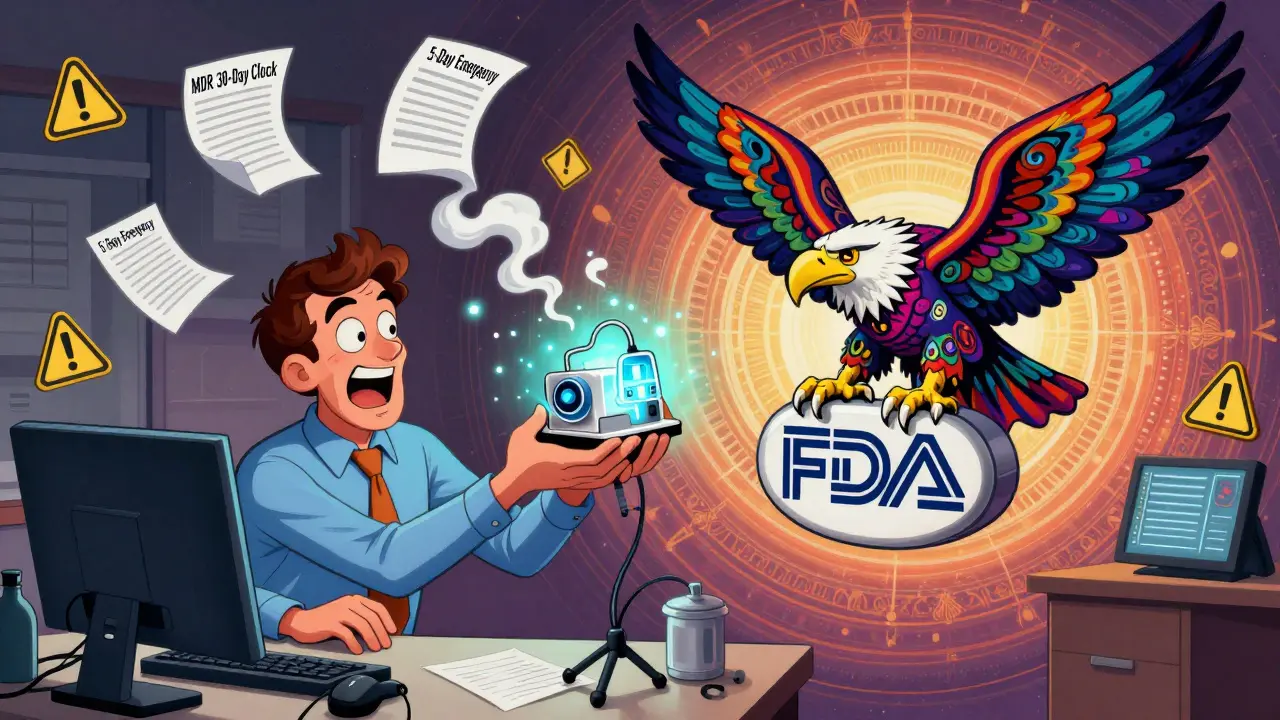
When a medical device fails, a children’s toy breaks, or a car part malfunctions, the consequences can be deadly. But what happens after the incident? Who’s responsible for telling the government? The answer lies in manufacturer reporting - a set of legal obligations that force companies to disclose safety problems before more people get hurt. This isn’t optional. It’s not a suggestion. It’s the law, enforced by federal agencies with real penalties for non-compliance.
What Exactly Are Manufacturer Safety Reporting Obligations?
Manufacturer reporting means companies must tell government agencies when their products cause or could cause harm. These rules exist because waiting for a pattern of injuries to emerge before acting is too late. The goal is to catch problems early - often before anyone even gets hurt. The three main agencies handling this are the FDA (for medical devices and drugs), CPSC (for consumer products like appliances and toys), and NHTSA (for vehicles and auto parts).Each agency has its own rules, but they all share the same core idea: if you know your product might be dangerous, you have to report it. The FDA’s system, called Medical Device Reporting (MDR), requires companies to file reports on deaths, serious injuries, and malfunctions that could cause harm if they happened again. The CPSC demands even faster action - within 24 hours of learning about a defect that could create a serious risk. NHTSA collects quarterly data on crashes and injuries tied to vehicles and parts, with specific thresholds that trigger additional reports.
How Do Reporting Rules Differ Between Agencies?
The differences between agencies aren’t just paperwork - they’re life-or-death timelines.Under FDA rules (21 CFR Part 803), manufacturers have 30 calendar days to report a death or serious injury linked to a medical device. If the problem requires immediate repair to prevent harm, that window shrinks to just 5 working days. The FDA also requires companies to investigate every report, document their findings, and keep records for at least two years after the device is last sold. In 2023, the FDA received over 1.2 million of these reports.
CPSC’s rules are stricter on time but looser on proof. You don’t need to confirm an injury happened. If your internal testing, customer complaints, or warranty claims suggest a product could cause serious injury or death - even if it hasn’t yet - you must report within 24 hours. This is called “reportable information.” In 2023, CPSC received over 14,000 such reports. The pressure is intense: 54% of home appliance makers got warning letters in 2023 for missing that deadline.
NHTSA’s Early Warning Reporting is different again. Tire makers must report if they get info on five or more deaths, ten or more injuries, or ten or more property damage claims tied to a single tire model. Car manufacturers report quarterly on crash data, injury rates, and warranty claims. The system doesn’t require immediate action on every report - it’s designed to spot trends over time.
Pharmaceutical companies have their own timeline: serious side effects from over-the-counter drugs must be reported within 15 business days. Non-serious ones? No report needed. That’s a key distinction - not every problem triggers a report.

Why Is This So Hard for Companies to Get Right?
The rules sound simple. But in practice, they’re messy.One big problem: What does it mean to “become aware”? If a customer emails a complaint to customer service, does that count? What if the email goes to a warehouse worker who then tells a manager? The FDA says any employee who might reasonably pass the info to someone responsible for reporting triggers the clock. That means every employee - from receptionists to engineers - needs training. One MedTech quality manager reported spending 1,200 hours a year just on reporting tasks. Small companies with under 50 employees spend nearly 20% of their quality budget on compliance.
Another headache: inconsistent interpretations. Reddit threads and industry forums are full of stories about FDA inspectors giving different answers to the same question. One inspector says a malfunction is reportable. Another says it’s not. That uncertainty leads to over-reporting (wasting resources) or under-reporting (risking fines).
And then there’s the tech barrier. The FDA requires electronic submission through its Electronic Submission Gateway. Setting that up isn’t plug-and-play. Companies need IT staff trained on specific data formats. A 2023 study found it takes 2.5 full-time employees just to manage the tech side of reporting for a mid-sized medical device maker.
What Are the Real Costs of Compliance?
Compliance isn’t just about time - it’s about money.Small medical device manufacturers spend an average of $50,000 a year just on reporting. Larger firms pay over $750,000 for quality management systems that track complaints, investigations, and submissions. These aren’t one-time costs. They’re ongoing. Training staff, updating software, hiring compliance officers - it all adds up.
But here’s the twist: the cost of not reporting is far higher. The FDA can fine companies up to $252,756 per violation. In 2024, several companies were hit with six-figure penalties for late or missing reports. CPSC can issue recalls, seize products, or even ban sales. For a small company, that’s a death sentence.
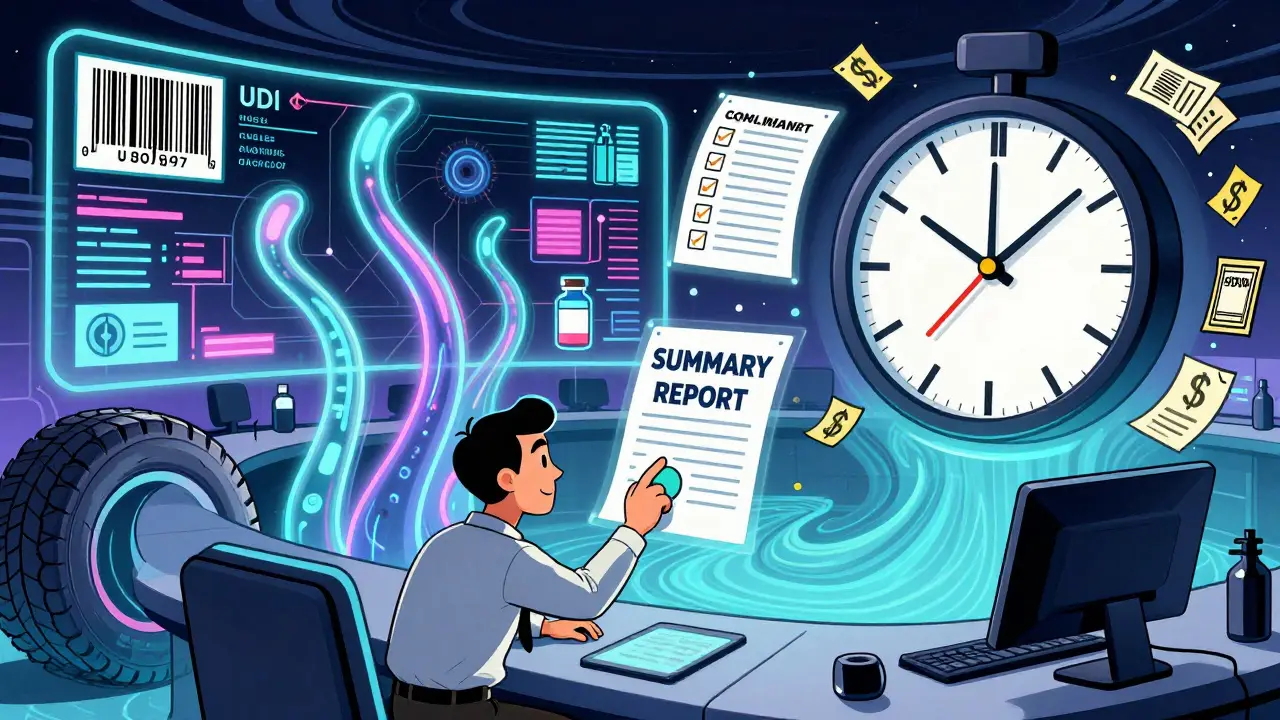
There’s one bright spot: the FDA’s Voluntary Malfunction Summary Reporting program. Starting in August 2024, companies can submit summary reports for certain low-risk malfunctions instead of filing individual reports for each one. Medtronic reported a 63% drop in individual reports after joining. That saved them hundreds of hours and thousands of dollars.
What’s Changing in 2025 and Beyond?
The rules are evolving - and getting more demanding.The FDA is pushing for faster reporting on high-risk devices. A bill called the Medical Device Safety Act of 2023, which has bipartisan support, would cut the reporting window from 30 days to 15 days for certain devices. If it passes, companies will have even less time to react.
CPSC is investing $25 million in 2025 to modernize its reporting system, aiming to cut review times from 17 days to 10 by 2026. They’re also pushing for better electronic submissions and clearer guidelines.
On the tech side, AI is starting to help. Philips Healthcare uses machine learning to automatically flag potential safety issues from customer feedback and warranty data. Their MDR preparation time dropped from 8.2 hours per report to just 3.5. Experts predict AI will cut reporting time by 60% and reduce false negatives by 45% by 2027.
And then there’s the Unique Device Identification (UDI) system. By 2026, every medical device sold in the U.S. must have a unique barcode. That means if a device fails, regulators can trace it back to the exact batch, factory, and date of production. It’s a game-changer for pinpointing problems - but it also means manufacturers must now track and report even more data.
What Should Companies Do Now?
If you make a product that’s sold in the U.S., here’s what you need to do:- Identify which agency regulates your product - FDA, CPSC, or NHTSA.
- Map out every point where safety info enters your company - customer service, tech support, warranty claims, field service reports.
- Train every employee on what counts as “reportable information.”
- Create written procedures for reviewing, investigating, and reporting safety events.
- Invest in a quality management system that can track complaints and automate reporting where possible.
- Explore voluntary summary reporting options if you’re under FDA jurisdiction.
- Set internal deadlines that are 3-5 days ahead of the legal deadline. That gives you breathing room.
Don’t wait for a recall or a fine to wake you up. The system is designed to catch problems early - but only if companies act early too. The cost of compliance is high. The cost of ignoring it? Often irreversible.
Do I have to report if no one got hurt?
Yes - under CPSC rules, you must report if you have reason to believe your product could cause serious injury or death, even if no incident has occurred yet. The FDA also requires reporting of malfunctions that could cause harm if they happened again. The absence of injury doesn’t mean the risk doesn’t exist.
What happens if I miss the reporting deadline?
You risk fines, product recalls, or even bans on sales. The FDA can impose penalties up to $252,756 per violation. CPSC may issue warning letters, require corrective actions, or publicly name your company. In extreme cases, executives can be held personally liable.
Can I report a problem anonymously?
No. All manufacturer reports must include the company name, product details, and contact information. Anonymous reporting is only allowed for consumers or healthcare providers. Companies are legally required to identify themselves.
Do small businesses have different rules?
No. The legal obligations are the same regardless of company size. However, the FDA and CPSC offer guidance and resources specifically for small businesses. The challenge is that small firms often lack the staff and budget to handle reporting efficiently, making compliance harder - not easier.
How long do I need to keep reporting records?
Under FDA rules, you must keep MDR records for at least two years after the device’s last distribution date. CPSC requires retention of all reportable information for five years. NHTSA requires records to be kept for five years from the date of the event. Always check the specific regulation for your product type.
Releted Post

Andy Dargon
Hi, I'm Aiden Lockhart, a pharmaceutical expert with a passion for writing about medications and diseases. With years of experience in the pharmaceutical industry, I enjoy sharing my knowledge with others to help them make informed decisions about their health. I love researching new developments in medication and staying up-to-date with the latest advancements in disease treatment. As a writer, I strive to provide accurate, comprehensive information to my readers and contribute to raising awareness about various health conditions.
So let me get this straight - we’re forcing small companies to spend 20% of their budget on paperwork just so the FDA can collect 1.2 million reports nobody reads? 😅
Meanwhile, actual safety improvements? Nah. Let’s just make sure the spreadsheet has the right checkbox.
bro this is wild. in india we just fix stuff and move on. here u gotta file 17 forms before u can even say 'oops'. 😅
but i guess if it saves one kid from choking on a toy part, worth it.
Let’s be honest - this entire regulatory apparatus is a monument to institutional overreach disguised as public safety. The FDA doesn’t want to prevent harm; it wants to create a bureaucratic empire where compliance officers earn six figures to interpret regulations that were written in 1976 by people who thought fax machines were cutting-edge.
And don’t get me started on the UDI system. You think this is about traceability? No. It’s about control. Every barcode is a leash. Every report, a tether. They’re not protecting consumers - they’re protecting their own relevance.
YAS. I love how CPSC makes you report even if NO ONE got hurt. Like, if my toaster glows a little too bright, I gotta call the feds? 🤦♀️
Meanwhile, my neighbor’s kid is riding a hoverboard down a freeway and no one’s asking him to report that. 🤷♀️
They’re not here to protect you. They’re here to prepare the data for the next phase - the mandatory implantable tracking chips. You think the UDI is about safety? Nah. It’s the first step to linking every device you own to a federal biometric registry.
And the AI flagging system? That’s the neural net training on your complaints to predict when you’ll ‘become a risk.’
They already know you read this. They’ve been watching since you clicked.
The notion that ‘every employee’ must be trained on reporting thresholds is not just inefficient - it’s epistemologically incoherent. One cannot reasonably expect a warehouse associate with no medical training to discern between a ‘malfunction that could cause harm if it happened again’ and a mere aesthetic defect.
Furthermore, the FDA’s definition of ‘awareness’ is a legal fiction - a performative construct designed to shift liability downward while shielding upper management from accountability. The entire system is a Rube Goldberg machine of regulatory theater.
I just want to say thank you to the people who actually do this work - the quality managers spending 1200 hours a year on reports. You’re the unsung heroes.
And to the companies trying to do right by people? Keep going. Even if the system’s broken, your integrity isn’t.
We see you. And we’re rooting for you.
So… I pay $500 for a blender. If it sparks once, I’m supposed to call the government? And if I don’t? I get fined $250k?
Y’all really gonna make me a criminal for using my kitchen?
Okay but let’s be real - most of these reports are just corporate CYA. Companies report everything because they’re terrified of getting sued, not because they care about safety. Meanwhile, the real dangers? Like that cheap phone charger that melts in your backpack? Nobody reports those because the company just quietly discontinues the model and moves on.
And don’t even get me started on how the FDA lets pharma companies cherry-pick which side effects to report. It’s a joke. A very expensive, very deadly joke.
Biggest tip: set your internal deadline 5 days before the legal one. I’ve seen too many teams panic because someone forgot to forward an email.
Also - automate what you can. Even if it’s just a Google Form that auto-tags complaints. Saves your sanity.
And yes, training receptionists matters. They hear everything.
It’s funny - we built these systems to prevent harm, but we forgot to ask: who bears the cost of prevention?
Is it fair that a family-run medical device shop in Ohio has to spend more on compliance than on R&D?
Maybe the real question isn’t ‘how do we enforce reporting?’
But ‘how do we make reporting just?’
bro if u got a small biz and u think u can skip this? u r gonna get wrecked.
my cousin’s company got a letter from cpac for missing 24hr window - even tho no one got hurt. now they got to pay $40k in fines and redo their whole system.
just do it. save urself.
AI is going to save this whole mess
Imagine a system that reads customer service chats, warranty claims, social media rants, and auto-files reports before you even know you have a problem
That’s not future tech - that’s the only way this doesn’t collapse under its own weight
Companies that don’t adopt this will die
Not because they’re bad
But because they’re slow
And in this game, slow is suicide