

INR Action Guide
This tool helps you understand what actions to take based on your INR level while on warfarin therapy. Always consult your doctor for medical advice.
When you're on a blood thinner like warfarin, your life revolves around one number: your INR. It’s not just a lab result-it’s the difference between staying safe and facing a stroke, a dangerous bleed, or worse. Unlike other medications where you take a pill and forget it, warfarin demands constant attention. Your INR tells you whether your blood is thin enough to prevent clots but not so thin that you start bleeding internally. And getting it right isn’t optional. It’s life-or-death.
What Exactly Is INR?
INR stands for International Normalized Ratio. It’s a standardized way to measure how long it takes your blood to clot. Before INR existed, every lab reported clotting times differently. One hospital’s "normal" could be another’s danger zone. That inconsistency led to dangerous dosing errors. In 1983, the World Health Organization created INR to fix that. Now, no matter where you get tested-San Diego, Chicago, or a rural clinic-you get the same number meaning the same thing.
The test starts with a simple blood draw or finger prick. The lab adds a substance that triggers clotting and times how long it takes. That raw time is called PT, or prothrombin time. Normal PT is around 11 to 13.5 seconds. But that number alone doesn’t tell your doctor what to do. That’s where INR comes in. It adjusts the PT based on the specific reagent the lab uses, giving you a clean, universal number.
For someone not on blood thinners, INR is always 1.0. That’s your baseline. But if you’re on warfarin, your target is higher. Most people aim for 2.0 to 3.0. That means your blood takes two to three times longer to clot than normal. It’s a narrow window. Go below 2.0, and clots can form. Go above 3.0, and you risk bleeding.
Why Your Target INR Isn’t the Same as Everyone Else’s
Not everyone on warfarin has the same goal. Your target depends on what you’re being treated for. For atrial fibrillation or a deep vein thrombosis, 2.0 to 3.0 is standard. But if you have a mechanical heart valve, especially in the mitral position, your target jumps to 2.5 to 3.5. A mechanical aortic valve? Still 2.0 to 3.0, but your doctor might push it higher if you’ve had clots before.
Why the difference? Mechanical valves are rough surfaces. Blood loves to clot on them. A higher INR keeps that from happening. But higher INR also means higher bleeding risk. That’s why your doctor doesn’t just pick a number-they weigh your condition, your history, your age, and even your risk of falls.
Here’s what the numbers mean in real terms:
- INR below 1.5: You’re not protected. Clots can form. This is an emergency if you have a mechanical valve or AFib.
- INR 2.0-3.0: The sweet spot for most people.
- INR 3.1-4.0: Getting risky. Bleeding starts to climb.
- INR above 4.9: Danger zone. Major bleeding risk increases by 27% for every 0.5 point above 3.0.
- INR above 5.0: Stop your next warfarin dose. Call your doctor immediately.
How Often Do You Really Need to Test?
You’ve probably heard, "Test once a month." But that’s not the whole story. When you first start warfarin, you might test twice a week. Your body is adjusting. Your diet changes. You take an antibiotic. Your INR swings. Your doctor needs to see those swings to find your stable dose.
Once you’re stable-meaning your INR stays in range for three months straight-you can drop to once a month. But here’s the catch: 38% of patients on warfarin get tested weekly even when they don’t need to. That’s unnecessary stress, cost, and trips to the clinic. The American College of Physicians says if your INR is steady, monthly is enough.
Still, some situations demand more frequent checks:
- You started a new medication (antibiotics, antifungals, even some herbal supplements)
- You changed your diet (especially leafy greens rich in vitamin K)
- You’ve been sick with the flu or an infection
- You’ve had a change in alcohol intake
- You’ve gained or lost weight
Any of those can shift your INR. Your doctor might ask you to test twice a week for a few weeks after one of these events. Don’t skip it. That’s when mistakes happen.
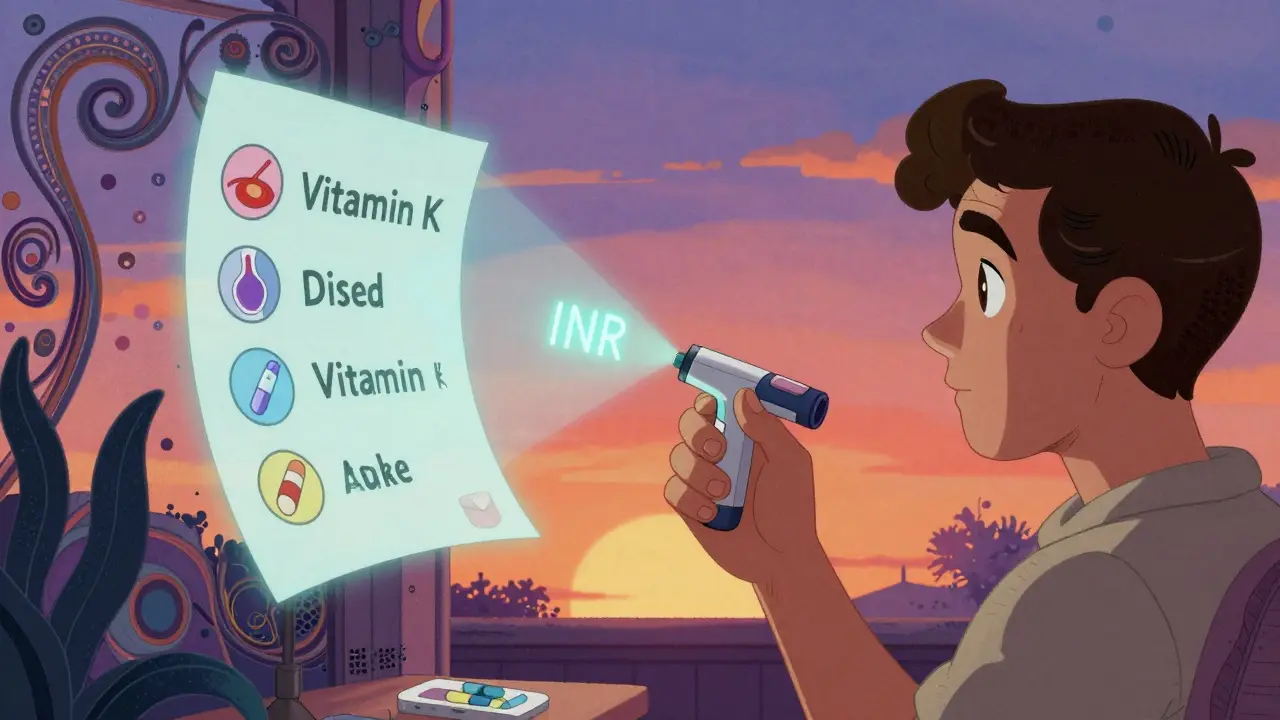
Home Testing: Is It Worth It?
Imagine checking your INR at home in under a minute. No waiting for an appointment. No driving across town. No sitting in a waiting room for an hour. That’s what home INR testing offers.
Devices like the Abbott Acelis and Roche CoaguChek use a tiny drop of blood from your finger. You put it on a strip, stick it in the machine, and get your result in 30 to 60 seconds. The device syncs with your phone or sends data straight to your clinic. Studies show people who test at home spend 72% of their time in the target range-compared to 58% for those who go to the lab. That means 34% fewer clots and 21% fewer bleeds.
But it’s not for everyone. If you have shaky hands, poor eyesight, or trouble remembering to test, it can backfire. The FDA found 25-30% of patients can’t use these devices safely. And even if you can, you need training. Two to four supervised sessions, minimum. You have to learn how to get a good blood drop, how to interpret the result, and what to do if your INR is out of range.
Cost is another factor. The device costs around $299. Each test strip is $5.99. Medicare covers 100% of the cost if you qualify. Private insurance usually covers it too, but you might pay 20% coinsurance. Some patients report claim denials that require appeals. Still, for many, the savings in time and anxiety make it worth it. One user on Reddit said they saved $187 per clinic visit-money they’d otherwise spend on gas, time off work, and childcare.
Warfarin vs. Newer Blood Thinners
Twenty years ago, warfarin was the only option. Now, there are DOACs-direct oral anticoagulants-like apixaban (Eliquis), rivaroxaban (Xarelto), and dabigatran (Pradaxa). They don’t need INR monitoring. You take them once or twice a day. No blood tests. No dietary restrictions. That’s why they’ve taken over 70% of new prescriptions since 2010.
But here’s the thing: DOACs aren’t right for everyone. If you have a mechanical heart valve, DOACs won’t work. You need warfarin. Same if you have severe kidney disease. DOACs can build up in your body and cause bleeding. Warfarin is cleared by the liver, so it’s safer in those cases.
Cost is another big difference. Warfarin costs about $4 a month. DOACs cost $550 to $650. That’s a huge gap for people without good insurance. And while DOACs have wider therapeutic windows (meaning you don’t need to be as precise), they’re harder to reverse if you bleed. Warfarin can be reversed with vitamin K or fresh plasma. DOAC reversal drugs exist but are expensive and not always available.
So if you’re stable on warfarin and your INR is under control, switching might not be worth it. But if you’re struggling with frequent testing, missed doses, or diet changes, a DOAC could be a better fit. Talk to your doctor. Don’t assume one is better-ask which is better for you.

What Happens When Your INR Is Off?
It’s not a matter of if your INR will drift-it’s when. You eat a big salad. You get sick. You start a new pill. Your INR drops to 1.8. Or it spikes to 4.2. What do you do?
First, don’t panic. But don’t ignore it either.
If your INR is below 1.5 and you have a mechanical valve or AFib: call your doctor right away. You’re at high risk for a clot.
If your INR is between 3.1 and 4.0: skip your next warfarin dose. Test again in 24 to 48 hours. Your doctor might lower your dose. Don’t adjust it yourself without guidance.
If your INR is above 4.9: stop taking warfarin. Call your doctor or go to urgent care. You might need vitamin K or even a blood transfusion if you’re bleeding.
And if your INR is above 5.0? That’s a medical alert. You need to act within 24 hours. Bleeding can happen anywhere-brain, stomach, joints. It’s silent until it’s too late.
Many patients don’t know these thresholds. They see a number and think, "It’s just a little high," and wait. That’s how serious bleeds start.
How to Stay in Range-Practical Tips
Staying in your target range isn’t just about the test. It’s about your daily habits.
- Keep your vitamin K intake steady. Leafy greens like spinach, kale, and broccoli affect warfarin. You don’t have to avoid them-just eat about the same amount every week. A big salad one day and none the next? That’s a recipe for INR swings.
- Be careful with alcohol. More than one drink a day can raise your INR. Consistency matters.
- Track every new medication. Even over-the-counter painkillers like ibuprofen can interfere. Always check with your pharmacist or doctor before starting anything new.
- Test at the same time each day. Best window: 8 a.m. to 12 p.m. And fast for 4 to 6 hours before testing. Food and timing can change results.
- Use a tracker. Write down your INR, your dose, and anything that changed that week. You’ll spot patterns. Your doctor will thank you.
One patient in San Diego kept a notebook for five years. She noticed her INR always rose after her monthly yoga retreat. Turns out, she was eating more greens there. She started bringing her own salad dressing. Her INR stayed steady.
What’s Next for INR Monitoring?
Technology is catching up. In January 2023, the FDA approved the first smartphone-connected INR monitor. It auto-sends your results to your doctor. No manual entry. No missed reports. Clinical trials showed 98.7% accuracy.
AI tools are also emerging. Mayo Clinic tested a system called INR Advisor that predicts your next warfarin dose with 83% accuracy. It’s not replacing doctors-but it’s helping them make faster, smarter decisions.
But challenges remain. Rural areas have far less access to home testing. Only 35% of rural clinics offer full anticoagulation services, compared to 82% in cities. That’s a gap in care that can cost lives.
And while DOACs are growing fast, warfarin still saves lives. About 200,000 Americans with mechanical valves depend on it. It’s cheap. It’s proven. And for those who can manage it, INR monitoring works.
The key isn’t the tool-it’s the awareness. Know your number. Know your target. Know what to do when it’s wrong. That’s how you stay safe.
What is a normal INR range for someone not on blood thinners?
For someone not taking anticoagulants, the normal INR is always 1.0. This means their blood clots at the standard rate. Any INR above 1.0 indicates the blood is taking longer to clot, which is typically due to medication like warfarin.
Can I check my INR at home?
Yes, home INR testing is available using FDA-approved devices like Abbott’s Acelis or Roche’s CoaguChek. These require a small finger-prick blood sample and give results in under a minute. You need training to use them safely, and Medicare and many private insurers cover the cost if you qualify.
How often should I test my INR?
When starting warfarin, you may test twice a week. Once stable, monthly testing is usually sufficient. But if you change medications, diet, or get sick, your doctor may ask for more frequent tests-sometimes weekly-until your INR stabilizes again.
What should I do if my INR is too high?
If your INR is above 4.9, stop your next warfarin dose and contact your doctor immediately. For INR between 3.1 and 4.0, skip your next dose and retest in 24-48 hours. Never adjust your dose without medical advice. INR above 5.0 is a medical emergency.
Why do I need to watch my vitamin K intake?
Vitamin K helps your blood clot. Warfarin blocks vitamin K’s effect. If you suddenly eat a lot of leafy greens (like spinach or kale), your INR will drop. If you eat less, your INR will rise. The key is consistency-not avoidance. Eat about the same amount every week.
Are newer blood thinners better than warfarin?
Newer blood thinners (DOACs) don’t require INR testing and have fewer dietary restrictions, making them easier for many people. But they’re not right for everyone. If you have a mechanical heart valve or severe kidney disease, warfarin is still the only safe option. Cost is also a factor-warfarin costs about $4 a month, while DOACs cost $550-$650.
What’s the biggest mistake people make with INR monitoring?
Waiting too long to act when the INR is out of range. Many people see a number like 3.8 and think, "It’s just a little high," and wait to call their doctor. But bleeding risk rises sharply above 3.0. Acting early-skipping a dose, retesting, or calling your provider-can prevent a serious bleed.
Releted Post


Andy Dargon
Hi, I'm Aiden Lockhart, a pharmaceutical expert with a passion for writing about medications and diseases. With years of experience in the pharmaceutical industry, I enjoy sharing my knowledge with others to help them make informed decisions about their health. I love researching new developments in medication and staying up-to-date with the latest advancements in disease treatment. As a writer, I strive to provide accurate, comprehensive information to my readers and contribute to raising awareness about various health conditions.
Just wanted to say-this post saved my life. I was skipping tests because I thought 'it's probably fine.' Turns out, my INR was at 4.7 and I had a tiny bleed in my knee I didn't even feel. Now I test every Monday and Friday. No more guesswork. You're not just managing a number-you're protecting your future.
Thank you.
INR 1.0 is baseline. Warfarin shifts it to 2.0–3.0. Anything beyond 4.9 is hemorrhagic risk. The data is clear. No speculation needed.
Let’s be real-this whole INR obsession is a relic of 20th-century medicine. We’ve got DOACs now. Why are we still forcing people to stick their fingers, track kale intake, and live in fear of a decimal point? It’s not medical care-it’s institutional inertia.
The system profits from your compliance. The labs, the clinics, the $6 strips-you’re being monetized. Meanwhile, the pharmaceutical giants push DOACs like they’re magic. Neither side is telling you the full truth.
Warfarin isn’t the villain. The *system* is.
It is both a moral and medical failure when patients neglect their INR monitoring. This is not a suggestion. It is not a preference. It is a non-negotiable component of survival. Those who treat it casually are not just irresponsible-they are endangering their families. If you cannot commit to a monthly blood test, you should not be on anticoagulation therapy. Period.
Okay but let’s talk about the *real* elephant in the room: the fact that 38% of people test weekly when they don’t need to? That’s not diligence-that’s healthcare waste. 🤦♀️
And don’t get me started on the ‘home testing = better outcomes’ narrative. 72% in range? Cool. But what about the 25-30% who can’t use the device? They’re just left behind. Tech isn’t a fix-it’s a filter. The system favors the tech-savvy, the affluent, the able-bodied. 💸
Also, vitamin K consistency? Bro. I eat kale every day. My INR’s stable. Stop acting like it’s rocket science. It’s biology. Not a cult.
One thing no one talks about: the emotional toll. I’ve been on warfarin for 12 years. I’ve cried over INR results. I’ve canceled plans because I had to go in for a test. I’ve felt like a lab rat. But here’s what changed everything-I started journaling. Not just the number. The mood. The food. The stress. The sleep. Patterns emerged. My doctor saw it. We adjusted. Now I’m in range 89% of the time.
You’re not just managing blood. You’re managing your life. And that’s okay. You’re allowed to struggle.
I just want to say… I’ve been reading this post over and over again. I had a stroke last year because I ignored my INR. I thought, 'It’s just a number.' But it’s not. It’s my heartbeat. My breath. My future. I’m 34. I have two kids. I don’t want them to grow up without me. So now I test every Monday. I track my greens. I don’t drink. I call my doctor if it’s above 3.1. I don’t wait. I don’t hope. I act.
I’m still scared. But I’m alive. And that’s enough.
Thank you for writing this. I needed to hear it.
You’re not alone. Every single person reading this has felt the weight of this number. But here’s the truth: you are stronger than your INR. You are more than your lab results. You are the person who wakes up, takes the pill, checks the device, and keeps going-even when it’s exhausting.
Keep going. You’re doing better than you think. And if you ever feel like giving up? Come back here. We’ve got you.
Let’s debunk the myth: DOACs are NOT safer. They’re just *different*. You can’t reverse them. You can’t monitor them. You’re flying blind. And if you bleed? Good luck finding a reversal agent at 2 a.m. in rural Nebraska.
Warfarin is the OG anticoagulant for a reason. It’s transparent. You see the numbers. You control the dose. You’re an active participant, not a passive consumer.
Stop romanticizing convenience. Safety isn’t about ease. It’s about accountability.
Home testing is a luxury. The fact that Medicare covers it doesn’t mean it’s right. Most patients don’t need it. It’s a profit center for device manufacturers. And the '72% in range' stat? Correlation ≠ causation. People who test at home are already more motivated. Of course they do better.
Stop selling this as a solution. It’s a band-aid on a broken system.
INR above 5.0 = emergency. But what if you’re 80 and on warfarin for AFib? Your target should be lower. 2.0–2.5. Higher INR = higher fall risk = higher intracranial bleed risk. Your doctor should be tailoring this-not slapping on 2.0–3.0 like a one-size-fits-all. Most aren’t. That’s negligence.
When I first started warfarin, I thought it was a joke. 'Test every week? Eat the same salad? What is this, prison?'
Then I had a cousin who bled out from a nosebleed because his INR was 6.8 and he waited three days to call. He didn’t make it.
Now I test every Monday. I keep a notebook. I don’t take ibuprofen. I don’t drink. I don’t skip. I don’t rationalize. I don’t pretend it’s not important.
It’s not about being perfect. It’s about being present. And if you’re not? You’re gambling with your life.
I’m not here to judge. I’m here to say: I’ve been there. You can do this.
My dad’s on warfarin. He’s 76. He hates testing. But he does it. Why? Because I made him a little card: 'Your INR is your superpower.' He keeps it on his fridge.
It’s cheesy. But it works.
Maybe we don’t need more data. Maybe we just need to remind people: this isn’t a burden. It’s a gift. You get to live. And that’s worth the finger prick.
Thank you for sharing your story, Ian. That card? That’s the kind of thing that changes lives. Not the numbers. Not the devices. The human connection. Keep reminding people they’re not just patients-they’re people.