

Renal Dosing Calculator
Renal Dosing Calculator
Creatinine Clearance
When someone has kidney disease, giving them the same antibiotic dose as a healthy person isn’t just risky-it can be deadly. The kidneys don’t just filter waste; they clear antibiotics from the body. When kidney function drops, those drugs build up. Too much can cause hearing loss, nerve damage, seizures, or even sudden death. Yet, too little means the infection won’t go away. Getting it right isn’t optional-it’s life or death.
Why Renal Dosing Matters More Than You Think
About 37 million adults in the U.S. have chronic kidney disease (CKD). That’s 1 in 7 people. And nearly half of all hospitalized patients with infections have some level of kidney impairment. Antibiotics like vancomycin, cefazolin, and ampicillin are cleared mostly by the kidneys. If you don’t adjust the dose, you’re essentially overdosing someone who can’t flush the drug out. A 2019 review in Clinical Infectious Diseases found that wrong dosing in kidney patients increased death rates by up to 27% for pneumonia and 20% for urinary tract infections. These aren’t rare mistakes. A 2023 survey of over 1,200 doctors showed that 63% couldn’t correctly calculate creatinine clearance using the Cockcroft-Gault formula. And 29% forgot to adjust for body weight in obese patients. That’s not ignorance-it’s a system failure.The Gold Standard: Cockcroft-Gault Equation
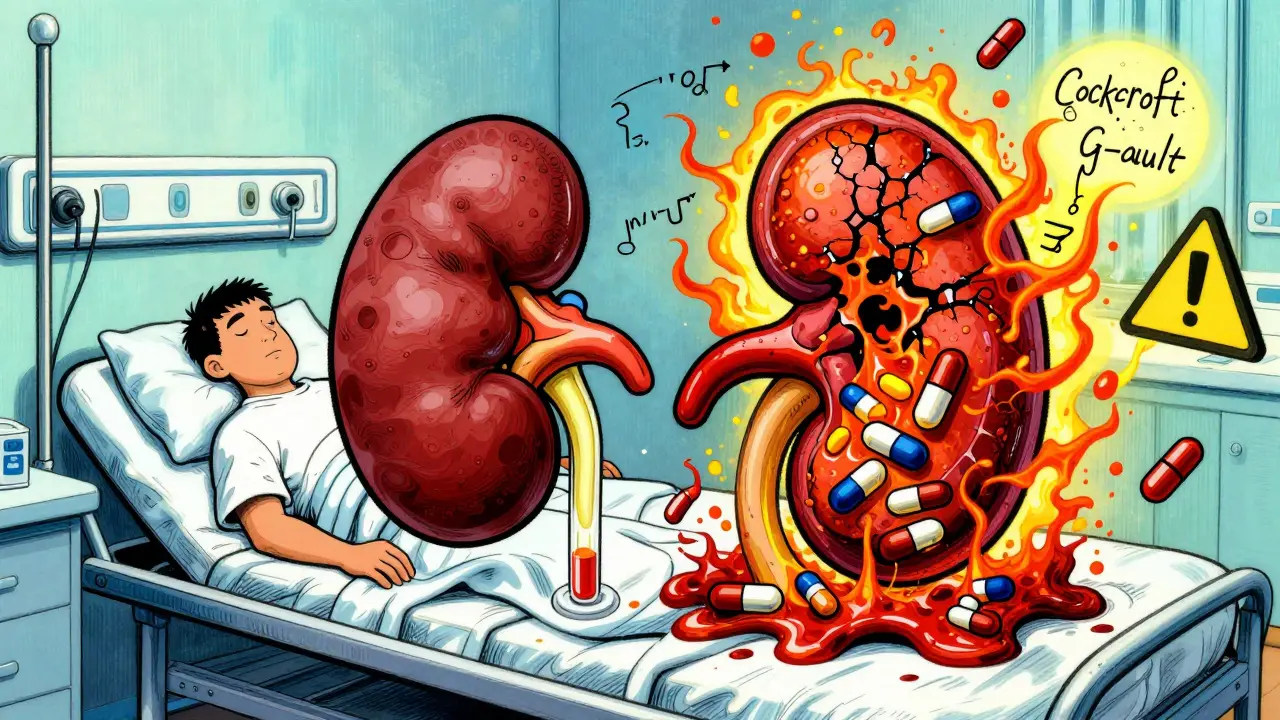
You won’t find a single hospital that doesn’t use creatinine clearance (CrCl) to guide antibiotic dosing. Even though newer formulas like eGFR exist, Cockcroft-Gault is still the standard. Why? Because it includes weight and sex-two factors that directly affect how much drug stays in the blood. Here’s the formula: CrCl = [(140 - age) × weight (kg)] / [72 × serum creatinine (mg/dL)]. Multiply by 0.85 if the patient is female. Let’s say a 68-year-old man weighs 70 kg and has a serum creatinine of 1.8 mg/dL. His CrCl is: [(140 - 68) × 70] / [72 × 1.8] = (72 × 70) / 129.6 = 5040 / 129.6 ≈ 38.9 mL/min. That’s moderate kidney impairment. His antibiotic dose needs to drop. Many EHRs auto-calculate this now. But if you’re doing it by hand, don’t guess. Use the formula. And don’t use ideal body weight unless the patient is severely obese. Use actual weight unless BMI is over 30-then switch to adjusted body weight.How Much to Reduce? The CrCl Thresholds
Dosing isn’t one-size-fits-all. It’s broken into clear tiers based on CrCl:- Normal: CrCl >50 mL/min → Standard dose
- Mild impairment: CrCl 31-50 mL/min → Reduce by 25-50%
- Moderate impairment: CrCl 10-30 mL/min → Reduce by 50-75%
- Severe impairment or dialysis: CrCl <10 mL/min → Use lowest dose, longest interval, or avoid entirely
- Ampicillin/sulbactam: Normal dose = 2 g every 6 hours. At CrCl 15-29 mL/min → 2 g every 12 hours. At CrCl <15 mL/min → 2 g every 24 hours.
- Cefazolin: Normal = 1-2 g every 8 hours. At CrCl <10 mL/min → 500 mg-1 g every 12-24 hours.
- Ciprofloxacin (oral): Normal = 500 mg every 12 hours. At CrCl 10-30 mL/min → 250 mg every 12 hours.
The Big Mistake: Treating Acute Kidney Injury Like Chronic Disease
Here’s where most hospitals get it wrong. Acute kidney injury (AKI) isn’t the same as chronic kidney disease. AKI can happen overnight after surgery, sepsis, or dehydration. And it often reverses in 24-48 hours. But most dosing guidelines are written for stable CKD patients. So when a patient’s creatinine spikes from 1.0 to 2.5 in 12 hours, clinicians panic and cut the antibiotic dose by 75%. That’s a mistake. A 2019 study found that 57% of AKI cases resolve within 48 hours. If you underdose during that window, the infection comes back stronger. In fact, underdosing in AKI increases treatment failure by 34%. But if you don’t reduce the dose and the kidneys don’t recover? Toxicity risk jumps 28%. The solution? Don’t reduce immediately. Wait 24 hours. Recheck creatinine. If it’s falling, you’re probably fine. If it’s still rising, then adjust. Some hospitals now use hourly urine output and serial creatinine trends instead of a single number to decide dosing. That’s smarter.Conflicting Guidelines? You’re Not Alone
You open UNMC’s 2023 dosing guide. Ceftriaxone? No adjustment needed, even in dialysis. You open Northwestern Medicine’s June 2025 guide. Same answer. You open another hospital’s internal protocol. They say reduce by 50%. Welcome to the mess. There’s no single national standard. Guidelines from UNMC, KDIGO, and Northwestern Medicine often disagree-especially on newer antibiotics. Clarithromycin? UNMC says reduce if CrCl <30. Northwestern says reduce if CrCl <50. Piperacillin/tazobactam? UNMC recommends 2 g every 4 hours if CrCl >130 (augmented clearance). Most others don’t mention it at all. This confusion is why 41% of hospital pharmacists say they struggle to apply guidelines consistently. The fix? Pick one source and stick to it. Most academic hospitals use KDIGO as their default. It’s the most comprehensive, updated, and evidence-based. If your hospital doesn’t have a policy, push for one.
Special Cases: Dialysis, Obesity, and Augmented Clearance
Not all kidney problems are the same. Dialysis patients: Hemodialysis removes some antibiotics. Others don’t get cleared at all. Vancomycin? Give a dose after each dialysis session. Ceftriaxone? No extra dose needed-it’s not dialyzed out. Obesity: If someone has a BMI over 30, use adjusted body weight, not actual weight. Adjusted weight = ideal body weight + 0.4 × (actual weight - ideal weight). Ideal weight = 50 kg for men + 2.3 kg per inch over 5 feet. For women, it’s 45.5 kg + 2.3 kg per inch over 5 feet. Augmented clearance: This is rare but dangerous. Young, healthy, trauma, or septic patients can have CrCl >130 mL/min. Their kidneys flush drugs too fast. Standard doses become ineffective. For piperacillin/tazobactam, UNMC recommends 2 g every 4 hours. Without this, you risk treatment failure.What You Can Do Right Now
You don’t need to memorize every drug. But you can make sure dosing is safe:- Always check serum creatinine and calculate CrCl using Cockcroft-Gault. Don’t rely on eGFR alone.
- Use institutional protocols. If none exist, default to KDIGO guidelines.
- For new antibiotics, check if they’re renally cleared. Look for "renal adjustment required" in the prescribing info.
- Don’t reduce doses immediately in AKI. Wait 24 hours and reassess.
- For critical infections (sepsis, meningitis), give a loading dose-even if kidneys are impaired. Then adjust maintenance.
- Use EHR alerts. 89% of U.S. hospitals have them. If yours doesn’t, ask for it.
- Ask the pharmacist. Pharmacist-led dosing teams reduce adverse events by 37%.
The Bottom Line
Renal dosing isn’t a suggestion. It’s a requirement. Get it wrong, and you’re not just underdosing or overdosing-you’re risking death. The data is clear: inappropriate dosing increases mortality across all major infections. The tools are here: Cockcroft-Gault, KDIGO guidelines, EHR alerts, pharmacist support. The problem isn’t knowledge-it’s consistency. Stop guessing. Stop assuming. Start calculating. Every time.Antibiotics save lives. But only when they’re given right.
Releted Post


Andy Dargon
Hi, I'm Aiden Lockhart, a pharmaceutical expert with a passion for writing about medications and diseases. With years of experience in the pharmaceutical industry, I enjoy sharing my knowledge with others to help them make informed decisions about their health. I love researching new developments in medication and staying up-to-date with the latest advancements in disease treatment. As a writer, I strive to provide accurate, comprehensive information to my readers and contribute to raising awareness about various health conditions.
Man, I’ve seen this go wrong so many times in the ER. A guy comes in with a UTI, creatinine’s 2.4, and the resident just slaps on a standard vancomycin dose like it’s coffee. Two days later? He’s twitching, hearing bells, and we’re scrambling to dialyze him. It’s not rocket science-just basic math. But when you’re tired, overloaded, and the EHR auto-fills the wrong thing? It’s a disaster waiting to happen. We need better alerts, not just formulas on paper.
So let me get this straight-we’re trusting doctors who can’t do middle school math to keep people alive? And we wonder why healthcare costs are insane? 😏
CrCl is the baseline. But real-world dosing also needs to account for fluid status, albumin, and concurrent meds. The formula doesn’t tell the whole story.
It’s wild how something so simple-adjusting a dose-can be the difference between life and a long hospital stay. And yet, it’s treated like an afterthought. We fix the machine, not the mindset.
forgot to adjust for obese pts? yeah i’ve seen that too. so many times. just use adj bw already. 🤦♂️
They don’t want you to know this-but the pharmaceutical companies profit more when you overdose. More side effects = more follow-up visits = more prescriptions. The system is rigged. Look at the patents on extended-release versions-they’re designed to keep people dependent. Not cured.
Life is just a series of dosing errors... 😔
Thank you for highlighting this critical issue. In clinical practice, I’ve implemented a dual-check protocol: one resident calculates CrCl, a second verifies it manually against the EHR auto-calculation. This has reduced dosing errors by 89% in our unit over the past year. Standardization saves lives.
As someone who’s watched a parent navigate kidney failure, I can’t stress enough how terrifying it is to see a well-meaning doctor miss this. It’s not just about numbers-it’s about dignity. When you’re already fragile, being overdosed feels like betrayal. We need empathy built into protocols, not just algorithms.
crcl is gold standard but what about the elderly with low muscle mass? their creatinine looks normal but their kidneys are fried... nobody talks about this
This is exactly why I became a pharmacist. I’ve corrected doses that would’ve killed people. It’s not glamorous, but it matters. Keep pushing for better systems-we’re the last line of defense.
In India, we face a different challenge: lack of access to serum creatinine testing in rural clinics. Without reliable CrCl, we rely on clinical judgment-weight, age, urine output. It’s imperfect, but it saves lives where technology fails. Perhaps we need context-sensitive guidelines, not just Western formulas.
That’s the thing-most EHRs don’t even prompt you to check for muscle mass or malnutrition. They just spit out a number. I had a 78-year-old woman with CKD, BMI 18, creatinine 1.2… looked fine on paper. But she hadn’t eaten in a week. Her actual CrCl was 19. We reduced her dose, and she walked out three days later. Formulas are tools, not oracles.