

Getting the right dose of levothyroxine isn’t enough. If you take it at the wrong time, or with the wrong food, your body might absorb barely half of what you paid for. That’s not speculation-it’s science. Studies show up to 40% less absorption when levothyroxine is taken with breakfast, coffee, or calcium supplements. For millions of Americans managing hypothyroidism, this small mistake can mean weeks of fatigue, brain fog, or unexplained weight gain-all because the medication wasn’t absorbed properly.
Why Timing Matters More Than You Think
Levothyroxine is a synthetic version of T4, the main hormone your thyroid makes. Your body converts it into T3, the active form that powers your metabolism, heart, brain, and muscles. But here’s the catch: levothyroxine doesn’t absorb well unless your stomach is completely empty. It needs an acidic environment (pH below 3.5) to dissolve and enter your bloodstream. Food, drinks, and even some medications change that pH, blocking absorption.
According to the American Thyroid Association, only 60% to 80% of a dose gets absorbed when taken on an empty stomach. That number can drop to 40% or lower if you take it with food. And since your TSH target is usually between 0.4 and 4.0 mIU/L-even tighter if you’ve had thyroid cancer-small drops in absorption can push your levels out of range. A 2021 study in Thyroid found patients who took their pill with breakfast had TSH levels 1.0 point higher on average than those who waited 60 minutes. That’s enough to trigger a dose adjustment.
The Gold Standard: Morning Fasting
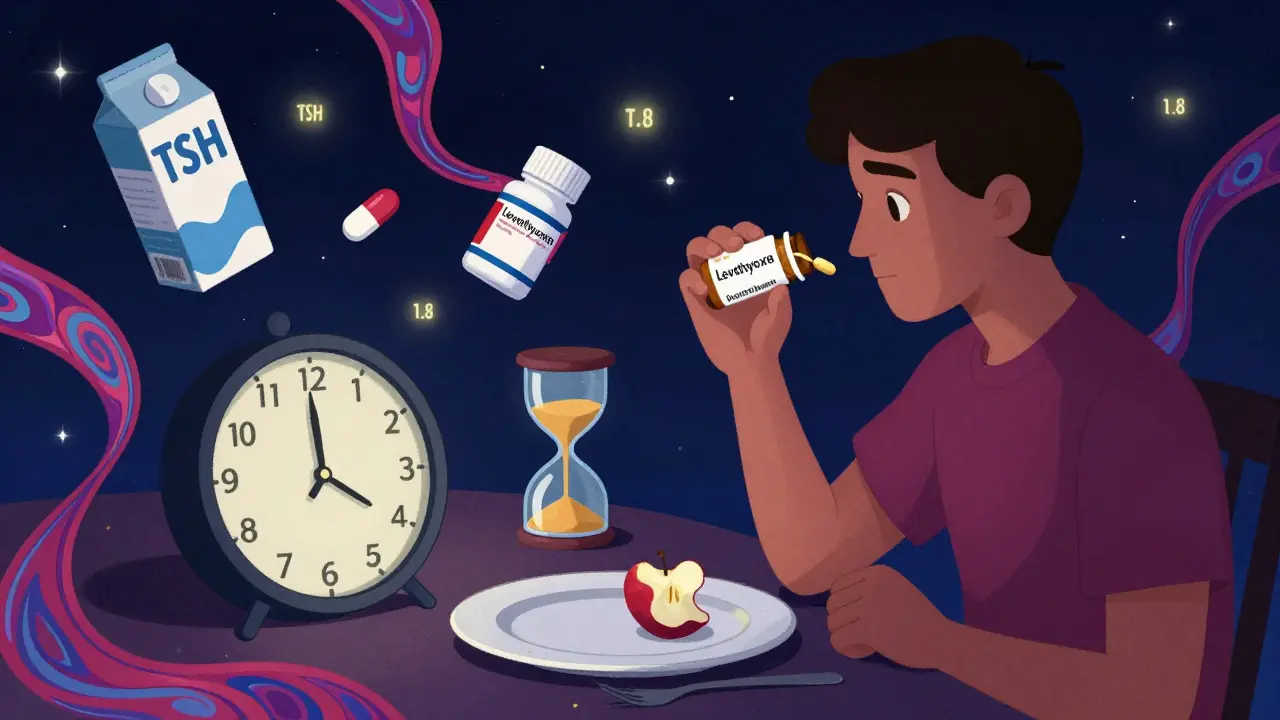
The most proven method is taking levothyroxine 30 to 60 minutes before breakfast. This gives your stomach time to return to its natural acidic state after overnight fasting. It’s simple: wake up, take the pill with a full glass of water, then wait. No coffee. No toast. No yogurt. Just water.
Why water? Because other liquids interfere. Coffee reduces absorption by 9% to 14%, according to a 2020 meta-analysis in the Journal of Clinical Endocrinology & Metabolism. Even decaf has the same effect. Soy milk? That’s a no-go too-it cuts absorption by 20% to 30%. Same with high-fiber cereals or bran muffins. These aren’t myths. These are lab-tested facts.
Endocrinologists overwhelmingly stick with this method. A 2023 survey of U.S. doctors showed 87% still recommend morning fasting. The FDA’s labeling for Synthroid, Levoxyl, and other brands all say: “Take one-half to one hour before breakfast.” The Mayo Clinic, the American Thyroid Association, and Johns Hopkins all echo the same advice.
Bedtime Dosing: A Viable Alternative?
But what if you can’t wait an hour before breakfast? What if you’re a shift worker, a parent rushing kids to school, or someone who gets stomach cramps on an empty stomach? There’s another option: bedtime.
Some studies show better absorption at night. A 2010 study by Dr. Leonardo Bartalena found patients taking levothyroxine at bedtime had 27% higher T4 levels and 34% lower TSH than those taking it in the morning. Why? Because your stomach is naturally more acidic after a full day without food. No breakfast rush. No coffee. No interference.
But it’s not that simple. Other studies, like one from 2011 by Bach-Huynh, found the opposite-TSH levels went up with nighttime dosing. The confusion comes from inconsistent fasting. If you eat dinner at 7 p.m. and take your pill at 10 p.m., that’s only 3 hours. You need at least 3 to 4 hours after your last meal. And if you take a midnight snack? You’ve ruined it.
The latest data, including a 2022 trial with 150 patients, shows that when done correctly, bedtime dosing works just as well as morning dosing. The American Thyroid Association updated its 2023 guidelines to say: “Bedtime administration may be considered for patients unable to consistently fast before breakfast.” That’s a big shift. But it’s not a free pass. You still need to avoid calcium, iron, and antacids for 4 hours before and after.
What You Must Avoid
It’s not just food. A lot of common supplements and medications block levothyroxine. Here’s the short list of absolute no-gos within 4 hours of taking your pill:
- Calcium supplements - reduce absorption by 27% to 36%
- Iron pills - drop absorption by 39% to 59%
- Proton pump inhibitors (like omeprazole) - cut absorption by 15% to 22%
- Soy products - reduce absorption by 20% to 30%
- High-fiber meals - lower absorption by 15% to 25%
- Coffee - 9% to 14% reduction, even decaf
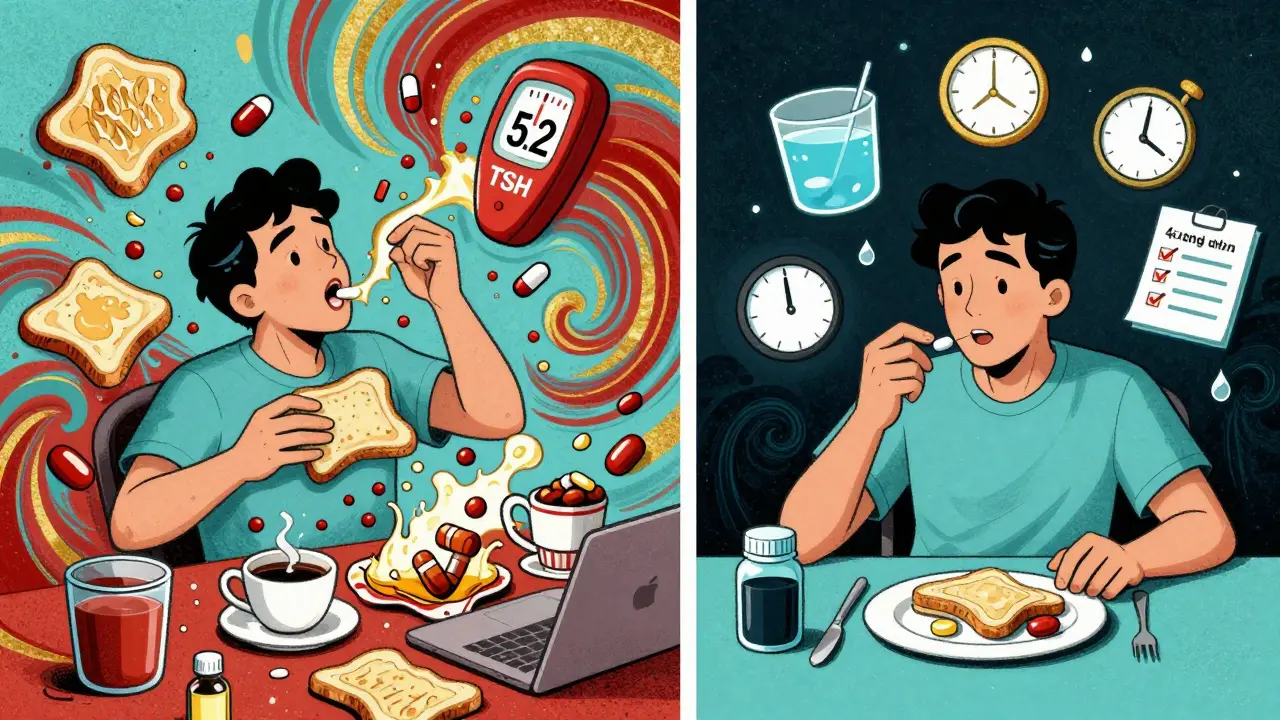
These aren’t suggestions. They’re deal-breakers. One patient on Reddit reported her TSH jumped from 1.8 to 5.2 after taking her pill with coffee. She spent three months feeling awful and had to increase her dose. That’s avoidable.
Even multivitamins can be a problem. Many contain iron or calcium. If you take one, do it at lunch or dinner-not morning or night with your thyroid med.
Form Matters: Tablets vs. Capsules
Not all levothyroxine is the same. Most people take tablets. But there’s also a liquid-filled softgel capsule called Tirosint. It’s more expensive-3 to 5 times the cost of generic-but it’s less affected by food. Studies show it only loses 8% to 12% absorption when taken with breakfast, compared to 20% to 30% for tablets.
Why? The liquid formulation bypasses the need for stomach acid to dissolve the pill. If you’ve struggled with timing, or you take multiple medications that interfere, Tirosint might be worth discussing with your doctor. It’s not a magic fix, but it gives you more flexibility.
Also, stick to one brand. Generic levothyroxine is bioequivalent, but the FDA’s 2022 update on bioequivalence standards shows that even small formulation changes between manufacturers can cause TSH shifts. If you switch brands, get your TSH checked in 6 to 8 weeks.
Real-Life Tips That Actually Work
Knowing what to do is one thing. Doing it every day is another. Here’s what patients who’ve mastered their timing actually do:
- Keep your pill next to your toothbrush. That’s the #1 tip from endocrinologists. When you brush your teeth, you take your pill. No thinking. No forgetting.
- Set two alarms. One for medication. One for breakfast. Even if you’re not hungry, wait the full 30 to 60 minutes. Your body needs that window.
- Use a pill organizer labeled “NO FOOD FOR 60 MIN.” Many thyroid support groups recommend this. Visual reminders stick.
- Track your doses. Apps like MyThyroidMedication show users improve adherence by 34%. You can’t fix what you don’t measure.
- Write down your routine. If you switch from morning to bedtime, tell your doctor. Keep a log of when you take it and when you eat. It helps spot patterns.
One patient, ‘ThyroidWarrior42,’ switched to bedtime dosing after 3 years of fluctuating TSH levels. Her doctor was skeptical. Her labs proved it worked. She now takes it at 10 p.m., after her last meal at 6 p.m. No coffee. No calcium. No issues.
What If You Forget?
Missed a dose? Don’t panic. Levothyroxine has a half-life of about 7 days. That means your body holds onto it for a while. If you remember within a few hours of your usual time, take it then. If it’s already lunchtime, skip it. Don’t double up the next day. That can spike your heart rate or cause anxiety.
Consistency matters more than perfection. If you take it at 7 a.m. one day and 9 p.m. the next, your TSH will wobble. Pick a time-morning or night-and stick to it. Even if you’re traveling or on vacation. Your body craves routine.
When to Get Your TSH Checked
If you’ve just started levothyroxine, or changed your timing, get your TSH tested in 6 to 8 weeks. That’s how long it takes for levels to stabilize. If you’ve been stable for over a year and changed nothing, once a year is fine. But if you’ve changed your dose, added a new medication, started or stopped PPIs, or switched brands-get tested sooner.
And if you’re a thyroid cancer survivor? Your target TSH is much lower-0.1 to 0.5 mIU/L. Missing a dose or taking it with food isn’t just inconvenient. It’s risky. For you, timing isn’t optional. It’s critical.
Bottom Line: Do This Every Day
Here’s your simple checklist:
- Take levothyroxine first thing in the morning, 30 to 60 minutes before eating.
- Use only water. No coffee, juice, or milk.
- Avoid calcium, iron, soy, fiber, and PPIs for at least 4 hours before and after.
- If you can’t do morning, try bedtime-3 to 4 hours after your last meal.
- Stick to one brand. Don’t switch generics without checking your TSH.
- Track your doses. Use an app or a calendar.
- Get your TSH tested after any change.
You don’t need to be perfect. But you do need to be consistent. Because when your thyroid hormone levels are steady, your energy, mood, and health follow.
Can I take levothyroxine with water and then eat right away?
No. Even if you take it with water, eating immediately after still interferes with absorption. You need to wait 30 to 60 minutes after taking the pill before eating anything. Your stomach needs time to absorb the hormone before food changes the environment.
Is it okay to take levothyroxine at night if I eat dinner late?
Yes, as long as you wait 3 to 4 hours after your last meal. If you eat dinner at 8 p.m., taking your pill at 11 p.m. is fine. But if you eat at 10 p.m. and take your pill at 11 p.m., you’re too close to food. That’s when absorption drops.
Why does coffee affect levothyroxine even if I drink it black?
Coffee-whether black, decaf, or with cream-changes stomach acidity and speeds up gut movement. Both reduce how much levothyroxine your body absorbs. Studies show a 9% to 14% drop in absorption, which is enough to cause TSH fluctuations over time. Wait at least 60 minutes after taking your pill before drinking coffee.
Can I switch from morning to bedtime dosing on my own?
You can try it, but you should tell your doctor first. Switching timing can change your TSH levels, even if you’re doing everything right. Get your TSH tested 6 to 8 weeks after the switch to make sure you’re still in range. Don’t assume it’s working just because you feel better.
Do I need to take levothyroxine at the exact same time every day?
Yes. Because levothyroxine has a long half-life, small timing changes won’t cause immediate problems. But over weeks and months, inconsistent timing leads to TSH fluctuations. That’s why doctors recommend the same time every day-even on weekends. Pick morning or night and stick with it.
What if I take my pill and then realize I forgot to take my calcium?
If you took calcium within 4 hours of your levothyroxine, it likely reduced absorption. Don’t take another dose. Just wait until tomorrow and space them out. Take calcium at lunch or dinner, at least 4 hours after your thyroid med. If this happens often, consider switching to a multivitamin without calcium or iron.
Releted Post


Andy Dargon
Hi, I'm Aiden Lockhart, a pharmaceutical expert with a passion for writing about medications and diseases. With years of experience in the pharmaceutical industry, I enjoy sharing my knowledge with others to help them make informed decisions about their health. I love researching new developments in medication and staying up-to-date with the latest advancements in disease treatment. As a writer, I strive to provide accurate, comprehensive information to my readers and contribute to raising awareness about various health conditions.
Just took my pill with water at 6:30 a.m. and didn’t eat until 8 - felt like a new person this week. Consistency is everything.
Everyone says morning but nobody talks about how impossible this is if you work night shifts or have kids who wake up at 5 a.m. I’ve been taking mine at 11 p.m. for two years and my TSH is rock steady at 1.2. The rules are made by people who don’t live real lives.
Let’s be real - the FDA and endocrinologists are just repeating dogma. The real reason morning dosing is pushed is because it’s easier to study in controlled trials. Real humans don’t live by alarm clocks and fasting windows. The science is oversimplified to the point of being misleading.
My TSH didn’t budge when I started taking it with my morning coffee. Maybe absorption rates are overstated? Or maybe your body adapts? They never test long-term adaptation in clinical studies.
And don’t get me started on Tirosint. It’s a cash grab. The brand-name companies know people are desperate, so they charge $500/month for a pill that’s chemically identical to the $4 generic.
I’m from Iran and we’ve had thyroid patients take levothyroxine at bedtime for decades - no one here even thinks about morning dosing unless they’re following American guidelines. Our doctors say what matters is consistency and avoiding calcium/iron. The rest is noise.
My cousin in California switched from morning to night after reading this post - her TSH dropped from 5.1 to 1.9 in six weeks. She never changed her dose. Just timing.
Maybe the real issue isn’t the pill - it’s the cultural obsession with rigid routines. Humans adapt. Biology adapts too.
Thank you for writing this. I was so frustrated with my fatigue and brain fog - thought it was depression. Then I realized I was taking my pill with my oatmeal and almond milk. One week of water-only, 60-minute wait - and I could actually think again. No magic, just science.
Also, I keep my pill next to my toothbrush. It’s dumb but it works. I don’t think about it. I just do it.
I appreciate the depth of this post. I’ve been on levothyroxine for 12 years and only recently learned about the coffee interaction. I was taking it at 7 a.m. and drinking coffee at 7:15. My TSH was hovering around 4.5. After switching to 6 a.m. with water and waiting until 7:30 for coffee, my TSH dropped to 1.8 in six weeks. Simple changes, profound results.
I also switched from a generic brand to Synthroid after a doctor’s recommendation - my TSH stabilized immediately. I was skeptical about brand differences, but the data is clear.
My grandfather in India took ashwagandha with his thyroid med. Said it helped his energy. He lived to 92. Maybe the real issue isn’t the coffee - it’s that we’ve forgotten how to listen to our bodies.
Western medicine treats thyroid like a dial you turn. But the body isn’t a machine. It’s a rhythm. Maybe we need to align with nature, not fight it with alarms and timers.
Have you ever wondered why the pharmaceutical industry pushes the ‘morning fasting’ myth? Because if people knew bedtime dosing worked just as well - and didn’t require them to wake up early - they’d stop buying expensive coffee makers, breakfast foods, and ‘thyroid-friendly’ meal plans. This is a multi-billion dollar industry built on keeping you anxious and dependent.
They don’t want you to know that your body can absorb levothyroxine just fine at night. They want you to believe you need to be perfect. That’s control. That’s profit.
And don’t get me started on Tirosint. That’s not medicine - it’s a luxury product designed to make you feel guilty for not being able to afford it. Meanwhile, your doctor gets kickbacks from the reps.
Wake up. This isn’t science. It’s marketing.
bro i took mine with my morning latte for 3 years and i’m fine 😅 maybe my body just does its own thing 🤷♂️✌️
The entire paradigm of thyroid management is a Western reductionist fantasy. You treat the hormone as a discrete chemical input, ignoring the systemic interplay of circadian biology, gut microbiota, and adrenal function. The pill is not the solution - it’s a bandage on a ruptured system.
Why are we so obsessed with optimizing absorption when the root cause of hypothyroidism is often autoimmunity, stress, or environmental toxins? We’ve turned a complex endocrine disorder into a pharmacological choreography.
And yet, you’ll find no study on how cortisol rhythms affect T4-to-T3 conversion in patients who take levothyroxine at 6 a.m. versus 10 p.m. Why? Because the industry doesn’t fund research that undermines the pill-as-solution narrative.
The real ‘gold standard’ is not timing - it’s healing the terrain. But that doesn’t sell.
So yes, take your pill with water. But don’t mistake compliance for cure. Your thyroid isn’t broken - your life is.
I switched to bedtime dosing after having a baby and I swear, it’s the only thing that made me feel human again. No more rushing. No more coffee guilt. Just me, my pill, and 10 p.m. silence. 🌙
The evidence supporting morning fasting is robust, reproducible, and endorsed by multiple international societies. Deviations from this protocol should be undertaken only under clinical supervision and with documented laboratory follow-up.
I’ve been thinking about this a lot - not just the timing, but the emotional weight of it. People with thyroid issues aren’t just managing a hormone. They’re managing shame. Shame for forgetting. Shame for not being ‘well enough.’ Shame for needing a pill to feel normal.
That’s why the rigid rules feel so cruel. Because they turn a medical necessity into a moral test. ‘Did you wait 60 minutes? Did you skip coffee? Did you buy the expensive brand?’
What if the real treatment isn’t the pill - but the permission to be imperfect? To take it at 8 a.m. when you’re running late. To skip it once when you’re traveling. To forgive yourself when your TSH wobbles.
Consistency matters. But so does compassion. The body doesn’t care about your alarm clock. It cares about your peace.
I stopped tracking every dose. I started trusting myself. My TSH hasn’t changed. But my life has.