
The Pharmaceutical Benefits Scheme (PBS) is the backbone of Australia’s medicine access system. It’s not just a subsidy program-it’s what keeps millions of Australians from choosing between paying for insulin or groceries. Since 1948, the PBS has ensured that essential medicines are affordable, no matter your income. Today, it covers over 5,400 prescription drugs, and 87% of all prescriptions in Australia are subsidized through it. But behind the numbers is a complex, high-stakes system that shapes how generics enter the market, who gets access, and how much you pay at the pharmacy counter.
How the PBS Actually Works
The PBS doesn’t give you free medicine. It lowers the price. For most people, you pay a co-payment-$31.60 for general patients and $7.70 for concession card holders as of mid-2024. The government picks up the rest. That’s about 90% of the cost. But here’s the twist: the government doesn’t just accept whatever price the drugmaker asks for. It negotiates. Hard.
The Pharmaceutical Benefits Pricing Authority (PBPA) sits down with drug companies and says, “This is what we’re willing to pay.” If they don’t agree, the medicine doesn’t get listed. That’s why Australia’s drug prices are 30-40% lower than in the U.S., but still 15-20% higher than the UK’s NHS. The PBPA uses a cost-per-QALY (quality-adjusted life year) benchmark of around $50,000. That means if a drug costs more than $50,000 to extend a year of healthy life, it’s unlikely to be approved-unless it’s for a rare disease.
That’s where the Highly Specialised Drugs Program (HSDP) comes in. It’s a safety net for ultra-rare conditions. But it’s strict. To qualify, a drug must meet eight criteria, including life expectancy impact and cost-effectiveness. Many breakthrough treatments for orphan diseases get stuck here. Patients wait years. Some never get access.
The Rise of Generic Medicines in Australia
Generic drugs are the quiet heroes of the PBS. They make up 84% of all prescriptions by volume-but only 22% of the total cost. Why? Because they’re cheap. Once a brand-name drug’s patent expires, multiple generic versions flood the market. The PBS pushes this through its Reference Pricing System. It groups similar drugs into “price disclosure groups.” The government only pays the price of the cheapest one. So if you’re prescribed a brand-name statin, and a generic version exists, the pharmacist will give you the cheaper one unless your doctor says otherwise.
This system has been brutal for drugmakers-but great for patients. Within 12 months of a generic entering the market, prices drop by 62% on average. In cardiovascular drugs, the drop is even steeper-74%. That’s why statins like atorvastatin are now dirt cheap on the PBS. You can get a month’s supply for less than $5. But not all drug classes follow the same pattern. Biologics? Those are trickier. Complex to copy. Hard to substitute. Only 63% of biologic prescriptions are filled with generics, even after patents expire.
The top five generic manufacturers-Symbion, Sigma, Mylan, Aspen, and Hospira-control nearly 70% of the market. They’ve built their businesses around the PBS rules. They know exactly how the pricing triggers work. After six months, the reference price drops to 60% of the original. After a year, it’s 43%. So timing matters. Companies rush to launch generics the moment a patent expires. The first one often gets a big market share. The others fight over the rest.
Who Pays What-and Who Gets Left Behind
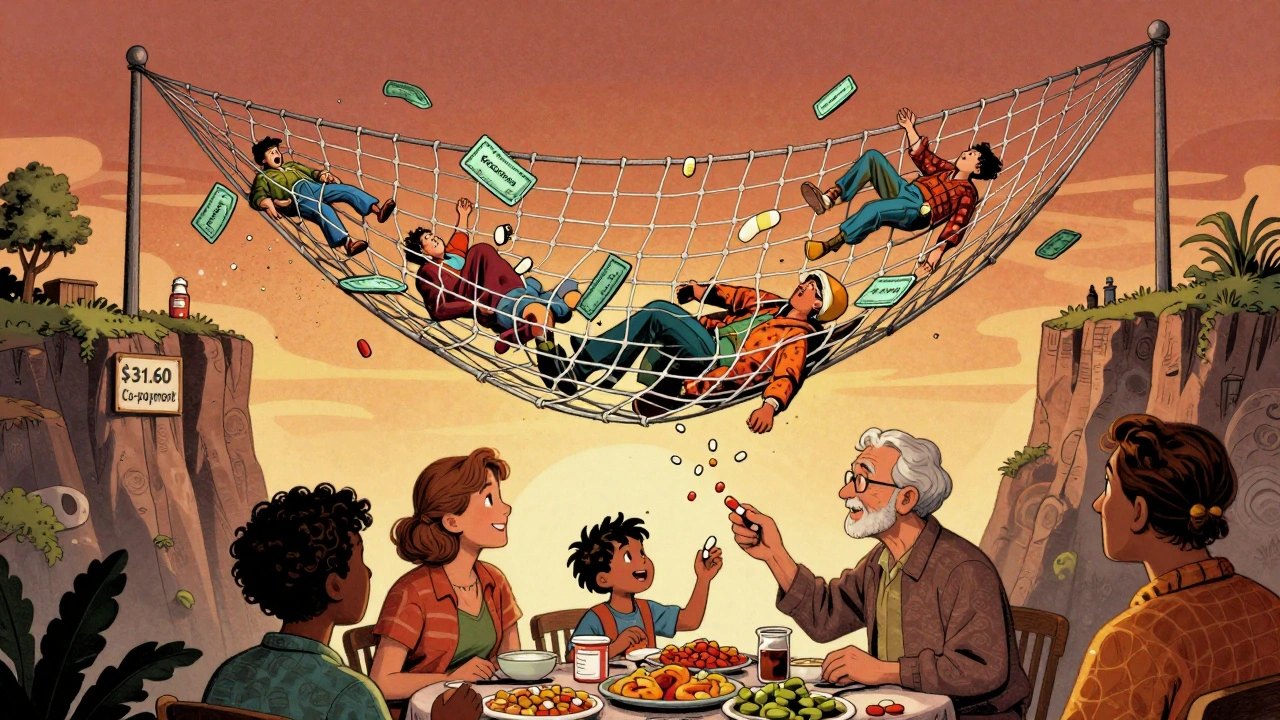
The PBS safety net is one of its strongest features. Once you spend $1,571.70 on PBS medicines in a year, your co-payment drops to $7.70 for concession holders and $31.60 for everyone else. That’s a lifeline for people with chronic illnesses. One person on Reddit, ‘MedicareWarrior,’ said they pay $158 a month for five medications. That’s $1,896 a year. Without the safety net, they’d be stuck paying full price. With it, they’re protected.
But here’s the problem: not everyone hits the safety net. Many people skip doses because they can’t afford even the $31.60 co-payment. The Australian Bureau of Statistics found that 12.3% of general patients-roughly 1.8 million people-have skipped or delayed filling prescriptions due to cost. That’s not just inconvenience. That’s dangerous. For diabetics, skipping insulin can mean hospitalization. For heart patients, missing blood pressure meds can mean a stroke.
Low-income households are hit hardest. The Australian Council of Social Service found that 28% of families managing multiple chronic conditions cut back on food to afford medicines. One in five admit to skipping doses. The PBS is designed to be fair. But reality doesn’t always match the design.
Delays, Bureaucracy, and the PBS Black Hole
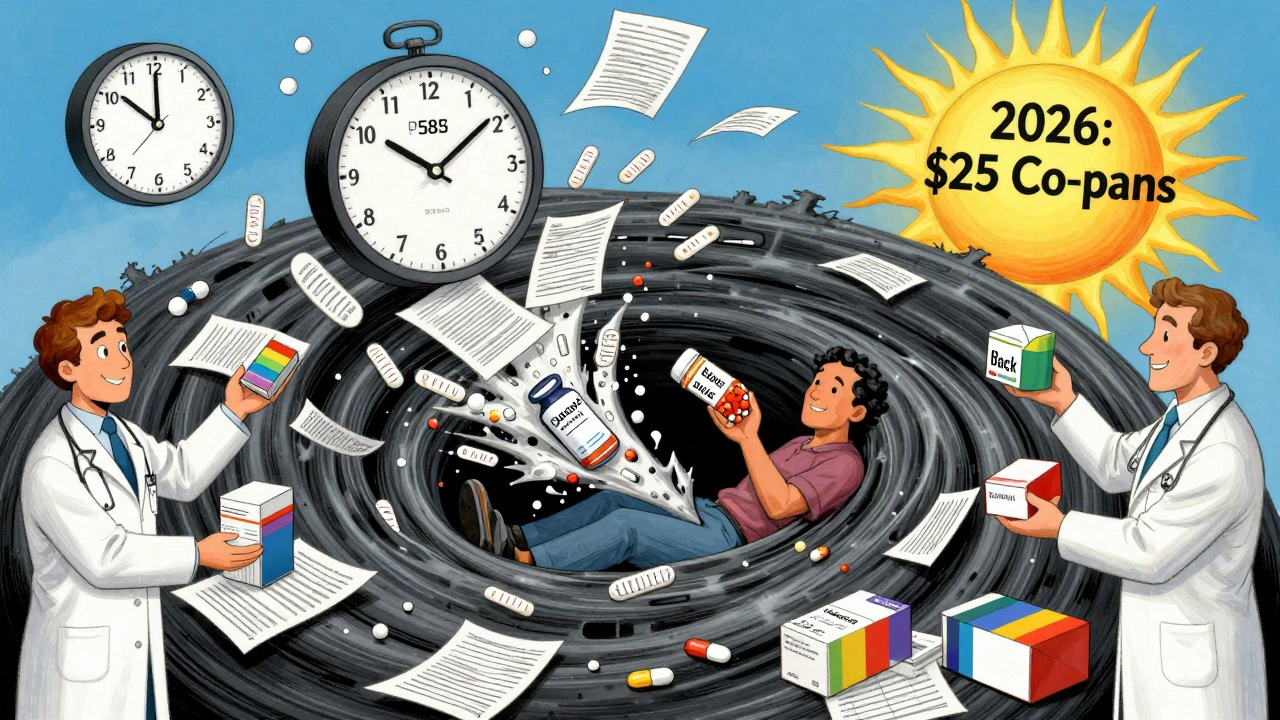
Even when a drug is approved by the Therapeutic Goods Administration (TGA)-Australia’s regulator for safety and quality-it doesn’t mean you can get it on the PBS. There’s a gap. A long one. On average, it takes 14.2 months for a newly approved drug to be listed on the PBS. That’s called the “PBS black hole.”
During that time, patients pay full price. For a new cancer drug, that can mean $1,850 out of pocket per month. That’s not just expensive-it’s life-threatening. KPMG found the median time from global launch to PBS listing is 587 days. In Germany, it’s 320 days. In Canada, 410. Australia is slow. Why? The PBAC review process is thorough, but it’s also overloaded. The committee meets monthly. Applications pile up. The system isn’t broken-it’s clogged.
Prescribers feel it too. Nearly half of GPs say authority-required prescriptions are a nightmare. These are drugs that need special approval before they can be subsidized. The process can take days. Paper forms? Seven business days. Online? Still 1.8 days. That’s time lost. Time that patients don’t have.
What’s Changing in 2025 and Beyond
Change is coming. The National Health Amendment (Cheaper Medicines) Bill 2025 passed in May, and it’s a big deal. Starting January 1, 2026, the general patient co-payment drops from $31.60 to $25. That’s a $6.60 saving per script. For someone on five medications, that’s $33 a month-or $396 a year. Over four years, it’ll save patients nearly $800 million.
But there’s a trade-off. The government will spend an extra $689 million to cover the gap. That’s not free money. It comes from the budget. And with Australia’s population aging, PBS spending is projected to hit $18.7 billion by 2029-30. That’s up from $13.5 billion in 2022-23. The real challenge isn’t just affordability-it’s sustainability.
The HSDP is also getting a refresh. In November 2025, two of the eight criteria for rare disease drugs will be relaxed. That could open the door for more patients with ultra-rare conditions to get access. It’s a small change, but it’s meaningful.
Meanwhile, the government is adding 150,000 new patients to the PBS in 2025 alone by listing new drugs like Talazoparib for prostate cancer and Relugolix for endometriosis. These aren’t just new drugs-they’re new hopes.
What This Means for You
If you’re on PBS-subsidized meds, you’re getting one of the best deals in the world. Australia’s system is more efficient than the U.S., more accessible than Canada’s, and more affordable than most of Europe. But it’s not perfect. Delays, bureaucracy, and cost barriers still exist.
Know your rights. Use the PBS app. Check the website monthly for new listings. If you’re on multiple medications, track your spending. You might be close to the safety net. If you’re a self-funded retiree or on a low income, talk to your pharmacist or social worker. There are support programs you might not know about.
And if you’re a prescriber? Learn the PBS rules. The 40-hour training exists for a reason. A single misplaced code can delay a patient’s access for weeks.
The PBS isn’t just a policy. It’s a promise. A promise that no one in Australia should have to choose between health and survival. The system works-most of the time. But keeping it working means constant pressure, constant reform, and constant care.
What is the PBS co-payment for 2025?
As of July 2024, the general patient co-payment is $31.60, and the concession card holder co-payment is $7.70. These amounts are indexed annually to the Consumer Price Index. However, starting January 1, 2026, the general patient co-payment will drop to $25.00 under the National Health Amendment (Cheaper Medicines) Bill 2025. The concession co-payment will remain unchanged.
How does the PBS safety net work?
The PBS safety net protects people who spend a lot on prescription medicines in a calendar year. Once you reach $1,571.70 in out-of-pocket PBS costs in 2025, your co-payment drops to $7.70 for concession card holders and $31.60 for general patients for the rest of the year. This applies to all PBS-listed medicines, even if they’re not your regular prescriptions. You don’t need to apply-Services Australia tracks your spending automatically using your Medicare number.
Why are some medicines not covered by the PBS?
Not all medicines are listed on the PBS because they haven’t passed the cost-effectiveness review by the Pharmaceutical Benefits Advisory Committee (PBAC). The PBAC assesses whether a drug offers enough health benefit for the price. If the cost per quality-adjusted life year (QALY) is too high-or if there’s already a cheaper, equally effective alternative-it won’t be listed. Some drugs are also excluded because they’re considered lifestyle medications, like certain hair loss or cosmetic treatments.
Can I get generic versions of all PBS medicines?
Almost all off-patent medicines have generic versions listed on the PBS. For most drugs, pharmacists are required to dispense the generic unless the doctor writes “Do Not Substitute.” However, biologic medicines (like those for rheumatoid arthritis or cancer) are harder to copy, and substitution is limited due to regulatory and safety concerns. In those cases, generics are not yet available, or only a few have been approved.
How long does it take for a new drug to be listed on the PBS?
On average, it takes 14.2 months from when a drug is approved by the Therapeutic Goods Administration (TGA) to when it’s listed on the PBS. This delay is known as the “PBS black hole.” The full process from global launch to PBS listing averages 587 days-much longer than in countries like Germany or Canada. This delay forces patients to pay full price for months or even years.
Who is eligible for PBS subsidies?
All Australian citizens and permanent residents with a current Medicare card are eligible. International visitors from 11 countries with reciprocal health agreements are also covered: New Zealand, the UK, Ireland, Sweden, the Netherlands, Finland, Italy, Malta, Norway, Slovenia, and Belgium. You must present your Medicare card or equivalent at the pharmacy to receive the subsidy.
Releted Post

Andy Dargon
Hi, I'm Aiden Lockhart, a pharmaceutical expert with a passion for writing about medications and diseases. With years of experience in the pharmaceutical industry, I enjoy sharing my knowledge with others to help them make informed decisions about their health. I love researching new developments in medication and staying up-to-date with the latest advancements in disease treatment. As a writer, I strive to provide accurate, comprehensive information to my readers and contribute to raising awareness about various health conditions.
The PBS is one of those quiet miracles you don’t notice until it’s gone. I’ve seen people in my family skip meds because they’re scared of the cost-even with the subsidy. That $31.60 adds up fast when you’re on five scripts. Glad they’re lowering it to $25. Small win, but it matters.
Ugh I just got charged $42 for my blood pressure med last week and I thought the PBS was supposed to save me?? My pharmacist said it’s because the generic wasn’t in stock and they gave me the brand. That’s BS. You’d think they’d stock the cheap one first. Someone needs to fix this.
I’m from the Philippines and I moved here 3 years ago. Back home, my dad had to choose between insulin and rice. Here? I pay $7.70 and get it without a second thought. This system isn’t perfect, but it’s the closest thing to healthcare justice I’ve ever seen. Don’t let anyone tell you otherwise.
Oh wow so now we’re pretending the PBS is some socialist utopia? You know what happens when you cap prices too hard? Companies stop innovating. Next thing you know, Australia’s stuck with 1990s meds while the rest of the world moves on. The real problem isn’t cost-it’s that we’ve turned healthcare into a bureaucratic nightmare with no room for breakthroughs.
87% of prescriptions subsidized? Yeah right. My cousin got denied a cancer drug for 18 months because it cost $52K per QALY. That’s not a benchmark-it’s a death sentence written in spreadsheet form. The government doesn’t care if you live or die. They care if the math adds up.
Let’s not romanticize this system-it’s a beautifully engineered machine designed to crush innovation under the weight of bureaucratic pragmatism. The PBAC operates like a medieval council of monks deciding who deserves life based on cost-per-QALY, as if human existence can be reduced to a line item in a ledger. And yet, we praise it? We praise the very mechanism that delays life-saving drugs for over a year, while pharmaceutical companies in the U.S. make billions off the same molecules? The hypocrisy is staggering. Australia doesn’t have a healthcare system-it has a cost-control algorithm with a heart-shaped sticker on it.
It’s heartbreaking to think that 1.8 million people are skipping doses because they can’t afford $31.60. That’s not just a number-it’s someone’s mother who’s not taking her statins because she’s saving for her grandkid’s birthday. The safety net exists, but it’s invisible until you’re falling. And even then, the fall is long. We talk about access like it’s a policy problem, but it’s a moral one. The PBS works for most-but not for the ones who need it most. That’s the quiet crisis.
As a U.S. healthcare economist, I’ve studied this system for over a decade. The PBS is the most efficient publicly funded drug program in the developed world. The reference pricing model, the aggressive negotiation, the tiered generic rollout-it’s textbook optimal policy. The delays in PBAC listing? A function of volume, not incompetence. And the co-payment drop? Long overdue. The U.S. spends 18% of GDP on healthcare and still has 25% of patients rationing meds. Australia does it with 9%. Stop comparing apples to oranges.
Did you know the government secretly gives kickbacks to big generic manufacturers? My cousin works at a pharmacy and says they get bonuses for pushing certain brands-Mylan, Aspen, you know the ones. The 'cheaper meds' bill? Just a distraction. They’re locking in monopolies under the guise of savings. The real cost isn’t on the receipt-it’s in the silence. Watch how fast biologics get blocked again after 2026.
One sentence: The PBS is the last great social contract in Australia and if you think it’s broken, you’re just not paying attention to the people it saves every single day