
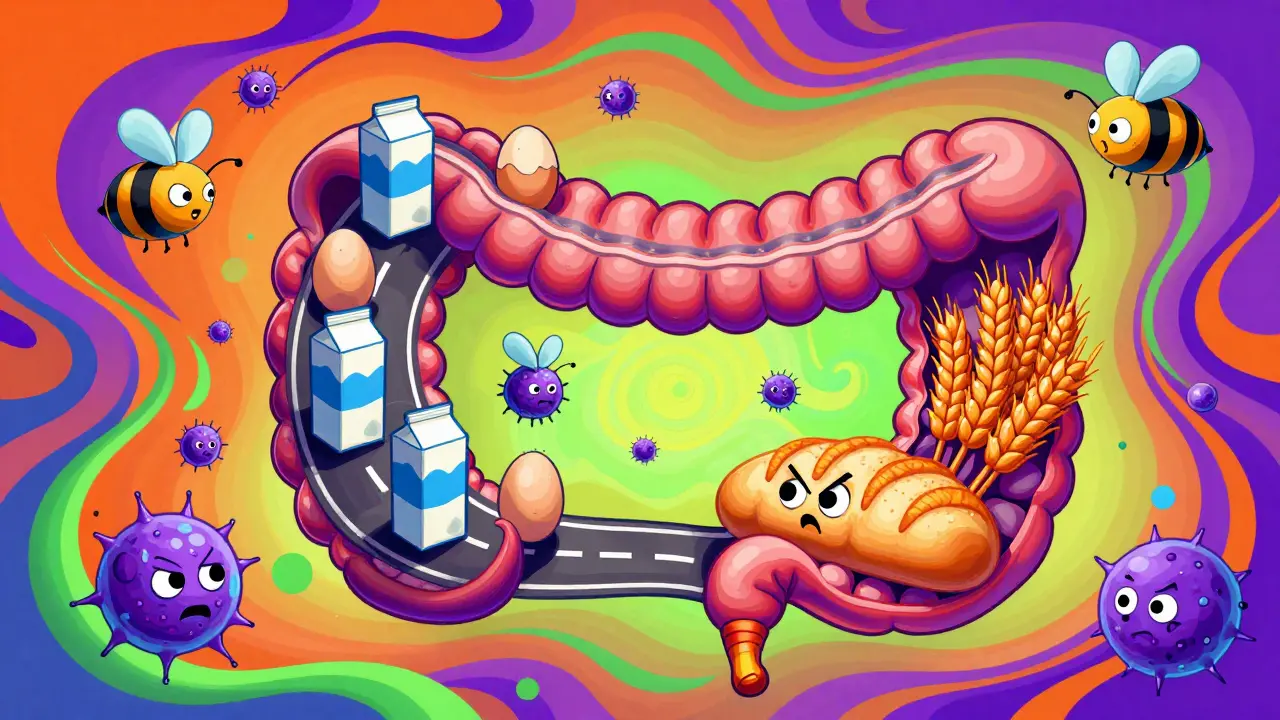
Eosinophilic esophagitis (EoE) isn’t just heartburn that won’t go away. It’s a silent, stubborn condition where your esophagus becomes lined with white blood cells called eosinophils-triggered by foods your body mistakenly sees as invaders. Swallowing becomes a chore. Food sticks. Pain follows. And if you’ve been told it’s just acid reflux, you’re not alone. Most people with EoE get misdiagnosed for years. But here’s what actually works: cutting out the right foods and using steroid slurries the right way.
What Exactly Is Eosinophilic Esophagitis?
EoE isn’t an allergy you feel in your nose or skin. It’s an allergy that lives in your throat. When you eat something your immune system doesn’t like-like milk, eggs, or wheat-your body sends eosinophils to the esophagus. These cells don’t just hang around. They cause swelling, scarring, and narrowing. Over time, your esophagus can turn into a stiff tube that doesn’t stretch. That’s why even soft foods like bread or chicken can get stuck.
It’s not rare. About 57 out of every 100,000 people in North America have it. That’s more than 160,000 people in the U.S. alone. And it’s growing. Doctors are diagnosing it more often because they’re finally looking for it. Before 2007, many thought it was just severe GERD. Now, we know it’s its own disease.
The Big Six: Most Common Food Triggers
Not all foods trigger EoE the same way. But six stand out-again and again-in study after study. These are the six-food elimination diet triggers:
- Milk
- Eggs
- Wheat
- Soy
- Fish and shellfish
- Nuts (including peanuts and tree nuts)
For years, doctors told patients to cut out all six at once. That’s tough. It means giving up pizza, cereal, yogurt, hummus, salmon, and almond butter. But a 2022 NIH study changed everything. They found that removing just milk worked just as well as removing all six-64% of adults went into remission with dairy elimination alone. That’s nearly the same as the 65% who cut out all six. For kids, the six-food diet still works better (75-80% success), but for adults, milk is the key.
And here’s the twist: allergy tests don’t help much. Skin prick tests and blood tests miss the real triggers in 70-80% of cases. The only way to know for sure what’s causing your EoE is to eliminate, then slowly bring foods back in-while getting an endoscopy to check your esophagus.
Steroid Slurries: How They Work and How to Use Them
If diet feels too overwhelming, steroids are the next step. But you don’t swallow them like pills. You make a steroid slurry.
Doctors use fluticasone (Flovent) or budesonide (Pulmicort)-medications meant for asthma inhalers. But instead of inhaling, you mix them with water, honey, or applesauce and swallow them. The goal? Coat your esophagus. Let the medicine sit there. Kill the inflammation. Not your lungs. Not your stomach. Your esophagus.
The FDA approved a special version of budesonide called Jorveza in January 2023. It’s made just for EoE. In trials, 64% of patients saw their eosinophil count drop below 15 per field-meaning their esophagus was healing. Placebo? Only 2%.
Here’s how to make a slurry right:
- Take 220 mcg of fluticasone (two puffs from a standard inhaler).
- Swirl it with 2-3 mL of water or honey in a small cup.
- Don’t swallow right away. Hold it in your mouth for 30 seconds.
- Swallow slowly. Don’t drink water after-let the medicine stick.
- Do this twice a day for 8 to 12 weeks.
Most people feel better in 2-4 weeks. Swallowing gets easier. Pain fades. But here’s the catch: 15% get oral thrush-a yeast infection in the mouth. Rinse your mouth with water after each dose. Don’t skip it.
Diet vs. Steroids: What Works Better?
There’s no one-size-fits-all. But here’s how they stack up:
| Approach | Remission Rate | Time to Relief | Side Effects | Long-Term Sustainability |
|---|---|---|---|---|
| One-food elimination (milk only) | 64% | 6-8 weeks | None (if nutrition is maintained) | Hard-40% relapse after reintroducing foods |
| Six-food elimination | 65% | 6-8 weeks | Nutritional gaps (calcium, vitamin D) | Very hard-socially isolating |
| Steroid slurry (budesonide) | 60-70% | 2-4 weeks | Oral thrush (15%), bitter taste | Good-symptoms return if stopped |
| Steroid slurry (fluticasone) | 50-60% | 3-6 weeks | Oral thrush (15%), harder to dose | Good-symptoms return if stopped |
| Elemental diet | 94% | 4-6 weeks | Extremely unpalatable, $1,500/month | Not sustainable for most |
People who choose diet say they feel more in control. But they also say it’s lonely. One Reddit user wrote: “I tracked every bite for 8 weeks. Found out soy was my trigger. But I missed birthdays, holidays, dinners with friends.”
Steroid slurries work faster. But the taste? “Like swallowing chalk mixed with mud,” says a 2022 survey of 327 patients. And if you stop, the inflammation comes back.
What’s New in 2025? Biologics and Better Testing
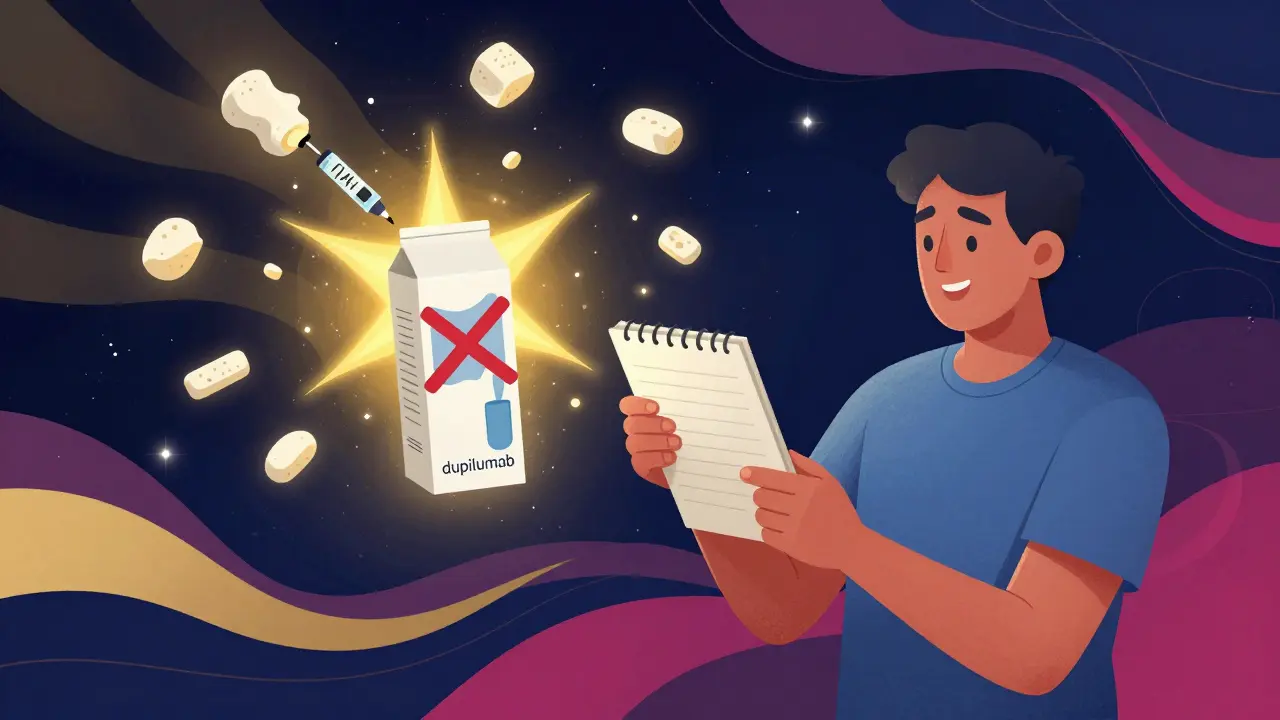
The biggest breakthrough in the last year isn’t a diet or a slurry. It’s dupilumab (Dupixent). Approved by the FDA in May 2023, it’s the first biologic drug for EoE. It’s an injection given every two weeks. In trials, over half of patients saw their eosinophil count drop to near-zero. It’s not a cure-but it’s a game-changer for adults who can’t stick to diet or can’t tolerate steroids.
And researchers are getting smarter. A new NIH study called CEGIR is testing blood markers that might predict your food triggers without eliminating everything. If it works, you won’t need to give up pizza for months just to find out you’re allergic to eggs.
Meanwhile, component-resolved diagnostics are helping identify which specific proteins in milk or soy are causing the problem-not just “milk,” but casein or whey. That could mean less restrictive diets in the future.
What to Do If You Suspect EoE
If you’ve had trouble swallowing for months-especially if you’re an adult, or your child is refusing food-you need an endoscopy. No pill, no diet, no slurry will help if you haven’t confirmed it’s EoE.
Start here:
- See a gastroenterologist who knows EoE. Not every GI does.
- Ask for an endoscopy with biopsy. Normal endoscopy? Doesn’t rule it out. You need tissue.
- If diagnosed: pick your path. Try milk elimination first. Or start budesonide slurry. Don’t do both at once.
- Work with a dietitian. Cutting out dairy or wheat can leave you low on calcium and vitamin D.
- Track symptoms. Keep a food and symptom journal. It helps when you reintroduce foods.
And don’t be afraid to ask for help. The American Partnership for Eosinophilic Disorders (APFED) offers free dietitian consults and food pantries. The Cincinnati Center runs a free food program for qualifying patients. You don’t have to do this alone.
Final Thought: It’s Manageable, Not a Life Sentence
EoE isn’t curable. But it’s controllable. You can eat. You can live. You can go out to dinner. You can travel. You just need to know your triggers and stick to a plan.
Some people stick with diet for life. Others switch to steroids. A few now use dupilumab. There’s no right answer-only the right one for you. The goal isn’t perfection. It’s relief. And it’s possible.
Releted Post

Andy Dargon
Hi, I'm Aiden Lockhart, a pharmaceutical expert with a passion for writing about medications and diseases. With years of experience in the pharmaceutical industry, I enjoy sharing my knowledge with others to help them make informed decisions about their health. I love researching new developments in medication and staying up-to-date with the latest advancements in disease treatment. As a writer, I strive to provide accurate, comprehensive information to my readers and contribute to raising awareness about various health conditions.
I’ve been living with EoE for 5 years and milk elimination changed everything. No more choking on toast. No more panic at restaurants. I still eat dairy-free pizza-yes, it exists-and my endoscopy last month showed zero eosinophils. It’s not perfect, but it’s life-changing.
Also, shoutout to the dietitian I found through APFED-she helped me replace calcium without turning my meals into a science project.
Oh wow, so the steroid slurry is just asthma medicine you swallow like a weird smoothie? I’m surprised no one’s turned this into a TikTok trend. ‘Swallow chalk + honey = freedom from food jail.’
Y’all need to hear this: if you’re struggling with EoE, you’re not alone. I used to cry in the grocery store because I couldn’t find safe bread. Now I meal-prep with rice noodles and almond milk (yes, the kind without carrageenan) and I actually enjoy food again.
Start small. One change at a time. You don’t have to do the six-food elimination on day one. Milk first. Just milk. Trust me, your esophagus will thank you.
Okay, but let’s talk about the emotional toll. I get the science-milk triggers, steroid slurries, dupilumab. But what nobody says is how lonely it gets. You sit there at a birthday party, watching everyone eat cake, and you smile and say ‘I’m good’ while your stomach screams.
And then there’s the guilt-‘Am I being dramatic?’ ‘Is this really a disease?’ ‘Why can’t I just tough it out?’
It’s not just a medical condition. It’s a silent grief. And honestly? I’m glad someone finally wrote this down. I needed to feel seen.
Just a quick note on dosage: if you’re using fluticasone, make sure you’re using a metered-dose inhaler with a spacer. The actuation can be inconsistent without it, and you might not be getting the full 220 mcg. Also, honey is better than water for coating-it’s viscous, so it clings longer. And yes, rinse after. Thrush is no joke.
64% remission on milk alone? That’s statistically insignificant. The sample size was probably under 100. Also, you didn’t mention the confounding variable of probiotic use. Most EoE patients are on low-FODMAP diets, which alter gut flora-could that be the real modulator, not milk? And dupilumab? It’s just a fancy IL-4 inhibitor. Nothing new. We’ve known about Th2 pathways since 2010. This is just pharma rebranding.
People suffer because they eat too much. The body is smart. It rejects what is not pure. Milk is from a cow. Why do humans drink cow milk? It is not natural. God made us to eat fruits, vegetables, rice. All this science is just confusion. Eat simple. Live simple. Your body will heal.
It is with profound humility that I address this discourse on eosinophilic esophagitis, a condition which, while medically documented, remains emblematic of the modern era’s pathological over-intellectualization of physiological phenomena.
One cannot help but observe the paradoxical nature of our medical interventions: we prescribe steroid slurries derived from asthma inhalers, yet we neglect the primordial wisdom of ancestral dietary patterns. The imposition of elimination diets, while statistically validated, betrays a fundamental epistemological flaw-the assumption that disease can be reduced to molecular triggers, when in truth, it is the dissonance between the human spirit and the industrialized food matrix that precipitates such afflictions.
Furthermore, the normalization of biologics such as dupilumab, while heralded as breakthroughs, merely extends the hegemony of pharmaceutical capitalism over bodily autonomy. Is it not more noble to cultivate inner stillness than to inject synthetic antibodies? The esophagus, after all, is not merely a conduit-it is a sacred channel of communion between the self and the world.
Let us not mistake symptom suppression for healing. Let us not confuse data points with wisdom. Let us, instead, return to the quietude of whole foods, mindful consumption, and the unadorned rhythm of nature’s design.
-Kishor Raibole, M.A. in Comparative Philosophy, University of Calcutta