
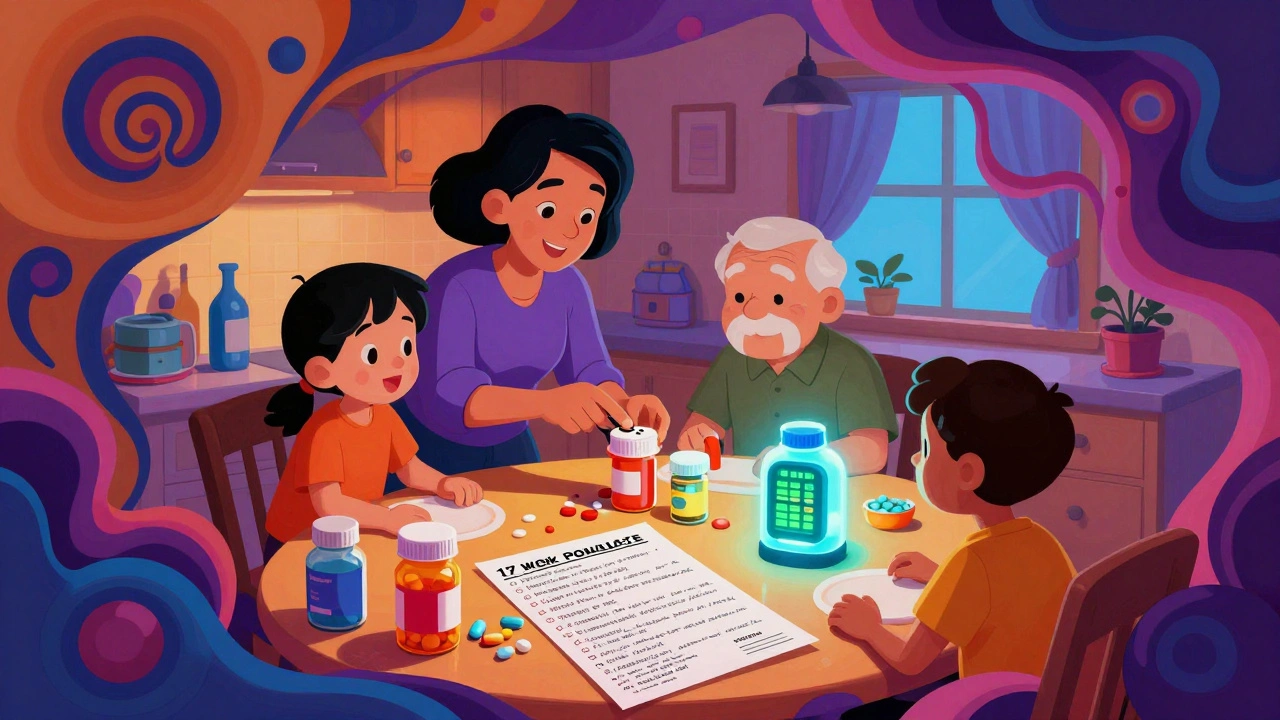
Managing medications at home isn’t just about remembering to take pills. It’s about making sure the right dose is taken at the right time, avoiding dangerous interactions, and catching mistakes before they cause harm. For many older adults and people with chronic conditions, this task is too complex to handle alone. That’s where family members or caregivers come in. But simply saying, “Can you remind Mom to take her pills?” isn’t enough. Effective medication support requires structure, communication, and tools that actually work.
Start with a Complete Medication List
Before anything else, build a master list of every medication the person takes. Not just the names. Include the brand and generic name, exact dosage (like “Lisinopril 10mg”), how often to take it (e.g., “once daily at 8 AM with breakfast”), who prescribed it, why it’s being taken, and any known side effects or interactions. The Agency for Healthcare Research and Quality says this list needs 17 specific data points per medication to be truly useful.Update this list within 24 hours of any change-whether it’s a new prescription, a dose adjustment, or a drug being stopped. Hospital discharges are the most dangerous time. Studies show 50-60% of medication errors happen when someone comes home from the hospital. Bring the list to every doctor visit. One caregiver in Ohio told her story on the Caregiver Action Network forum: “I caught a dangerous interaction between my mother’s blood pressure med and her arthritis drug because I had the full list. The pharmacist said we almost had a crisis.”
Use a Pill Organizer That Fits the Routine
A simple 7-day pill box with morning and evening compartments reduces missed doses by 37%, according to a 2022 study in the Journal of the American Geriatrics Society. But not all pill organizers are equal. If someone takes medication four times a day, a basic box won’t cut it. Look for ones with separate compartments for each time of day.For people who forget easily or have memory issues, electronic dispensers like Hero Health or MedMinder can be game-changers. These devices beep, flash lights, and even call a caregiver if a dose is skipped. Clinical trials show they reduce missed doses by 62%. They’re not cheap, but many Medicare Advantage plans cover them if prescribed by a doctor. Pharmacies like CVS and Walgreens also offer automatic refill programs that ship meds before they run out-just make sure the system is set up at least 7-10 days before the last pill is gone.
Build Medication Habits Into Daily Routines
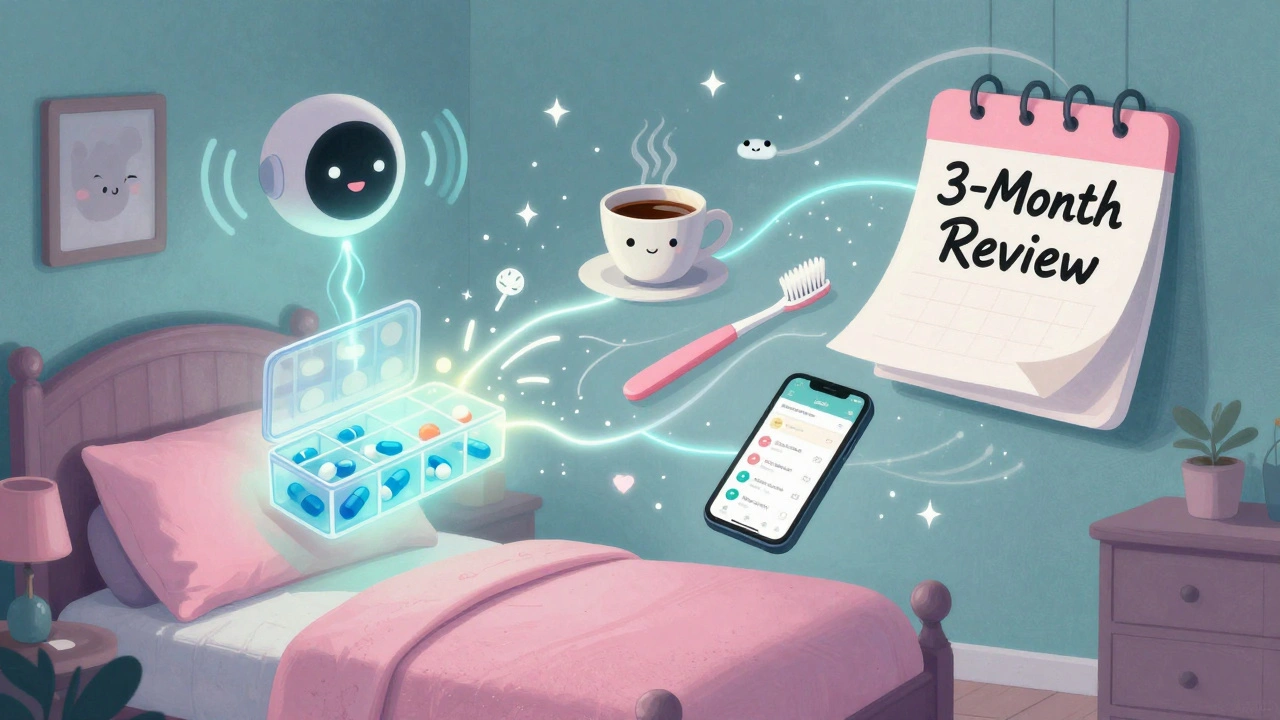
The National Institute on Aging calls this “habit stacking.” Link taking meds to something you already do every day. Brush your teeth? Take your blood pressure pill right after. Eat breakfast? That’s when you take your cholesterol med. Tie it to a consistent, visible action.This simple trick increases adherence by 28% in real-world studies. Why? Because habits don’t rely on memory-they rely on triggers. If the person has a routine of drinking coffee at 7:30 a.m., make taking their thyroid pill part of that ritual. Over time, the coffee cup becomes the cue, not a phone alarm or a sticky note.
Set Up Reliable Reminders
Paper calendars and handwritten notes? They get lost. Phone alarms? They get silenced. Digital tools work better. Apps like Medisafe and Round Health send push notifications, track doses taken, and even alert family members if a dose is missed. Users of these apps see a 45% improvement in adherence compared to paper logs.For those with dementia or hearing loss, voice assistants like Amazon Alexa or Google Home can help. Ask Alexa, “When does Dad take his blood thinner?” and it will reply with the time and dosage. Set up daily reminders: “Alexa, remind me to give Mom her insulin at 7 p.m.” A 2023 University of Pittsburgh study found these voice reminders cut missed doses by 37% for cognitively impaired patients.
Get the Pharmacist Involved
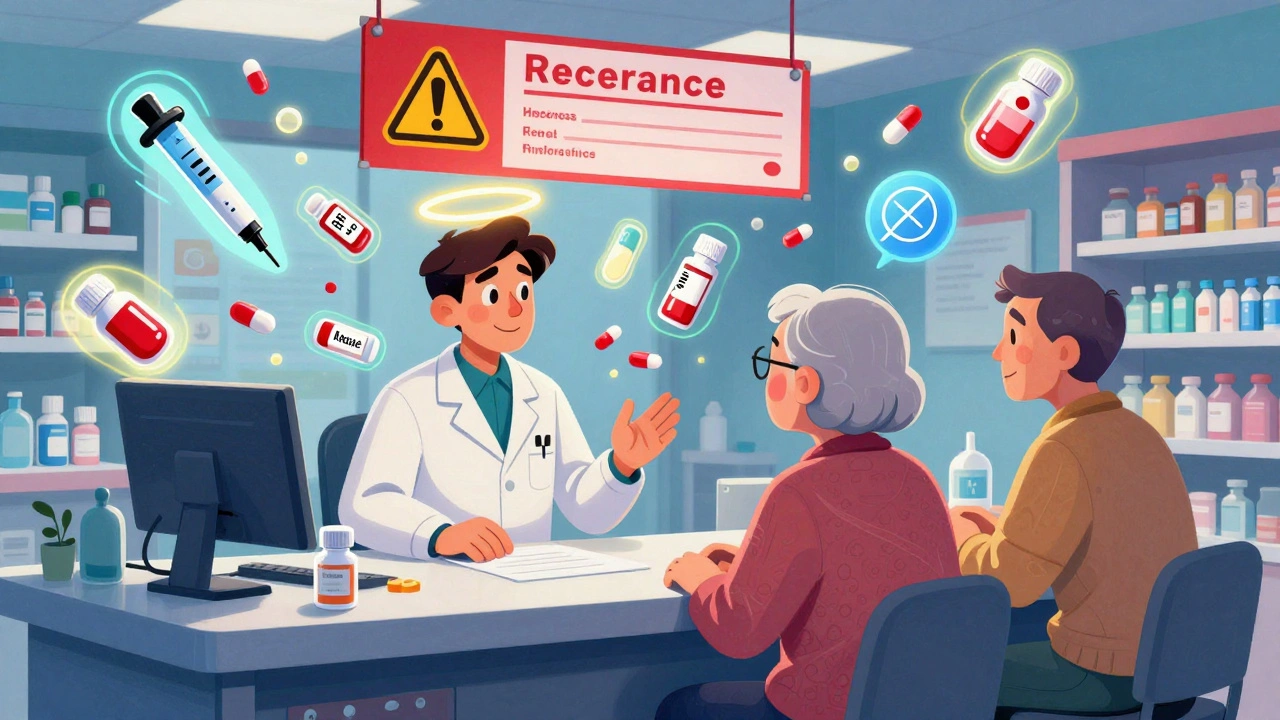
Pharmacists are the most underused resource in medication safety. In 2023, 92% of U.S. pharmacies had pharmacists available for free consultations without an appointment. Don’t wait for a problem-go in. Bring the full medication list. Ask four key questions:- What time should this be taken relative to meals?
- Are there foods, alcohol, or other drugs it shouldn’t be mixed with?
- What should I do if a dose is accidentally skipped?
- When should I expect to see results-or notice side effects?
Pharmacists can spot dangerous combinations. The American Geriatrics Society’s Beers Criteria lists 30 medications that are risky for older adults. A pharmacist can flag these and suggest safer alternatives. One study found caregivers who used complete medication lists and consulted pharmacists reduced adverse drug events by 41%.
Review Medications Regularly
People on four or more medications should have a full medication review every three months. This isn’t just about checking doses-it’s about asking: “Do we still need all of these?” Polypharmacy (taking five or more drugs) affects 45% of adults over 65. It increases the risk of falls by 50% and hospitalizations by 30%, according to Columbia University’s Dr. Barbara Guglielmo.Ask the doctor: “Is this still necessary?” “Could any of these be stopped?” “Are there cheaper or safer options?” Medicare Part D requires pharmacists to offer Medication Therapy Management (MTM) to people taking eight or more Part D drugs with three or more chronic conditions. In 2023, 68% of eligible beneficiaries used these free services. Use them.
Create an Emergency Plan
Not all missed doses are equal. Some medications, like insulin, blood thinners, or heart medications, can cause serious harm if skipped. Build a “medication red list” - a separate note kept with the main list that highlights these high-risk drugs. Include what to do if a dose is missed: call the doctor? Skip it? Take a double dose? Write it down.A 2023 study in the Annals of Internal Medicine found that families with a red list reduced emergency room visits by 19%. Keep this list on the fridge, in the medicine cabinet, and in the caregiver’s wallet. If the person collapses or is taken to the hospital, this list could save their life.
Attend Appointments Together
Caregivers who go to medical visits with the patient understand the plan better. The AARP’s 2023 survey found 89% of caregivers who attended appointments reported clearer understanding of the medication regimen. Bring the list. Take notes. Ask questions. Don’t let the doctor rush through it. If the person has multiple specialists, it’s easy for prescriptions to clash. One Reddit user wrote: “My dad saw four doctors. None knew what the others prescribed-until I brought the list to every appointment.”Watch for Burnout
Medication management is stressful. The National Alliance for Caregiving found 42% of caregivers say managing meds is their most stressful task. If you’re feeling overwhelmed, it’s okay to ask for help. Talk to a social worker. Ask the doctor about home health services. Many home care agencies now train their staff in medication support-up from 41% in 2019 to 73% in 2024.Don’t try to do it all alone. Use tools. Delegate. Take breaks. Your well-being matters too. If you’re exhausted, mistakes happen. And mistakes with medications can be deadly.
What’s Next?
Technology is getting smarter. The FDA has approved over a dozen digital pill systems that track when a pill is swallowed. AI-powered assistants like Alexa Care Hub saw 200% growth in 2023. By 2027, experts predict 65% of caregiver medication support will use AI tools. But even the best tech won’t replace human attention. The real breakthrough comes when families, pharmacists, and doctors work together-with clear lists, simple routines, and open communication.The goal isn’t perfection. It’s safety. One less missed dose. One fewer dangerous interaction. One more day the person stays healthy at home.
What’s the most common mistake caregivers make with medication management?
The biggest mistake is assuming the patient remembers everything or that the doctor knows all the meds being taken. Many caregivers don’t create a complete, updated list. Others don’t bring it to appointments. Without a full picture, doctors can prescribe dangerous combinations or duplicate medications. Studies show this leads to half of all home medication errors.
Can I use a smartphone app instead of a pill organizer?
Yes, but not always as a full replacement. Apps like Medisafe are excellent for reminders and tracking, especially if the person is tech-savvy. But for someone with memory loss or limited vision, a physical pill box with labeled compartments is more reliable. The best approach is combining both: use the app for alerts and logs, and the pill box for daily dosing. One study showed using both improved adherence by 52%.
What if the person refuses help with their meds?
Respect their autonomy, but don’t give up. Start small. Offer to help organize the pill box, not take control. Say, “I’ll set this up for you, and you can take it from there.” Frame it as helping them stay independent longer. If they’re worried about losing control, involve them in choosing the tools-let them pick the pill organizer color or decide which app to use. Often, resistance fades once they see how much easier it makes their day.
Does Medicare cover any of these tools or services?
Yes. Medicare Part D requires pharmacies to offer free Medication Therapy Management (MTM) to eligible beneficiaries-those taking eight or more Part D drugs with three or more chronic conditions. Some Medicare Advantage plans cover electronic pill dispensers if prescribed by a doctor. Automatic refill programs through CVS, Walgreens, and others are free. Check with your plan’s customer service. Many also offer free medication reviews by pharmacists.
How often should the medication list be updated?
Immediately after any change-new prescription, dose change, or drug stopped. Also update it every 30 days as a habit, even if nothing changed. This catches hidden issues, like over-the-counter drugs or supplements that weren’t recorded. The Agency for Healthcare Research and Quality recommends updating within 24 hours of any change, especially after hospital visits. Keep a printed copy in your wallet and a digital version backed up in the cloud.
What should I do if I notice a side effect I don’t understand?
Don’t ignore it. Write down exactly what happened-when it started, how bad it is, and if it’s linked to a specific time of day or medication. Call the pharmacist first. They can tell you if it’s a known side effect or something to worry about. If it’s severe-like chest pain, confusion, swelling, or trouble breathing-go to urgent care or call 911. Don’t wait. Many dangerous reactions can be reversed if caught early.
Are there free resources to help caregivers manage meds?
Yes. The Caregiver Action Network offers a free downloadable “Medication Organizer” template with all 17 recommended fields. AARP has a free online course called “Managing Medications for Older Adults.” CVS and Walgreens offer free in-store medication reviews with pharmacists. The National Council on Aging provides a free tool called “My Meds” that helps track prescriptions. These aren’t just pamphlets-they’re practical tools backed by research.
Medication safety isn’t about control. It’s about connection. When families step in with the right tools and knowledge, they don’t just prevent mistakes-they preserve dignity, independence, and life.
Releted Post

Andy Dargon
Hi, I'm Aiden Lockhart, a pharmaceutical expert with a passion for writing about medications and diseases. With years of experience in the pharmaceutical industry, I enjoy sharing my knowledge with others to help them make informed decisions about their health. I love researching new developments in medication and staying up-to-date with the latest advancements in disease treatment. As a writer, I strive to provide accurate, comprehensive information to my readers and contribute to raising awareness about various health conditions.
I’ve been managing my mom’s meds for three years now. The biggest game-changer was the pill organizer with separate compartments for each time of day. Before that, she was double-dosing on her blood pressure med. Now she takes it like clockwork. No alarms, no notes-just the box and her morning coffee.
Also, bringing the list to every appointment saved us from a dangerous interaction between her arthritis med and a new antibiotic. The pharmacist nearly had a heart attack. We didn’t even know it was a risk until she flagged it.
Don’t underestimate the pharmacist. They’re not just the people who hand out pills. They’re your secret weapon.
This is one of the most comprehensive, well-researched guides I’ve seen on medication management. Every point is backed by data, not anecdote. The emphasis on the 17-point medication list is particularly vital-most caregivers stop at ‘name, dose, frequency.’ That’s not a list; it’s a guess.
I’ve trained caregivers in London using this exact framework. The 62% reduction in missed doses with electronic dispensers is not an outlier-it’s replicable. The key is matching the tool to the user’s cognitive and physical capacity. One size does not fit all.
Also, the habit stacking advice? Brilliant. Linking medication to a routine behavior bypasses executive function deficits. That’s neuroscience, not just advice.
People still use paper lists? In 2025? How is this even still a thing? You’re lucky if your mom doesn’t die from a drug interaction. The fact that you need a 17-point list means you’ve already failed at basic healthcare literacy. Why didn’t you start with a digital app from day one? Or at least a spreadsheet?
And don’t get me started on voice assistants. Alexa doesn’t care if your dad skips his pill. It just repeats the reminder. That’s not support-that’s noise. Real care requires human presence, not gadgets.
Update the list after every change. No excuses.
Pharmacist consults are free. Use them.
Don’t wait for a crisis.
That’s it.
Ohhhhh, so now we’re supposed to trust American pharmacies and their ‘Medicare Advantage’ nonsense? You think this works in India? Here, people die because they can’t afford one pill, let alone a $300 electronic dispenser! You talk about ‘tools that work’ like we’re all living in a Silicon Valley fantasy!
My uncle took six pills a day. He had no list. No app. No Alexa. He had his daughter, who worked two jobs, and a torn piece of paper with scribbles in Hindi. And he lived to 89. Why? Because love doesn’t need Bluetooth.
You Americans think tech fixes everything. It doesn’t. It just makes you feel better about doing nothing real.
While I appreciate the structural rigor of this piece, I must emphasize the profound epistemological gap between Western medical paradigms and the lived reality of familial caregiving in collectivist societies. The notion of ‘habit stacking’ presupposes an individualistic, time-bound existence that is antithetical to the fluid, relational temporality of South Asian households, wherein medication adherence is embedded within intergenerational rhythms of meal preparation, prayer, and communal observation.
Furthermore, the privileging of digital tools as ‘solutions’ reflects a neo-colonial technocratic impulse that pathologizes non-Western caregiving practices. The pill organizer, while statistically efficacious, is a symbol of alienation from embodied familial duty. One does not ‘manage’ medication as one manages a spreadsheet. One tends. One witnesses. One holds space.
Let us not mistake efficiency for ethics.
Okay, but have you considered the *aesthetic* dimension of medication management? Like, the pill organizer should be a *statement*. I’ve got this custom-made rose-gold one with engraved initials and a tiny LED that glows when it’s time. It’s not just functional-it’s a curated extension of my mother’s identity.
And the app? I use Medisafe, but I’ve synced it to my Google Home and my Apple Watch. The notifications are timed to match her circadian rhythm-gentle chime at 8 AM, not a blaring alarm. It’s like a wellness ritual. Also, I printed the 17-point list on linen paper and laminated it. It’s hanging in her kitchen next to her favorite photo. It’s not a document. It’s a memorial to her autonomy.
Look, if you’re not treating this like a mindfulness practice, you’re doing it wrong. And no, I don’t care if it’s expensive. My mother deserves beauty in her care.
It’s funny how we treat medication like a problem to be solved with systems, when really, it’s about presence.
I used to stress over whether my dad took his pills. I’d check his pillbox every morning. Then one day, I just sat with him while he took them. No checklist. No app. Just us. Talking about the rain. He forgot once. Didn’t matter. I didn’t scold him. We just did it again.
The tools help. But the real magic? When the person knows they’re not alone. When the pill isn’t the center of the moment-it’s just part of it.
Maybe we’re over-engineering this.
Just be there.
Wow. So many apps. So many boxes. So many lists.
Meanwhile, my neighbor’s wife takes her meds by putting them in her coffee cup. One pill, one sip. No organizer. No alarms. No drama. She’s 92 and still gardens.
Maybe the real secret isn’t the tech.
It’s that some people just… remember.
Or maybe they don’t care enough to forget.
Either way, I’m not buying a $400 dispenser.
My grandma’s pillbox has a little sticker on it that says ‘I’m not old, I’m vintage.’
She takes her meds every morning while watching Wheel of Fortune.
She’s never missed one.
She doesn’t have a list.
She doesn’t need one.
Did you know the FDA and Big Pharma pushed these ‘medication safety’ programs to get people hooked on more pills? They want you to think you need 17 data points just to take aspirin.
My uncle took 12 pills a day. He died at 74. The autopsy said it was heart failure.
But the meds? They were all prescribed.
Who’s really in control here?
And why are we trusting pharmacies that charge $400 for a pillbox that beeps?
Something’s off.
Everyone’s so obsessed with ‘adherence’ and ‘dose accuracy’-but what about the person? What if they don’t want to take the pills? What if the pills are making them feel worse? What if they’re just tired of being a patient?
You call it ‘safety.’ I call it control.
And who gave you the right to manage someone’s body with checklists and alarms?
Maybe the real mistake isn’t forgetting the pill.
It’s forgetting the person.
Pharmacist consultations are free? In India they charge $10. In the US you need insurance. In rural areas, no pharmacist within 50 miles.
Stop pretending this is for everyone.
This guide is for the privileged.
Most people just hope the doctor remembers what they wrote last time.
Ohhh, so now we’re supposed to believe that ‘Alexa’ can replace a daughter who wakes up at 5 a.m. to give insulin? That’s not innovation-that’s abandonment wrapped in Silicon Valley glitter!
My mother’s pills are managed by my sister, who works night shifts, sleeps 3 hours, and still remembers every single dose-even the ones from the local herbal shop that no one on this list even mentioned!
You talk about ‘tools’ like they’re sacred. But the real tool? The hand that holds the cup. The voice that says, ‘Beta, take your medicine.’
Technology doesn’t love. People do.
And no app can replace that.