

When you hear "probiotics," you might think of yogurt commercials or a shelf full of colorful bottles at the grocery store. But here’s the real question: do they actually help your gut, or is it just hype? The answer isn’t simple. Some people swear by them. Others take them for months and feel nothing. The science? It’s mixed-but far from useless.
What Probiotics Actually Are (And What They’re Not)
Probiotics aren’t magic pills. They’re live bacteria-and sometimes yeast-that are meant to support your gut microbiome. The official definition, set by the International Scientific Association for Probiotics and Prebiotics (ISAPP) in 2014, says they must be alive, given in enough numbers, and proven to help your body. That last part is key. Not every bacteria in a supplement counts. Only specific strains, at specific doses, have real evidence behind them.
Think of it like this: not all dogs are good guard dogs. A Chihuahua won’t scare off a burglar, but a German Shepherd might. Same with probiotics. Lactobacillus rhamnosus GG is a strain with solid proof for reducing diarrhea. It’s been tested in over 80 clinical trials and is one of the most studied probiotics in the world. But if you buy a random blend labeled "10 billion CFU," you might not even have that strain in there.
The Evidence: Where Probiotics Actually Work
Let’s cut through the noise. There are only a few conditions where probiotics have clear, consistent benefits-and most of them involve diarrhea.
Antibiotic-associated diarrhea (AAD) is one of the strongest cases. When you take antibiotics, they don’t just kill bad bacteria-they wipe out good ones too. That imbalance often leads to loose stools. A 2023 review from the National Institutes of Health (NIH) looked at 12 studies with nearly 1,500 people. Those who took Lactobacillus rhamnosus GG (at doses between 4 billion and 12 billion CFU daily) cut their risk of diarrhea from 22% down to 12%. That’s a 45% drop. Another strain, Saccharomyces boulardii, showed similar results. Both are backed by multiple randomized trials.
Acute infectious diarrhea in kids is another win. A 2020 Cochrane Review of 82 studies with over 12,000 children found probiotics reduced the chance of diarrhea lasting more than 48 hours by 36%. In many cases, kids recovered a day faster. That’s not a small thing when you’re dealing with a sick child and a disrupted work schedule.
Ulcerative colitis has some support too. The American Gastroenterological Association reviewed 17 studies with over 1,600 patients. They found certain probiotics-especially the blend called VSL#3-could help maintain remission in mild to moderate cases. But here’s the catch: no probiotic has been shown to help Crohn’s disease. That’s a critical distinction.
Where Probiotics Fall Short
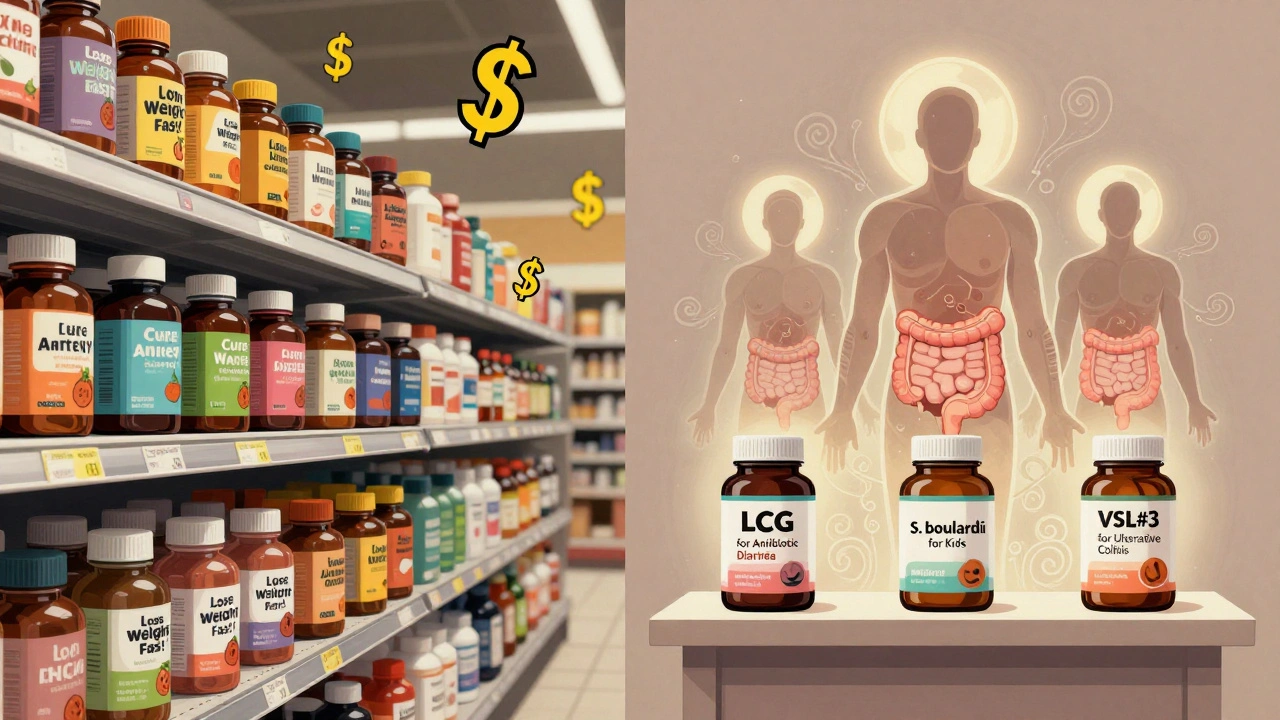
Don’t believe everything you read online. Probiotics are often marketed as a cure-all for bloating, IBS, weight loss, and even anxiety. The truth? The evidence for most of these claims is weak or inconsistent.
Irritable Bowel Syndrome (IBS) is the biggest disappointment. Some studies show small improvements in bloating or pain. Others show zero effect. A 2023 review in Nature concluded that while some strains might help a subset of patients, there’s no universal probiotic for IBS. Why? Because everyone’s gut microbiome is different. What works for one person might do nothing for another.
And what about those claims that probiotics help with weight loss or blood sugar? A 2024 study in Frontiers in Nutrition found a few strains might influence metabolism-but these were lab studies or tiny human trials. Nothing close to proof. If you’re hoping probiotics will melt belly fat, you’re better off focusing on sleep, fiber, and movement.
Strain Matters More Than You Think
Here’s where most people get tripped up. You can’t just say "I take Lactobacillus acidophilus" and expect results. There are dozens of strains under that name-and they’re not interchangeable.
Lactobacillus acidophilus has at least five major strains: LA-1, LA-5, NCFM, DDS-1, and SBT-2026. Each has different effects. NCFM has been linked to reduced bloating. DDS-1 has shown promise in supporting immune function. LA-5 is often used in dairy fermentation but has less clinical backing for supplements.
It’s like saying "I take vitamin C" without specifying if it’s ascorbic acid, calcium ascorbate, or liposomal C. They’re all vitamin C, but they behave differently in your body. Same with probiotics. If a product just says "L. acidophilus" without the strain name, you’re guessing.
How to Choose a Probiotic That Actually Works
Not all probiotics are created equal. Here’s how to cut through the marketing:
- Look for the strain-not just the species. If it doesn’t say LGG or S. boulardii CNCM I-745, keep looking.
- Check the CFU count. For AAD or infectious diarrhea, aim for at least 10 billion CFU per day. Lower doses often don’t work.
- Verify third-party testing. Brands like Culturelle, Renew Life, and Seed carry USP or NSF certification. A 2019 ConsumerLab test found 30% of probiotics had fewer live bacteria than claimed.
- Know the storage needs. Some need refrigeration (like VSL#3). Others, like S. boulardii, are shelf-stable. If your bottle sits on a hot kitchen counter, those bugs might be dead.
- Match the strain to your goal. For antibiotics? Use LGG or S. boulardii. For ulcerative colitis? Try VSL#3. For general gut balance? No proven strain exists yet.

When to Take Them (And When to Avoid Them)
Timing matters. If you’re on antibiotics, take your probiotic at least two hours apart. That way, the antibiotics don’t kill the good bugs before they can settle in. Keep taking them for one to two weeks after you finish your antibiotics.
Side effects? A small number of people get gas or bloating at first. That’s normal. Your gut is adjusting. Most of the time, it fades in 3-7 days. If it doesn’t, stop.
Who should avoid them? People with weakened immune systems-like those on chemotherapy, with organ transplants, or severe illnesses. There are rare case reports of probiotics causing bloodstream infections in these groups. If you’re healthy, they’re likely safe. But if you’re immunocompromised, talk to your doctor first.
What the Experts Really Say
Dr. Mary Ellen Sanders of ISAPP puts it plainly: "Different strains have different effects." That’s the core truth. There’s no "best probiotic." Only the right one for your situation.
The European Food Safety Authority (EFSA) has rejected over 200 health claims for probiotics because the evidence wasn’t strong enough. The only ones they approved? Yogurt cultures that help people digest lactose. That’s it.
Dr. Purna Kashyap from Mayo Clinic warns: "Probiotics are not a one-size-fits-all solution." Your gut microbiome is as unique as your fingerprint. What works for your friend might do nothing for you.
And here’s the reality check: the global probiotic market is worth over $50 billion. That’s a lot of money chasing a lot of hope. But science doesn’t care about sales numbers. It cares about data. And the data says: probiotics help with specific problems, not general wellness.
The Bottom Line
Probiotics aren’t useless. But they’re not miracle workers either.
If you’ve had antibiotic-associated diarrhea or your child got sick with a stomach bug, probiotics-specifically LGG or S. boulardii-can help. They’re backed by strong evidence.
If you’re taking them for bloating, IBS, weight loss, or "overall gut health," you’re gambling. The science doesn’t support it consistently. You might get lucky. You might waste money.
Don’t buy a bottle because it says "100 billion CFU" or has a cute logo. Look for the strain. Check the certification. Know why you’re taking it. And if you don’t see results after 4-8 weeks, stop. Your gut doesn’t need more supplements. It needs time, fiber, and maybe less sugar.
The best probiotic isn’t in a bottle. It’s in your diet: kimchi, kefir, sauerkraut, and plain yogurt. These foods have lived bacteria, no labels, and no marketing hype. And they’ve been helping human guts for thousands of years.
Do probiotics help with constipation?
There’s limited evidence. A few strains, like Bifidobacterium lactis BB-12, have shown small improvements in bowel movement frequency in some studies. But results are inconsistent. For constipation, fiber, water, and movement are far more reliable solutions.
Can I get probiotics from food instead of supplements?
Yes-and it’s often better. Fermented foods like yogurt (with live cultures), kefir, sauerkraut, kimchi, and miso naturally contain live bacteria. They also come with fiber, vitamins, and other nutrients that supplements don’t offer. Plus, they’re less likely to be mislabeled or expired.
Are probiotics safe for long-term use?
For healthy people, yes. There’s no evidence that long-term use causes harm. But there’s also no proof that taking them daily gives you extra benefits beyond what you get from a healthy diet. If you’re not using them for a specific reason, you might not need them at all.
Why do some probiotics need refrigeration?
Some bacterial strains are delicate and die at room temperature. Refrigeration keeps them alive longer. Shelf-stable probiotics, like Saccharomyces boulardii, are yeast-based and naturally hardier. Always check the label-if it says "refrigerate," don’t leave it on your counter.
How long does it take for probiotics to work?
For acute issues like antibiotic-related diarrhea, you might see results in 2-3 days. For chronic issues like IBS or bloating, it can take 2-8 weeks. Don’t give up after a week. But if you feel worse or see no change after 8 weeks, it’s probably not helping you.
Releted Post


Andy Dargon
Hi, I'm Aiden Lockhart, a pharmaceutical expert with a passion for writing about medications and diseases. With years of experience in the pharmaceutical industry, I enjoy sharing my knowledge with others to help them make informed decisions about their health. I love researching new developments in medication and staying up-to-date with the latest advancements in disease treatment. As a writer, I strive to provide accurate, comprehensive information to my readers and contribute to raising awareness about various health conditions.
Probiotics aren't magic, but they're not snake oil either. The strain-specific evidence is actually pretty solid for antibiotic-associated diarrhea and pediatric infectious diarrhea. If you're taking antibiotics, LGG or S. boulardii are backed by more than 80 clinical trials. Most people just buy whatever's on sale without checking the label - that's the real problem, not the science.
It's like buying a car and blaming the engine when you didn't check the model number. The data exists. You just have to look for it.
Really appreciate this breakdown. Too many people treat probiotics like vitamins - pop one daily and hope for the best. But the science is way more nuanced. I’ve seen friends spend hundreds on fancy bottles while ignoring fermented foods. Kefir and sauerkraut have been doing the job for centuries without a single clinical trial.
Also, storage matters. I once bought a $40 probiotic that was sitting in a sunlit cabinet. Dead bugs. No wonder it did nothing.
Oh wow. Another post that treats probiotics like they’re the new holy water. Let me guess - next you’ll tell us that ‘gut-brain axis’ is why your dog’s anxiety improved after eating yogurt?
Look, if you’re healthy and eating fiber, you don’t need probiotics. The $50 billion industry thrives on people who think their gut is a broken iPhone that needs a ‘download.’ The only thing being ‘restored’ here is the profit margin of supplement companies.
Also, VSL#3? That’s a medical food, not a supplement. You can’t buy it at Walmart. But sure, go ahead and Google ‘best probiotic for IBS’ and buy the one with the prettiest bottle.
As someone who’s dealt with IBS for 12 years, I’ve tried everything - from expensive probiotics to elimination diets. Honestly? The only thing that worked was fiber + hydration + stress management. Probiotics? Some strains helped a little with bloating, but only for 2 weeks, then nada.
And yes - strain matters. I bought a $60 bottle labeled ‘L. acidophilus’ and later found out it was LA-1, which has zero data for IBS. NCFM might’ve helped, but I never knew because the label didn’t say.
Also, fermented foods > supplements. I started eating homemade kimchi daily. No pills. No marketing. Just spicy cabbage. My gut thanked me. 🌶️🥬
And if you’re taking probiotics for ‘overall gut health’ - you’re just throwing money at a mystery. Your gut doesn’t need fixing. It needs feeding. Fiber. Water. Sleep. Not a 100 billion CFU capsule.
Probiotics are a scam. Big Pharma and supplement companies made billions off people too lazy to eat real food. You think a pill fixes your gut? Wake up. Your gut is a complex ecosystem. You can’t fix it with a few dead bacteria in a capsule.
And don’t even get me started on ‘clinical trials.’ Most are funded by the companies selling the product. The NIH review? They only included studies that showed positive results. The rest? Buried.
Stop buying into this. Eat vegetables. Stop sugar. Move your body. That’s the only ‘probiotic’ you need.
Interesting. But where’s the data on long-term use? Also, why does every article mention LGG but never mention that most people don’t respond to it? I’ve taken it for 6 months. Zero effect. So much for ‘evidence-based.’
Yup. This is the most realistic take I’ve seen. I used to buy every probiotic that said ‘gut health’ on it. Then I realized - I was just buying hope. Now I eat yogurt with live cultures and kimchi. No labels. No BS. And my stomach’s been chill for a year 😊
Westerners think they can fix everything with a pill. In India, we’ve been eating fermented foods for millennia - dosa batter, idli, curd - no lab-tested strains, no CFU counts. Just tradition. Your ‘science’ is just a fancy way of rediscovering what our grandmothers knew. You don’t need a $50 bottle. You need a spoon of curd with lunch.
I love this. I’ve been telling people this for years. Probiotics are not one-size-fits-all. I had chronic bloating for years. Tried 5 different brands. Nothing. Then I switched to VSL#3 after my colonoscopy - and boom, 80% better. But only because my doctor matched the strain to my condition. It’s like getting the right key for a lock. Most people just keep trying random keys and blame the lock.
Probiotics aren’t the hero - they’re the sidekick. The real MVP? Fiber. Prebiotics. Sleep. Water. Movement. These are the OG gut healers. Probiotics? They’re like the backup singer at a Beyoncé concert - nice to have, but nobody’s gonna remember them if the lead singer’s off-key.
And if your probiotic bottle says ‘100 billion CFU’ but doesn’t list the strain? That’s not science. That’s marketing theater. You’re buying glitter in a bottle.
Probiotics are a joke. You think bacteria in a capsule can fix your diet of pizza and soda? Wake up. The only thing that matters is what you eat. No supplement replaces a vegetable. No CFU count fixes sugar addiction. This whole industry is built on gullibility. Stop wasting money. Eat real food. That’s it.
Thank you for this. I’m a nurse, and I see patients waste hundreds on probiotics every month - then get mad when they don’t work. I always ask: ‘What’s your fiber intake?’ ‘Do you sleep?’ ‘Are you stressed?’ Nine times out of ten, the real issue isn’t gut bacteria - it’s lack of veggies, too much sugar, and chronic stress.
Probiotics are a tool. Not a cure. And only if you’ve already done the basics. If you’re not eating fiber, no strain in the world will help. Just sayin’.
Probiotics have limited clinical utility. Evidence supports use in specific conditions: antibiotic-associated diarrhea, pediatric acute infectious diarrhea, and maintenance of remission in ulcerative colitis with specific strains. No evidence supports use for general wellness, weight loss, or IBS as a universal treatment. Marketing exceeds evidence. Recommend dietary modification prior to supplementation.
OMG, YES. This is the most accurate, well-researched, and NON-SCAMMY article I’ve read in years. I’ve been screaming this for years - strain matters, storage matters, and your gut doesn’t need a ‘boost’ - it needs FIBER. I eat sauerkraut daily, and I’ve never taken a probiotic pill. My digestion? Perfect. My wallet? Still intact. Also - refrigeration? YES. I keep mine in the fridge like it’s a bottle of wine. Because it’s alive. Not a rock. 🙌
Probiotics help some people for specific things. Not everyone. Not every time. Not for bloating. Not for weight loss. Just… stop buying them unless you have a clear reason. And even then, try food first.