
ICH Harmonization Impact Calculator
See how ICH guidelines reduce development time, costs, and animal testing. Based on real-world data from FDA and industry reports.
Input Your Project Details
Harmonization Benefits
Based on ICH S1 (carcinogenicity testing) and M13A (bioequivalence) standards from article data:
- • 18 months average approval time reduction (FDA)
- • 40% animal testing reduction
- • $1.2B generic savings globally (2023)
Every pill you take, every vaccine you receive, and every new drug approved for use didn’t just appear out of thin air. Behind it is a complex web of science, regulation, and global cooperation - and at the center of it all are the ICH guidelines. These aren’t suggestions. They’re the invisible rules that ensure a drug tested in Tokyo is held to the same safety standards as one tested in Chicago or Berlin. Without them, patients would face inconsistent safety data, duplicated trials, and unnecessary delays - or worse, unsafe medicines slipping through cracks in fragmented systems.
What Are the ICH Guidelines and Why Do They Matter?
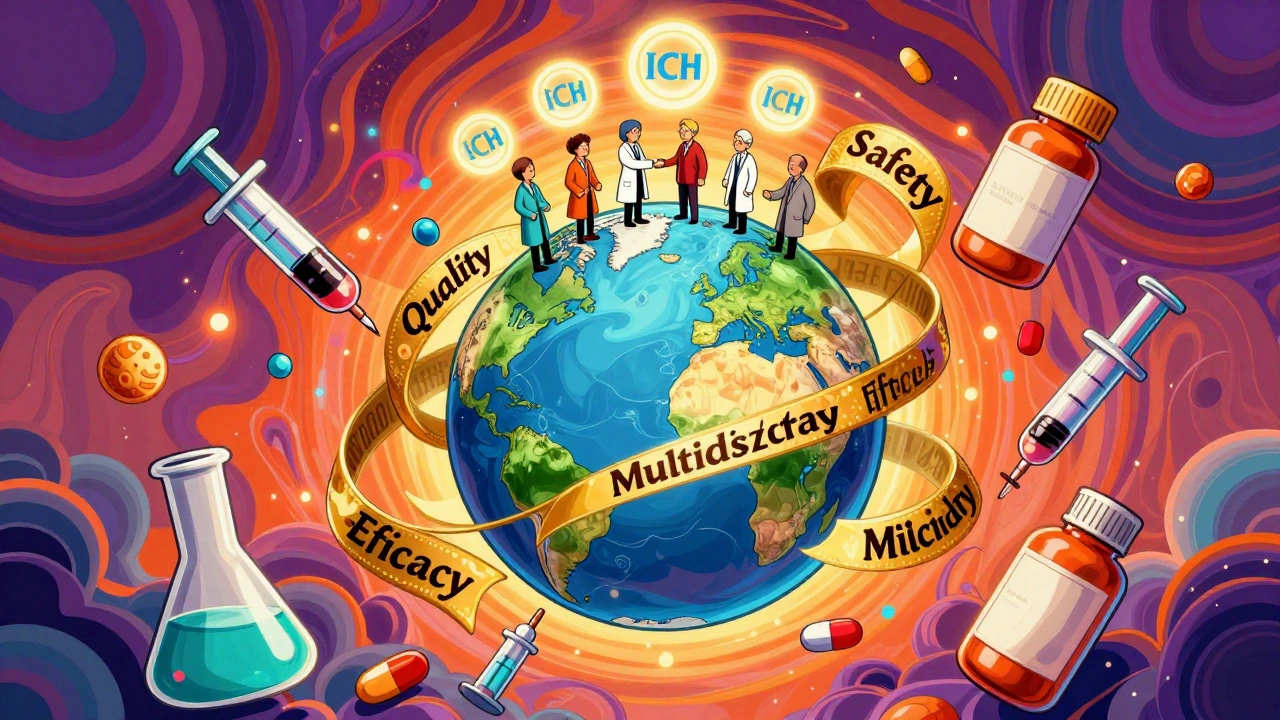
The International Council for Harmonisation of Technical Requirements for Pharmaceuticals for Human Use (ICH) started in 1990 as a quiet agreement between regulators from the U.S., Europe, and Japan. Today, it’s the global engine driving uniformity in how medicines are developed and tested. Its mission is simple: make sure safe, effective, high-quality drugs reach patients faster - without cutting corners. Before ICH, a company developing a new cancer drug might need to run separate clinical trials in each region just to meet local rules. That meant longer wait times, higher costs, and more people exposed to experimental drugs than necessary. ICH changed that. By creating one set of science-backed standards, it cut redundancy. Today, over 60 finalized guidelines cover everything from how to test for cancer-causing side effects to how to write a clinical trial report. The U.S. Food and Drug Administration (FDA) doesn’t just "recommend" ICH guidelines - it makes them official. When the FDA adopts an ICH guideline, it becomes a binding expectation for any drug company wanting to sell in America. The same is true in the European Union and Japan. That’s why global pharmaceutical companies treat ICH as non-negotiable. If you’re not following ICH, you’re not getting your drug approved anywhere major.The Four Pillars of ICH: Quality, Safety, Efficacy, and Multidisciplinary
ICH organizes its guidelines into four clear buckets:- Quality (Q) - How the drug is made, stored, and tested for purity. Think: manufacturing consistency, stability testing, impurity limits.
- Safety (S) - What happens when the body absorbs the drug. This includes toxicology, carcinogenicity, and reproductive harm testing.
- Efficacy (E) - Does the drug actually work? This covers clinical trial design, data reporting, and how to measure real patient benefit.
- Multidisciplinary (M) - Cross-cutting topics like electronic submissions, terminology, and now, real-world evidence.
How ICH Guidelines Are Made - And Why It Works
Unlike top-down regulations, ICH guidelines are built from the ground up. The process has five steps:- Proposal - A topic is identified by regulators or industry.
- Consensus - Experts from around the world draft the guideline through working groups.
- Adoption - Regulatory members vote to accept the draft.
- Implementation - Each member country adopts it into their own rules.
- Monitoring - Ongoing review to update or clarify as science evolves.

Real-World Evidence: The Next Frontier
ICH isn’t stuck in the past. In June 2024, it released a reflection paper on real-world evidence (RWE) - data from electronic health records, insurance claims, and patient registries. This isn’t just academic. It’s changing how drugs are monitored after approval. For example, if a new diabetes drug shows unexpected heart risks in a small trial, regulators used to wait years for large post-market studies. Now, with ICH’s new framework, they can use real-world data from millions of patients to spot patterns faster. That means quicker recalls, better warnings, and fewer surprises. The U.S., Europe, and Canada all co-sponsored this update. It’s a sign that ICH is evolving beyond traditional clinical trials. As AI, wearable sensors, and digital health tools become part of drug development, ICH is positioning itself to handle them - not as outliers, but as new data sources under the same trusted standards.Who Follows ICH - And Who Doesn’t?
The big players all follow ICH. The FDA, EMA, and Japan’s PMDA are founding members. The UK joined fully in 2022 after Brexit, showing ICH’s reach extends beyond its original trio. Canada, Australia, and Switzerland are also full members. Even China and South Korea are aligning their rules with ICH to get their drugs approved in Western markets. But here’s the catch: ICH guidelines aren’t legally binding by default. They become law only when a country adopts them. That’s why implementation can vary. Some countries take years to update their regulations. Smaller markets may lack the resources to fully adopt every guideline. Still, the pressure to comply is immense. If you’re a drug company and want to sell in the U.S. or EU, you have to follow ICH. There’s no workaround. That’s why even countries not officially part of ICH often mirror its standards - it’s just easier than building their own.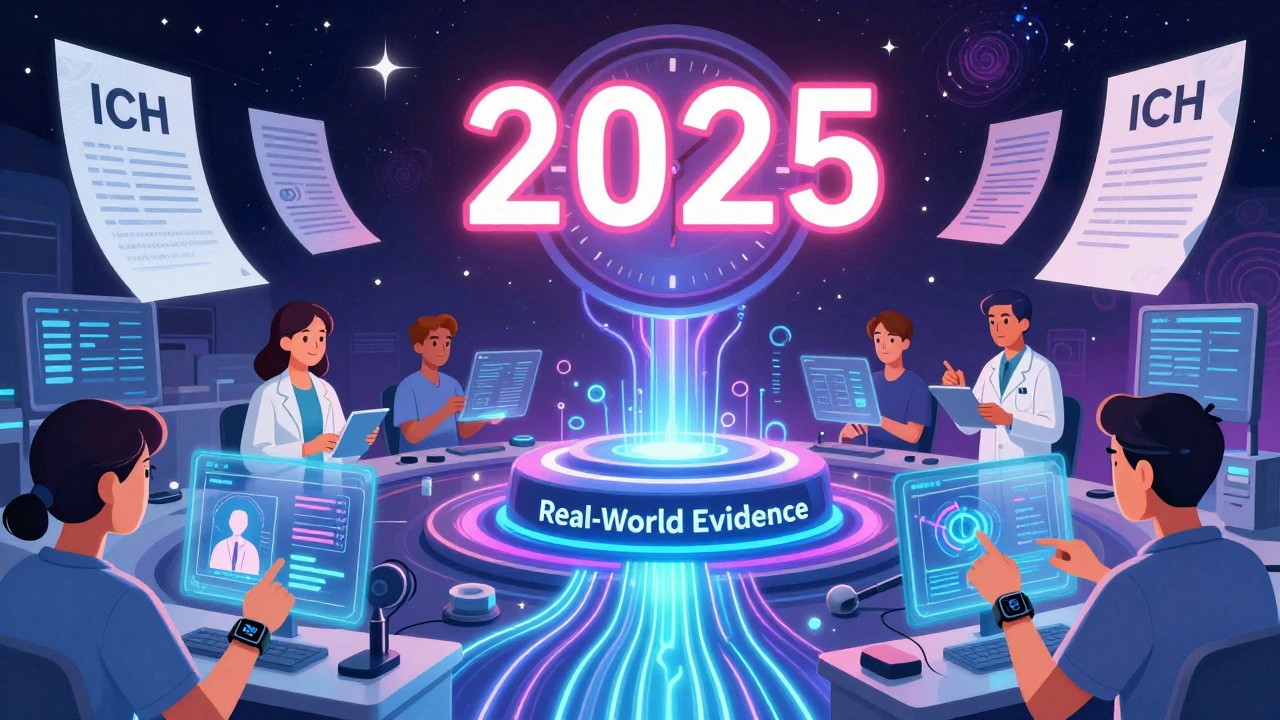
The Real Impact: Fewer Trials, Fewer Animals, Faster Access
The benefits aren’t theoretical. They’re measurable. - A 2023 FDA report showed that harmonization reduced the average time to approve a new cancer drug by 18 months. - Animal testing for carcinogenicity dropped by over 40% in countries using ICH S1, because one study replaced three different ones. - Generic drug makers saved an estimated $1.2 billion globally in 2023 by avoiding redundant testing thanks to ICH M13A. Patients benefit too. No more waiting five years for a drug approved in Japan to reach the U.S. No more being excluded from trials because your ethnicity didn’t match the study population (ICH E5 fixed that). No more unsafe drugs slipping through because one country’s standards were weaker.What’s Next for ICH?
The future of ICH is about speed and scope. Gene therapies, cell therapies, and AI-designed drugs are here. Current guidelines weren’t built for them. That’s why ICH is already working on new drafts for advanced therapies. Expect updates in 2025 and 2026 on:- How to validate AI models used in drug discovery
- Standardized methods for measuring gene therapy durability
- Guidance on using digital biomarkers (like smartphone data) in clinical trials
Where to Learn More
If you work in pharma, healthcare, or policy, the official ICH website (ich.org) is your go-to. It has all 60+ guidelines, implementation status, training materials, and Q&A documents. The FDA and EMA also publish their own versions with local context. For most people, ICH is invisible. But every time you get a new prescription, or your child gets a vaccine, you’re benefiting from decades of quiet, science-driven cooperation across borders. That’s the power of harmonization - and it’s working.Are ICH guidelines mandatory?
ICH guidelines aren’t laws by themselves, but they become mandatory when adopted by national regulators. In the U.S., the FDA enforces them as official guidance. In the EU, the EMA requires compliance. If you want to sell a drug in these markets, you must follow ICH. It’s not optional - it’s the only path to approval.
How often are ICH guidelines updated?
There’s no fixed schedule. Updates happen when science demands it. Some guidelines, like ICH E6 (Good Clinical Practice), get revised every 5-10 years as trial methods evolve. Others, like ICH S1 on carcinogenicity, have stayed largely unchanged because the science is solid. New guidelines are added regularly - ICH M13A on bioequivalence was adopted in 2024. The process is driven by emerging data, not deadlines.
Do ICH guidelines apply to generic drugs?
Yes, absolutely. ICH M13A, adopted in 2024, is a perfect example. It sets clear rules for proving that a generic pill behaves the same as the brand-name version. Before this, companies had to run different tests for different markets. Now, one study works globally. That’s why generic drugs are safer, cheaper, and faster to approve today.
Why does ICH include industry representatives?
Because drug companies are the ones actually developing and testing the medicines. Regulators know the science, but industry knows the practical challenges - how long a test takes, what equipment is needed, what data is feasible to collect. Including them ensures guidelines are scientifically sound and actually doable. It’s not about favoring industry - it’s about making rules that work in the real world.
Can a country ignore ICH guidelines?
Technically, yes - but it’s rare and risky. If a country refuses to adopt ICH, its drug companies can’t easily sell products abroad. Patients there may miss out on new treatments. Other countries may question the safety of drugs from non-ICH regions. Most countries adopt ICH not because they’re forced to, but because it’s the smartest way to ensure safety, efficiency, and global access.
Releted Post

Andy Dargon
Hi, I'm Aiden Lockhart, a pharmaceutical expert with a passion for writing about medications and diseases. With years of experience in the pharmaceutical industry, I enjoy sharing my knowledge with others to help them make informed decisions about their health. I love researching new developments in medication and staying up-to-date with the latest advancements in disease treatment. As a writer, I strive to provide accurate, comprehensive information to my readers and contribute to raising awareness about various health conditions.
ICH? Yeah, it’s just corporate paperwork dressed up as science.
I’ve worked in clinical ops for 12 years, and honestly? ICH is the reason I still believe in global health equity. Before this, we’d run three separate trials for one drug just because Japan wanted different endpoints. Now? One trial, same data, faster access. That’s not bureaucracy-that’s compassion in action. It doesn’t make headlines, but it saves lives every single day.
Let’s be real-ICH is the last bastion of Enlightenment rationality in an age of algorithmic chaos. 🤓 The fact that industry, regulators, and academics still sit in a room (virtually, of course) and hammer out consensus-driven science… it’s almost quaint. But somehow, it works. Unlike TikTok medical advice.
They say ICH saves money, but what about the poor countries that can’t afford to implement it? This isn’t global harmony-it’s a Western club with a fancy logo. People in rural India die because their regulators can’t keep up with E6. Don’t call it progress when it leaves half the world behind.
I just want to say how much I appreciate the way this post breaks down the four pillars-it made me finally understand why my grandma’s blood pressure med took so long to get approved. It’s not red tape, it’s layered safety. And the part about real-world evidence? That’s huge. Imagine if we could catch side effects faster using data from millions of people instead of waiting for a handful of trial participants to get sick. That’s not just science-it’s care made smarter.
Oh, so now we’re romanticizing regulatory bureaucracy? ICH is the velvet glove over the iron fist of Big Pharma’s global hegemony. The ‘consensus’ is orchestrated by consultants paid by Roche and Pfizer. The ‘science’? It’s sanitized, sanitized, sanitized-until the only thing left is profit with a side of peer-reviewed footnotes. 🌐💸
ich is good but why does it take so long to update? like i heard about this new ai drug thing and its like 2025 before they even start talking about it? come on. we got self driving cars and they still using 2010 trial rules. its not magic its just slow.
Wait… so you’re telling me that the FDA, EMA, and Big Pharma all sit in a room and decide what’s ‘safe’? And you think that’s trustworthy? What about the whistleblower reports? The hidden data? The ghost trials? ICH isn’t harmonization-it’s collusion. They’re not protecting patients-they’re protecting profits under a shiny ‘science’ label. Wake up.
Really fascinating how ICH M13A is reshaping generics. The bioequivalence standard used to be a patchwork of dissolution profiles, plasma curves, and regional quirks. Now? One assay, one submission, one approval. It’s a masterclass in reducing friction without sacrificing rigor. The real win? More patients in LMICs getting affordable meds faster. That’s harmonization with teeth.
every time i see a new vaccine or cancer med come out, i think about the people who spent 10 years in labs and meetings just to make sure it didn’t kill someone. ich is the quiet hero. no parades, no tweets, just steady, boring, brilliant work. 🤝❤️
the real win here is that ich lets smaller countries play in the big leagues without having to build their own regulatory infrastructure from scratch. it’s like open source for drug safety. sure it’s not perfect but it’s the best system we’ve got. and yeah i know some folks think its corporate but without it we’d have 50 different ways to test a pill and half the world wouldn’t get anything
ICH? More like ICH-USA-EU-JAPAN. Why should the rest of the world bend to Western standards? We don’t follow your traffic laws or your diet trends-why should we follow your drug rules? If China and India are adopting it, it’s because they’re scared of losing access to your markets-not because it’s better. This isn’t global, it’s imperial.
Let me just say-this entire post reads like a pharmaceutical industry white paper dressed in academic clothing. ICH is not a benevolent force. It is a cost-reduction mechanism disguised as patient safety. The fact that it ‘cuts redundancy’ means it cuts testing-and with it, the margin for error. We’ve seen what happens when safety standards are streamlined: Thalidomide. Vioxx. The opioid crisis. ICH doesn’t prevent disasters. It just makes them look more official.