
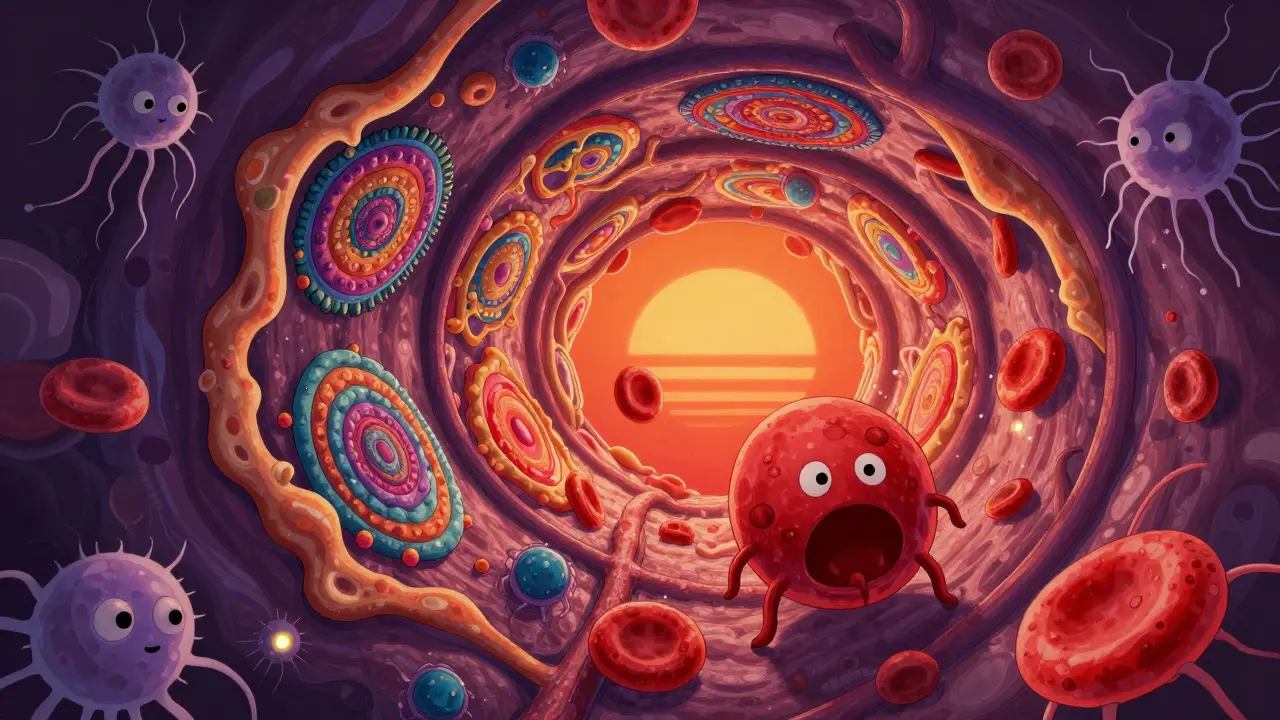
Coronary artery disease (CAD) isn't just a slow clog in the pipes-it's the #1 killer worldwide. Every year, over 360,000 people in the U.S. alone die from it. And the root cause? atherosclerosis. This isn't some distant medical term. It's the sticky, silent buildup of plaque inside your heart's arteries, slowly starving your heart muscle of oxygen. By the time chest pain shows up, the damage may already be advanced. But here’s the good news: you can stop it. Or at least slow it down-big time.
What Exactly Is Atherosclerosis?
Atherosclerosis starts long before you feel anything. It begins when low-density lipoprotein (LDL), often called "bad cholesterol," slips into the wall of your artery. Your body sees it as a threat, so immune cells rush in to clean it up. They get stuck. Fat, calcium, and cellular debris pile up. Over years, this forms a plaque-a hard, fatty deposit that narrows the artery.
Not all plaques are the same. There are two main types:
- Stable plaques: Thick, fibrous caps, lots of calcium. They grow slowly, often blocking more than 50% of the artery. They cause predictable chest pain when you’re exerting yourself-like climbing stairs or shoveling snow. This is stable angina.
- Unstable plaques: Thin caps, big oily cores, packed with inflammatory cells. They might only block 30% of the artery-but they’re ticking time bombs. They can rupture without warning, triggering a blood clot that suddenly blocks the artery. That’s a heart attack.
That’s why someone can have a heart attack with "only" mild narrowing. It’s not about how much space is left-it’s about whether the plaque can hold together.
Who’s at Risk? The Real Culprits Behind CAD
It’s not just age or genetics. While family history matters, most risk factors are within your control. The 2023 ACC/AHA guidelines break risk into three clear buckets: low (<1% yearly chance of death or heart attack), intermediate (1-3%), and high (>3%). About 60% of patients fall into the high-risk group-and they’re responsible for 75% of all major events.
Here’s what pushes you into high risk:
- Diabetes: It doesn’t just raise blood sugar-it damages blood vessels from the inside. People with diabetes have the same heart attack risk as someone who already had one.
- Smoking: One pack a day triples your risk. The chemicals destroy the artery lining, speed up plaque formation, and make blood stickier.
- High blood pressure: Constant high pressure wears down artery walls, making it easier for LDL to sneak in.
- High LDL and low HDL: LDL is the main ingredient in plaque. HDL helps clean it up. If your numbers are off, you’re feeding the fire.
- Obesity: Especially belly fat. It’s not just weight-it’s inflammation. Fat tissue releases chemicals that worsen artery damage.
- Chronic kidney disease: When your kidneys struggle, your blood pressure and mineral balance go haywire, wrecking your arteries.
- History of heart attack, stent, or bypass: If you’ve had one, you’re at much higher risk for another.
And here’s something most people don’t realize: atherosclerosis can start in your 20s. It just takes decades to become dangerous. That’s why prevention isn’t just for seniors-it’s for everyone.
How Is It Diagnosed? Beyond the Chest Pain
Many people think a heart attack is the first sign. But by then, it’s too late for prevention. Diagnosis starts with what you feel-and what tests can see.
First, your doctor will ask about symptoms. Chest pressure during activity? Shortness of breath? Pain radiating to your jaw or arm? These are classic signs.
Then come the tests:
- Electrocardiogram (ECG): Measures your heart’s electrical activity. Can show past damage or current stress.
- Stress test: You walk on a treadmill or get medicine to simulate exercise while your heart is monitored. If blood flow drops during stress, it’s a red flag.
- Coronary angiography: The gold standard. A thin tube is threaded to your heart, dye is injected, and X-rays show exactly where blockages are. Used when symptoms are clear or a heart attack is suspected.
- Ankle-Brachial Index (ABI): Measures blood pressure in your ankle vs. arm. If it’s low, you likely have artery disease elsewhere-like in your legs-which often means you have it in your heart too.
And here’s a growing area: INOCA-ischemia with nonobstructive coronary arteries. Some people have heart symptoms and reduced blood flow, but no major blockages. This is real, it’s common, and it’s often missed. It’s not "just anxiety." It’s microvascular disease-small artery damage that standard tests can’t catch.

Treatment: It’s Not Just Pills
There’s no magic bullet. Effective treatment is a three-legged stool: lifestyle, meds, and procedures-each supporting the other.
Lifestyle: The Foundation
Medications won’t work if you keep smoking, eating fried food, and sitting all day. The 2023 guidelines are clear: lifestyle isn’t optional-it’s the first line of defense.
- Diet: Focus on vegetables, fruits, whole grains, beans, nuts, fish. Cut back on processed carbs, sugar, and saturated fats. The Mediterranean diet has the strongest evidence for reducing heart events.
- Exercise: At least 150 minutes a week of brisk walking. That’s 30 minutes, 5 days a week. Even short walks help. Movement improves blood flow, lowers blood pressure, and reduces inflammation.
- Weight loss: Losing just 5-10% of your body weight can significantly improve cholesterol, blood pressure, and insulin sensitivity.
- Quitting smoking: Within one year, your heart attack risk drops by half. After 15 years, it’s nearly the same as someone who never smoked.
Medications: Managing the Numbers
These aren’t just for show-they save lives.
- Statins: Lower LDL by 30-60%. They don’t just reduce cholesterol-they stabilize plaques, making them less likely to rupture. Most people with CAD need a high-intensity statin like atorvastatin or rosuvastatin.
- Aspirin: Used in most patients to prevent clots. But it’s not for everyone-your doctor will weigh bleeding risk.
- ACE inhibitors or ARBs: Lower blood pressure and reduce strain on the heart, especially if you have diabetes, heart failure, or kidney disease.
- Beta-blockers: Slow your heart rate, lower blood pressure, and reduce chest pain. Often used after a heart attack.
- SGLT2 inhibitors and GLP-1 agonists: Originally for diabetes, these drugs now show clear heart benefits-even in people without diabetes. They reduce hospitalizations and death.
Procedures: Opening the Blockages
When lifestyle and meds aren’t enough, or when a blockage is severe:
- Percutaneous Coronary Intervention (PCI): Also called angioplasty. A balloon is inflated inside the blocked artery, and a metal mesh stent is left behind to keep it open. It’s minimally invasive, done through the wrist or groin. Recovery is quick-often same-day discharge.
- Coronary Artery Bypass Grafting (CABG): Surgery. A healthy vessel (from your leg, arm, or chest) is grafted to bypass the blocked section. Used when multiple arteries are blocked, especially if you have diabetes or weak heart muscle.
Here’s the key: PCI doesn’t prevent heart attacks in stable CAD. It relieves chest pain. But if you’re having a heart attack, it’s life-saving. CABG, on the other hand, improves long-term survival in complex cases.
The New Frontier: Cardio-Oncology and Personalized Care
People are living longer-with cancer, with diabetes, with heart disease. And now, these conditions are overlapping more than ever.
That’s where cardio-oncology comes in. Cancer treatments like chemotherapy and radiation can damage the heart. Meanwhile, heart patients need cancer care. Specialists now work together to balance both.
And the future? Personalized medicine. Your risk isn’t just based on age or cholesterol. It’s your genetics, your inflammation markers, your plaque type, your kidney function, your lifestyle habits. The 2023 guidelines stress that treatment must be tailored-not one-size-fits-all.
For example: If you have diabetes and CAD, you’re not just on a statin. You’re likely on an SGLT2 inhibitor too. If you’ve had a heart attack and also have atrial fibrillation, your blood thinner plan is more complex. One size doesn’t fit all.

What Happens After Diagnosis?
You’re not done when you leave the hospital. CAD is a lifelong condition. But it’s manageable.
- Take your meds daily-even if you feel fine.
- Get your cholesterol and blood pressure checked every 3-6 months.
- Attend cardiac rehab if referred. It’s proven to cut death risk by 25%.
- Know your numbers: LDL under 70 mg/dL is the target for most with CAD. Blood pressure under 130/80.
- Watch for new symptoms: Chest pain that’s worse, longer, or happens at rest? Call 911.
Many people think once they get a stent, they’re "fixed." They’re not. The stent keeps one artery open-but the disease is still in your body. Without lifestyle changes, new blockages will form.
Bottom Line: You Have More Power Than You Think
Coronary artery disease isn’t a death sentence. It’s a warning. And the warning comes decades before the crisis.
Plaque builds slowly. Risk factors accumulate quietly. But so do the benefits of change. Quitting smoking, walking daily, eating real food, taking your meds-these aren’t chores. They’re investments in your next 20 years.
And the data doesn’t lie: people who follow the guidelines live longer, feel better, and avoid hospital stays. You don’t need to be perfect. You just need to be consistent.
Your heart has been working for you since day one. It’s time to return the favor.
Releted Post

Andy Dargon
Hi, I'm Aiden Lockhart, a pharmaceutical expert with a passion for writing about medications and diseases. With years of experience in the pharmaceutical industry, I enjoy sharing my knowledge with others to help them make informed decisions about their health. I love researching new developments in medication and staying up-to-date with the latest advancements in disease treatment. As a writer, I strive to provide accurate, comprehensive information to my readers and contribute to raising awareness about various health conditions.
so like... i got my LDL at 140 last checkup and my doc was like "eh, we can watch it" but honestly i think that's bs. if you're 35 and your arteries are already whispering "we're tired" you don't get to wait for the scream. statins aren't scary, they're just medicine with a bad PR team.
I’ve been thinking about this a lot since my dad had his bypass last year. What struck me wasn’t the surgery-it was how quietly everything was falling apart before he even noticed. He didn’t have chest pain. He just got winded carrying groceries. And that’s the thing-atherosclerosis doesn’t knock. It just slowly turns your body into a house with rotting floorboards. You don’t feel the first nail being pulled out. You just wake up one day and the stairs are unsafe. Prevention isn’t about being perfect. It’s about not ignoring the creaks.
Oh wow, another American medical infomercial. Let me guess-you’re also gonna tell me that eating kale and doing yoga will reverse plaque? I’ve seen too many patients on statins with 100% blockages because they thought "eating clean" was enough. Medicine isn’t a TikTok trend. If you want to live, take the pills. Stop pretending lifestyle is a magic wand.
the thing no one talks about is that your heart doesn't care how much you 'meditate' or 'detox'-it only cares about what's in your blood. LDL doesn't take a break for your intermittent fasting. But also-honestly? I used to think this stuff was boring until my mom had a silent MI at 52. Turns out, "feeling fine" is the most dangerous lie we tell ourselves. So yeah, i take my rosuvastatin. And i walk. And i don't eat twinkies anymore. Not because i'm perfect-because i'm still here.
The data presented here is statistically sound but lacks contextual nuance. The conflation of correlation with causation in the lipid hypothesis remains contentious among epidemiologists. Furthermore, the emphasis on pharmaceutical intervention over systemic socioeconomic determinants of cardiovascular health is methodologically problematic. A reductionist approach to a multifactorial disease undermines long-term public health outcomes.
you are NOT too young to care. you are NOT too busy to walk. you are NOT too broke to eat vegetables. this isn't a privilege-it's survival. i used to think "heart disease" was for old guys in sweatpants. then i watched my cousin die at 41 from a plaque that "didn't look bad" on his last echo. stop waiting for a warning. start acting like your life matters.
Let me guess-you’re one of those people who thinks eating avocado toast is a cardiac intervention. You don’t get to be a hero because you swapped soda for sparkling water. Real prevention is quitting smoking at 25, not Instagramming your quinoa bowl at 45. And if you think statins are dangerous, you haven’t met a real heart attack survivor. Stop romanticizing wellness culture. This is biology, not a lifestyle brand.
In the Indian context, the burden of coronary artery disease is rapidly escalating among younger populations due to dietary transition, sedentary occupations, and genetic predisposition. While Western guidelines provide a framework, localized implementation must account for socioeconomic constraints, access to diagnostics, and cultural dietary patterns. The emphasis on statins is appropriate, yet the absence of community-based screening programs renders many interventions reactive rather than preventive. A holistic model integrating traditional dietary wisdom with modern cardiology may yield more sustainable outcomes.
I’m a nurse in rural Ohio. I see people who skip meds because they can’t afford the copay. I see grandmas walking 3 miles to the clinic because they don’t have a car. This post is accurate, but it assumes privilege. You can’t "eat Mediterranean" if your nearest grocery store is 40 miles away and your job doesn’t give you time off. Prevention needs policy, not just personal discipline.
Statins cause diabetes. That’s the truth they bury under marketing brochures. If you want to live longer, stop eating sugar. Stop being lazy. Stop blaming pills for your poor choices. The heart doesn’t lie. Your lifestyle does.
you know what’s wild? the same people who’ll drive 20 minutes for a $5 coffee will skip their statin because "it’s not that bad." your heart doesn’t care how busy you are. it just wants you to move, eat real food, and take the damn pill. i used to be the guy who thought "i’ll start next monday." now i’m the guy who walks 10k steps every day and sets a reminder for my meds. no drama. no guilt. just consistency. you got this.
The notion that atherosclerosis is reversible through lifestyle modification alone is a dangerous oversimplification. Clinical trials demonstrate that plaque regression requires aggressive LDL lowering, typically below 50 mg/dL, which is unattainable without pharmacologic intervention. Lifestyle changes serve as adjuncts, not alternatives. Misinformation of this nature contributes to patient noncompliance and increased mortality.
they don't want you to know this but the whole cholesterol thing is a pharma scam. they made up "bad cholesterol" so you'd buy statins. your body makes cholesterol because it's important. arteries clog because of sugar, not fat. and the real cause? 5G towers and fluoridated water. i stopped eating bread and now my blood pressure is fine. no pills needed. they just want you dependent.