
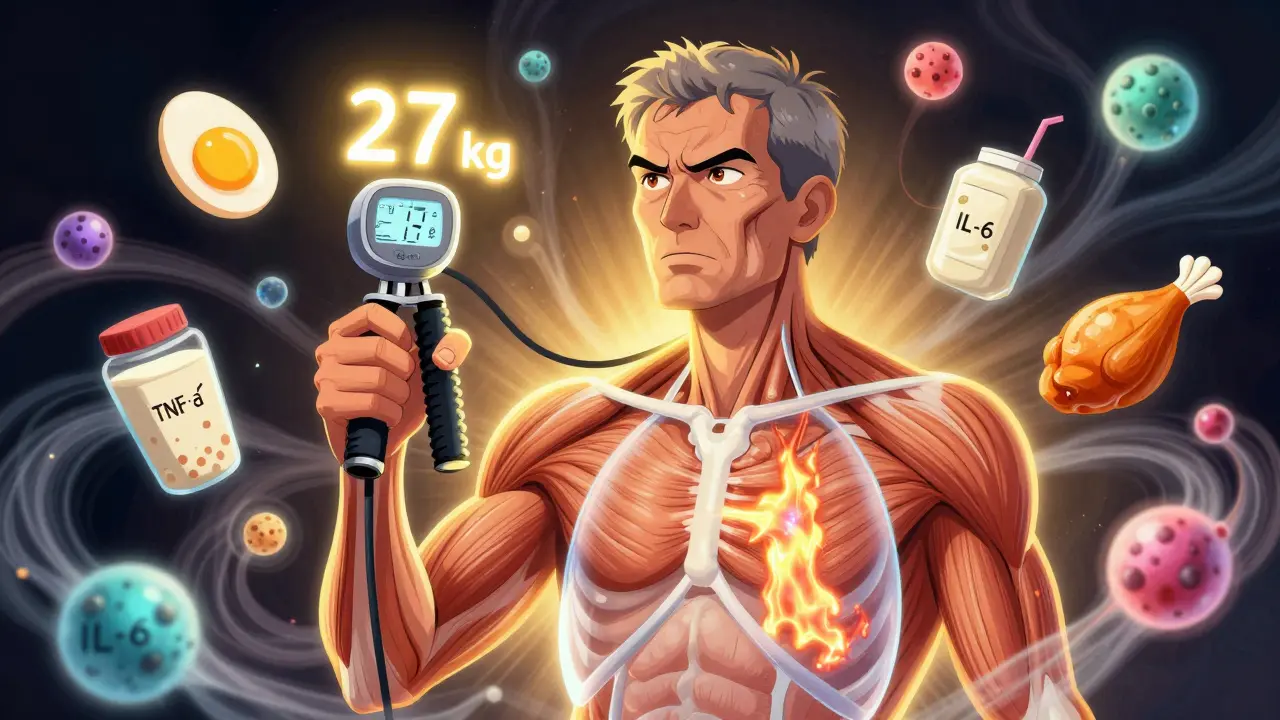
When you have COPD, your lungs aren't the only thing suffering. Many people don’t realize that sarcopenia - the loss of muscle mass and strength - affects nearly 1 in 5 COPD patients. This isn't just about getting weaker. It's about losing the ability to walk, climb stairs, or even carry groceries. And without the right nutrition and exercise, it can shorten your life. The good news? You can fight it. Not with drugs, but with simple, proven strategies that work even in advanced COPD.
Why Sarcopenia Is a Silent Killer in COPD
Sarcopenia doesn't show up on an X-ray. It doesn't cause coughing or wheezing. But it's one of the strongest predictors of death in COPD. Studies show patients with both COPD and sarcopenia have 20-40% higher mortality rates than those with COPD alone. Why? Because your muscles aren't just for lifting. They're for breathing. The diaphragm, chest wall, and arm muscles all help you breathe. When they weaken, every breath becomes harder. And that’s when hospitalizations spike.
The problem starts early. In COPD, inflammation rages inside your body. Chemicals like TNF-α and IL-6 flood your bloodstream, attacking muscle tissue. At the same time, many patients become less active because breathing feels exhausting. Then comes poor nutrition. Most people with COPD eat only 0.8-1.0 grams of protein per kilogram of body weight daily. The science says they need 1.2-1.5 grams. That gap is where muscle loss accelerates.
And it’s not just age. Healthy older adults lose about 1-2% of muscle per year. COPD patients lose 3.2%. That’s nearly triple the rate. No wonder 68% of COPD patients show major atrophy in their pectoral muscles - the ones that help lift your rib cage when you breathe. This isn’t normal aging. It’s a disease within a disease.
How to Know If You Have Sarcopenia
You can’t just guess. Sarcopenia has clear, measurable signs. The European Working Group on Sarcopenia (EWGSOP2) says diagnosis starts with muscle strength - not size. If you can’t grip a hand dynamometer at 27 kg (men) or 16 kg (women), that’s a red flag. Next, check your movement. Can you walk four meters in under 0.8 seconds? Can you stand from a chair without using your hands? If not, your physical performance is low.
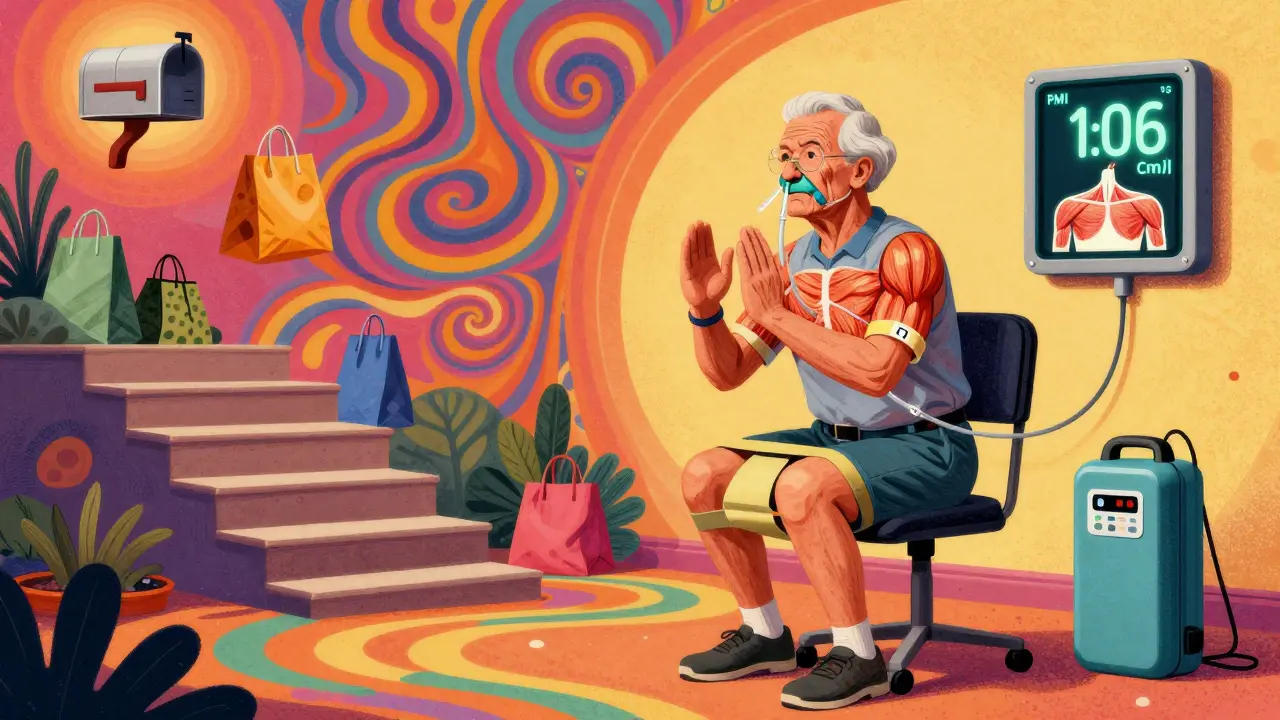
But here’s the twist: standard BMI or DEXA scans often miss sarcopenia in COPD. Why? Because many patients are underweight or have fluid buildup that masks muscle loss. That’s why experts now use the pectoralis muscle index (PMI). A CT scan at the third lumbar vertebra (L3) can measure how much muscle is left in your chest. If your muscle area divided by your BMI is below 1.06 cm²/BMI, you likely have sarcopenia. This method catches 30% more cases than traditional tools.
Doctors should screen everyone with moderate to severe COPD. Handgrip strength takes 30 seconds. The Short Physical Performance Battery (SPPB) takes five minutes. If you’re not being tested, ask for it. Early detection saves lives.
Nutrition: The Foundation of Muscle Recovery
Food isn’t just fuel. It’s medicine. If you’re eating 70 grams of protein a day but weigh 80 kg, you’re falling short. You need at least 96-120 grams daily. That’s not a suggestion - it’s a requirement.
Here’s how to make it work:
- Distribute protein evenly. Don’t save it all for dinner. Aim for 0.3-0.4 grams per kilogram per meal - that’s about 25-30 grams at each of your four meals.
- Choose high-quality sources. Eggs, lean meat, fish, dairy, and whey protein are best. They contain leucine - the amino acid that triggers muscle repair.
- Add leucine supplements. Studies show adding 2.5-3.0 grams of leucine per meal boosts muscle synthesis by 37% in COPD patients.
- Try protein shakes if you’re losing appetite. A whey-based shake with 20g protein and 10g leucine can be easier than solid food during flare-ups.
- Don’t skip calories. You need energy to build muscle. If you’re underweight, add healthy fats like nuts, avocado, or olive oil.
One patient, Mary Thompson, 68, told her rehab team she couldn’t eat enough. They gave her a daily shake with 30g protein and 10g leucine. After 12 weeks, she could carry two grocery bags without stopping. She didn’t gain weight - she gained strength.
Resistance Training: How to Start Without Worsening Breathlessness
You might think, “I can’t lift weights - I can’t even walk without getting winded.” But here’s the truth: avoiding exercise makes sarcopenia worse. The right kind of training? It helps you breathe easier.
Standard gym routines won’t work. In COPD, 42% of patients need supplemental oxygen during resistance training. That’s why protocols must be adapted.
Here’s what works:
- Start at 30% of your one-rep max. That means very light weights - maybe 1-2 pounds, or resistance bands.
- Focus on major muscle groups: legs (chair squats), arms (bicep curls), chest (wall push-ups), and back (seated rows with bands).
- Do 2-3 sessions per week. Each session: 2 sets of 10-15 reps. Rest 2-3 minutes between sets.
- Use your dyspnea scale. If your breathlessness hits a 5/10, stop. Wait. Breathe. Then continue.
- Progress slowly. After 4-6 weeks, increase weight or resistance by 5-10%. Don’t rush.
- Always have oxygen available. If you’re on home oxygen, use it during training. It’s not a sign of failure - it’s part of the plan.
At the Cleveland Clinic, 78 COPD patients with sarcopenia followed this exact plan. After 16 weeks, their 6-minute walk distance improved by 23%. That’s not just a number. It means walking to the mailbox without stopping. Getting out of the car without help. Keeping your independence.
Why Most Programs Fail - And How to Avoid It
Too many rehab programs treat sarcopenia like a side note. They focus on breathing exercises but skip strength training. Or they give protein advice without checking intake. Or they expect patients to train hard right away.
Patients who quit often say: “It made me too short of breath.” Or “I couldn’t eat enough.” Or “No one told me I needed oxygen during lifts.”
The fix? Three rules:
- Start lighter than you think. Many patients try 5-pound dumbbells and quit after one session. Start with 1 pound. Or use a resistance band. Progress slowly.
- Pair oxygen with training. If you use oxygen at rest, you likely need it during activity. Ask your provider for a prescription for exercise use.
- Track protein daily. Write down what you eat. If you’re under 1.2 g/kg/day, talk to a dietitian. Don’t wait until you’re too weak to change.
Also, don’t stop during flare-ups. Instead, modify. Do seated exercises. Shorten sessions. Use lighter bands. Even 10 minutes of movement helps prevent further loss.
The Future Is Here - And It’s Personalized
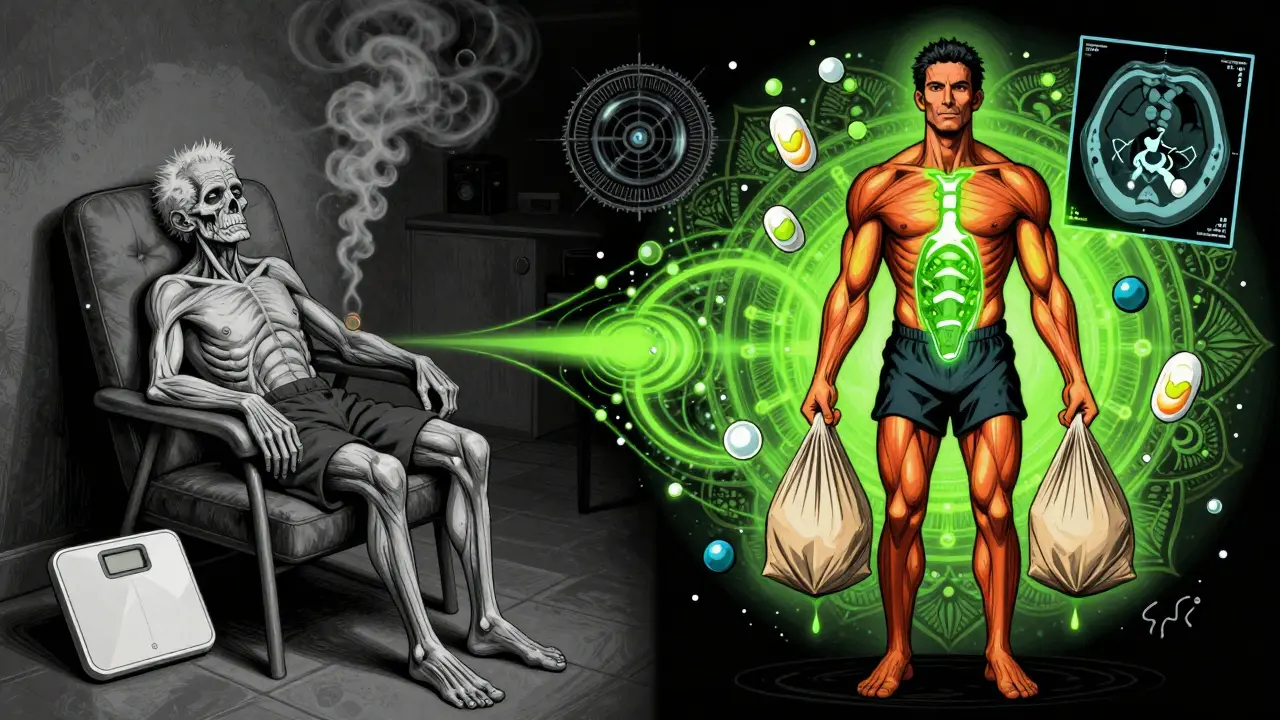
The Global Initiative for Chronic Obstructive Lung Disease (GOLD) just released its first sarcopenia management algorithm in 2024. It links overnight oxygen levels to training intensity. If your oxygen dips below 88% for more than 30% of sleep, your training load should be lower.
Researchers are testing new supplements like HMB (beta-hydroxy-beta-methylbutyrate), which helped patients preserve muscle mass 18% better than placebo in early trials. A new drug called PTI-501, which blocks myostatin (a protein that limits muscle growth), is in phase 2 trials and could be available by 2026.
But you don’t have to wait. The tools are here now: handgrip testing, protein timing, low-load resistance, and oxygen-supported training. These aren’t experimental. They’re evidence-based. And they’re being used successfully in top pulmonary rehab centers across the U.S.
What You Can Do Today
You don’t need a fancy gym or a prescription. Start here:
- Measure your grip strength. Use a handgrip dynamometer (available at pharmacies). If it’s below 27 kg (men) or 16 kg (women), talk to your doctor.
- Add protein. Aim for 25-30 grams at breakfast, lunch, dinner, and one snack. Use eggs, Greek yogurt, chicken, or a whey shake.
- Do 2-3 short resistance sessions this week. Sit in a chair. Lift light cans or bands. Do 10 reps. Rest. Repeat. No need to go heavy.
- Ask your pulmonary rehab team if they screen for sarcopenia. If not, request it.
Sarcopenia in COPD isn’t inevitable. It’s treatable. And every small step - one more gram of protein, one more set of light lifts - adds up. You’re not just building muscle. You’re rebuilding your ability to live.
Releted Post

Andy Dargon
Hi, I'm Aiden Lockhart, a pharmaceutical expert with a passion for writing about medications and diseases. With years of experience in the pharmaceutical industry, I enjoy sharing my knowledge with others to help them make informed decisions about their health. I love researching new developments in medication and staying up-to-date with the latest advancements in disease treatment. As a writer, I strive to provide accurate, comprehensive information to my readers and contribute to raising awareness about various health conditions.
Just read this and had to share - I’m a COPD patient and sarcopenia hit me hard last year. I thought it was just ‘getting old’ until my PT told me to grab a handgrip tester. Mine was 14kg. Oof.
Started doing 1lb dumbbell curls while watching TV and added a whey shake at breakfast. No magic, just consistency.
Three months later, I carried my own laundry up the stairs. Didn’t cry. Mostly. 😅
Good breakdown. The protein timing detail is spot on.
Most people think if they eat enough protein once a day it’s enough. But muscle synthesis peaks within 2-3 hours after intake. Spreading it out matters more than total amount.
Also, oxygen during training isn’t optional. It’s part of the rehab. Shame it’s still treated like an afterthought.
Actually the study you cite on TNF-alpha and IL-6 is outdated. That was from 2017. The 2022 meta-analysis in Thorax showed IL-1β is now the dominant cytokine driving muscle catabolism in COPD, not IL-6.
Also, leucine supplements? The Cochrane review says there’s no significant benefit over whole food protein. You’re overselling it.
And why are you ignoring the role of gut dysbiosis? Malabsorption is a huge factor in underweight COPD patients. Protein isn’t the issue - absorption is.
THIS is why the system wants you weak. Big Pharma doesn’t profit off protein shakes and resistance bands. They profit off ventilators, oxygen tanks, and hospital stays.
They don’t want you to know you can rebuild muscle with 2-pound dumbbells and eggs. That’s why your doctor never mentions it.
And why do you think they skip the pectoralis muscle scan? Because if you knew how much muscle you lost, you’d demand real answers - not pills.
Wake up. This isn’t medicine. It’s control.
PMI at L3 is the real MVP here. Most clinics still rely on BMI or DEXA - which is like using a ruler to measure a hurricane.
Had my CT done last year. PMI was 0.89. Doc said ‘classic COPD sarcopenia.’
Now I do seated band rows every morning. 10 reps. 2x/week. No pain. No oxygen. Just… more breath.
Also, leucine in the shake? Game changer. Felt it by week 3.
Let me tell you something nobody else will - this whole sarcopenia thing is a scam. I’ve been working with COPD patients for 18 years. Muscle loss? Sure. But it’s not because of inflammation or protein. It’s because people are lazy.
You think doing two sets of 10 reps with a water bottle is going to fix decades of inactivity? No. It’s not about protein. It’s about discipline.
And don’t get me started on those ‘leucine supplements.’ That’s just Big Supplement trying to sell you a bottle of chalk powder for $40.
Real strength? You get it from hard work. Not from shakes and CT scans.
Also, why are we using L3? Why not L1? Or T12? The data is all over the place. It’s a statistical mirage.
Wait - so you’re saying grip strength is the first indicator? Not walking speed or chair stands?
I’m asking because my mom’s grip is 18kg and she can still walk 500m without stopping. But she’s always been stubborn about eating.
Is grip strength really that predictive? Or is it just easier to measure than, say, thigh muscle volume?
Also, what’s the threshold for ‘low’ physical performance? Is 0.8 seconds for 4m really the cutoff? Seems tight.
As someone who works with elderly patients in rural India, I’ve seen this play out differently.
No one here has access to whey protein or CT scans. But we use dal, eggs, and homemade paneer. And resistance? They carry water buckets. They climb stairs with firewood.
Protein intake? Maybe 0.9g/kg - but they move constantly. And they eat with family. That’s the secret.
Maybe the real solution isn’t more supplements, but more community. More purpose. More being needed.
Also - 25g protein at breakfast? In my village, that’s 3 eggs + 1 cup yogurt. Simple. Real. Done.
YESSSSS. This is the energy I needed today.
I’ve been doing seated bicep curls with soup cans since March. 10 reps. 2x a week.
My husband said I looked ‘less like a ghost’ last week. I cried.
And I started adding a scoop of protein powder to my oatmeal. Not because I’m fancy - because I can’t eat big meals anymore.
TOGETHER WE GOT THIS. ONE REP AT A TIME. 💪❤️
Handgrip strength is a proxy variable - not a diagnostic. You’re conflating correlation with causation.
And leucine supplementation? The RCTs have high heterogeneity. The effect size is d=0.32. Clinically insignificant.
Also, the PMI cutoff of 1.06? Derived from a cohort of 87 patients in Cleveland. Not generalizable to global populations.
You’re promoting a protocol that’s not validated. That’s dangerous.
They don’t want you strong. They want you dependent. Oxygen machines cost $3000. Protein shakes? $20. Why would they let you fix this yourself?
And why is every study funded by Big Pharma? Because they’re scared you’ll realize you don’t need them.
They’re hiding the truth. You think this is medicine? It’s a business model. Wake up.
This is one of the most thoughtful, evidence-based overviews I’ve read on COPD-related sarcopenia.
The emphasis on protein distribution, low-load resistance, and oxygen use during training aligns perfectly with current GOLD guidelines.
Most importantly - it’s actionable. No jargon. No fluff. Just clear steps anyone can start today.
Thank you for writing this. It’s exactly what patients need - not more complexity, but clarity.