
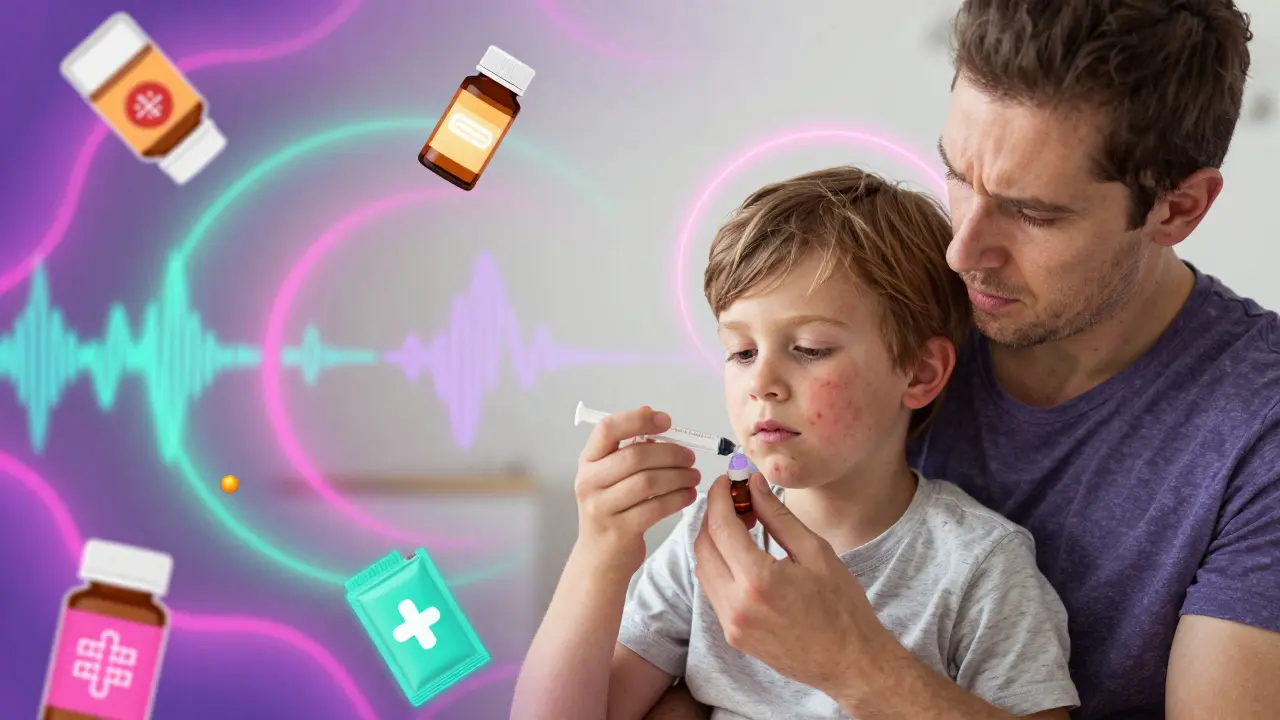
When your child starts a new medication, you’re not just giving them a pill or liquid-you’re stepping into a new role as their first responder. Side effects happen. They’re common. And while most are mild, knowing what to watch for and how to respond at home can keep your child safe and out of the emergency room.
What Side Effects Are Most Common in Kids?
Not all side effects are dangerous, but they’re not always predictable. In children, the body is still growing, and organs like the liver and kidneys process drugs differently than in adults. According to data from Children’s Hospital of Philadelphia, the most frequent reactions include:- Upset stomach or nausea (42% of cases)
- Diarrhea (28%)
- Drowsiness (19%)
- Unusual hyperactivity (12%)-yes, some allergy meds like diphenhydramine can make kids wired, not sleepy
- Rashes or skin irritation (23%)
When to Call the Doctor Right Away
Most side effects fade within a day or two. But some need immediate attention. The American Academy of Pediatrics says contact your pediatrician or go to urgent care if your child has:- Persistent vomiting-more than three times in 24 hours
- Fever above 102°F (38.9°C) that doesn’t come down with acetaminophen or ibuprofen
- Difficulty breathing or breathing faster than 40 breaths per minute (for infants) or 30+ breaths per minute (for older kids)
- Hives covering more than 10% of the body, swelling of the lips or face, or wheezing
- Seizures or loss of consciousness
Managing Gastrointestinal Side Effects at Home
Stomach upset, nausea, and diarrhea are the most common complaints. The goal? Prevent dehydration and let the gut settle. For vomiting:- Wait 30 to 60 minutes after the last episode.
- Start with 5-10 mL (about 1-2 teaspoons) of oral rehydration solution like Pedialyte every 5 minutes.
- If they keep it down for 2 hours, slowly increase the amount.
- After 6-8 hours without vomiting, try bland foods: bananas, rice, applesauce, toast (the BRAT diet).
- Keep giving fluids-water, diluted juice, or electrolyte solutions.
- Avoid sugary drinks like soda or undiluted juice; they can make diarrhea worse.
- Continue regular feeding if they’re eating. Starving a child doesn’t help-it slows recovery.
Dealing with Allergic Reactions
An allergic reaction isn’t just a rash. It’s your child’s immune system overreacting. Mild rashes might go away on their own. But if you see:- Swelling around the eyes, lips, or tongue
- Hives spreading quickly
- Coughing, wheezing, or trouble breathing

Stopping Antibiotics Too Early
This is one of the biggest mistakes parents make. When a child starts feeling better after 2-3 days of antibiotics, it’s tempting to stop. But that’s exactly when the strongest bacteria are still alive. Children’s Healthcare of Atlanta found that 29% of bacterial infections return because antibiotics were stopped early. And 31% of parents say they stopped because of side effects like diarrhea or vomiting. The fix? Talk to your doctor before stopping. Ask: “Is this side effect normal, or should I switch meds?” Most doctors will suggest switching to a different antibiotic or adding a probiotic to help with stomach upset-instead of quitting altogether.Getting the Dose Right-Every Time
The most dangerous side effect? A dosing error. Dr. Sarah Arbogast’s research found that 78% of parents misread dosing instructions. The biggest mistake? Confusing a teaspoon (5 mL) with a tablespoon (15 mL). That’s a 300% overdose risk. Here’s how to get it right:- Never use kitchen spoons. They’re not accurate.
- Use the oral syringe that came with the medicine-or buy a 1 mL syringe with 0.1 mL markings. They cost under $3 at any pharmacy.
- Always measure at eye level. Tilt the bottle, not the syringe.
- Write down each dose in a notebook or app. Include time, amount, and any reaction.
- Take a photo of the label before giving the medicine. It’s a simple habit that cuts wrong-medication errors by 44%.
Storing Medications Safely
Kids are curious. And they’re strong. A locked cabinet isn’t enough if it’s at their eye level. Dr. Helen Arbogast’s research at Children’s Hospital Los Angeles shows that storing meds at least 5 feet high-out of reach and out of sight-reduces accidental ingestions by 65%. But here’s what most people don’t know:- Never transfer pills to pill organizers or empty candy jars. That increases poisoning risk by 41%.
- Keep all meds in their original child-resistant containers. They’re tested to block 92% of kids under 5.
- Store liquids between 68-77°F (20-25°C). Most require refrigeration-check the label.
- Use a lockbox if you have toddlers or grandchildren visiting.

What About Hyperactivity from Medications?
It sounds backwards, but some drugs that are supposed to calm kids-like diphenhydramine (Benadryl) or certain asthma inhalers-can make them hyper. One study found 15% of kids given Benadryl became overly active, compared to just 2% of adults. If your child suddenly runs around nonstop, can’t sit still, or seems “wired,” it’s not bad behavior. It’s a reaction. Document it. Write down:- What time the medicine was given
- What they did (e.g., “ran in circles for 45 minutes,” “couldn’t sit still during dinner”)
- How long it lasted
New Tools Making Home Care Easier
Technology is helping parents stay on top of meds. Apps like MedTrak Pediatric, launched in late 2023, let you scan the barcode on the bottle to verify the dose, set reminders, and log reactions. In trials, they reduced dosing errors by 68%. Also, some pediatricians now ask parents to take photos of medication labels before giving a dose. It’s a simple step that catches 1 in 4 wrong-medication errors. And in the future? Genetic testing may soon predict which kids are more likely to have bad reactions to certain drugs. Early research shows it could catch 73% of severe reactions before they happen. But that’s still 3-5 years away.What’s Coming Next
The FDA’s proposed Pediatric Medication Safety Act, introduced in September 2023, could change everything. By 2027, it would require:- Standardized, picture-based dosing instructions
- Clear side effect profiles written for parents, not doctors
- Child-specific dosing for 95% of medications (right now, only 62% have them)
Final Thought: You’re Doing Better Than You Think
Parenting a child on medication is stressful. You’re juggling doses, side effects, doctor visits, and sleepless nights. But you’re not alone. Millions of families are doing the same thing. The goal isn’t perfection. It’s awareness. Keep a log. Know the red flags. Store meds safely. And when in doubt-call your pediatrician. Most offices have nurses on call 24/7. You don’t need to be an expert. You just need to be observant.What should I do if my child vomits right after taking medicine?
Wait 30 to 60 minutes, then try giving a small amount of oral rehydration fluid-5 to 10 mL every 5 minutes. If they keep it down for 2 hours, slowly increase the amount. Don’t give another full dose unless your doctor says to. If vomiting continues for more than 24 hours, contact your pediatrician.
Can I give my child over-the-counter medicine to treat side effects?
Only if your pediatrician says so. For example, giving ibuprofen for a fever caused by a new antibiotic is usually fine. But giving anti-diarrhea meds like Imodium to a child under 12 can be dangerous. Always check with your doctor before mixing medications-even if they’re sold without a prescription.
How do I know if a rash is an allergic reaction or just a side effect?
Take a photo and call your doctor. Allergic rashes often appear quickly, spread fast, and may be itchy or raised (hives). Side effect rashes from antibiotics like amoxicillin are often flat, red, and appear days after starting the medicine. Both need evaluation, but only allergic reactions require emergency care if swelling or breathing trouble occurs.
Is it safe to crush pills or mix medicine with food for my child?
Some pills can be crushed and mixed with applesauce or yogurt, but many cannot. Extended-release, enteric-coated, or capsule medications lose their effectiveness or become dangerous if altered. Always check the label or ask your pharmacist before mixing. If your child struggles to swallow pills, ask your doctor about liquid alternatives or use the graduated candy method-starting with Nerds and moving to Mini M&Ms over two weeks.
What’s the best way to store liquid medications?
Most liquid pediatric meds should be stored at room temperature (68-77°F or 20-25°C). About 73% require refrigeration-always check the label. Never leave them in the car, near the stove, or in a bathroom cabinet where humidity and heat can break them down. Keep them in their original child-resistant bottles and out of reach of children.
Why do some kids get hyper from allergy medicine?
Some antihistamines like diphenhydramine (Benadryl) affect children’s brains differently than adults’. In 15% of kids, instead of causing drowsiness, they trigger hyperactivity, restlessness, or irritability. This isn’t bad behavior-it’s a known side effect. Document the behavior and talk to your doctor. They may switch to a non-sedating antihistamine like loratadine or give the dose at bedtime.
Should I stop antibiotics if my child has diarrhea?
No-unless your doctor tells you to. Diarrhea is a common side effect of antibiotics, especially amoxicillin. Stopping early can cause the infection to come back stronger. In fact, 29% of recurrent infections happen because parents quit too soon. Call your pediatrician instead. They may suggest a probiotic or switching to a different antibiotic.
How can I prevent dosing mistakes?
Use an oral syringe with 0.1 mL markings-never a kitchen spoon. Measure at eye level. Write down each dose and time in a notebook or app. Take a photo of the label before giving the medicine. And always double-check the name and dose against the prescription. These simple steps cut errors by up to 68%.
Releted Post

Andy Dargon
Hi, I'm Aiden Lockhart, a pharmaceutical expert with a passion for writing about medications and diseases. With years of experience in the pharmaceutical industry, I enjoy sharing my knowledge with others to help them make informed decisions about their health. I love researching new developments in medication and staying up-to-date with the latest advancements in disease treatment. As a writer, I strive to provide accurate, comprehensive information to my readers and contribute to raising awareness about various health conditions.
Okay but let’s be real-this guide is basically the parenting bible for meds. I printed it out and taped it to the fridge next to the emergency numbers. My kid got amoxicillin last week and turned into a tiny tornado at 3am. I panicked. Then I remembered the hyperactivity bit. Didn’t call the doctor. Just waited it out. He slept like a log by 7am. Thank you for not sugarcoating this stuff.
78% of parents misread dosing instructions? That’s not incompetence. That’s systemic failure. We’re asking caregivers to be pharmacists while sleep-deprived, underpaid, and emotionally shattered. And the solution? Buy a $3 syringe. That’s like telling a starving person to just eat more. The system isn’t broken-it’s designed to fail families.
I just want to say thank you for writing this. My daughter had a rash after her first dose of amoxicillin and I thought we were gonna lose her. Took a photo. Called the nurse line. Turned out it was harmless. I cried. I’m not ashamed to say I needed this info. You made me feel less alone.
Don’t use kitchen spoons. Period. I used a tablespoon once. My kid got a triple dose. Ended up in urgent care. Never again. Got a 1mL syringe from CVS for $2.50. Best purchase of my life. Also-photos of labels? Genius. I started doing it after my cousin’s kid swallowed half a bottle of melatonin. Don’t wait for tragedy to change your habits.
Just wondering-has anyone tried the MedTrak app? I’m skeptical about tech solutions but the 68% error reduction stat is hard to ignore. I’ve been using a paper log since my son started his ADHD med. It’s messy but it works. Curious if digital is worth the switch.
It’s fascinating how this article meticulously catalogs pediatric pharmaceutical adverse events with epidemiological precision, yet utterly fails to address the socioeconomic underpinnings of medication non-adherence. The suggestion to purchase a $3 syringe presupposes disposable income, stable housing, and access to retail pharmacies-all privileges not universally held. This is harm reduction dressed as empowerment. It’s not advice. It’s a Band-Aid on a hemorrhage.
Let’s be real-90% of parents don’t even know what an enteric coating is. That’s why we need standardized pictograms. The FDA’s 2027 mandate? Long overdue. I’ve seen moms give liquid antibiotics with a turkey baster. No joke. The fact that we’re still using text-based labels for meds meant for toddlers is a national disgrace. 🤦♂️
They say you’re not an expert you just need to be observant
But what if you’re too tired to see
What if you’re scared to ask
What if you’ve been told your instincts are wrong too many times
Observation isn’t a skill
It’s a luxury
And we’re all just trying to survive the next dose