
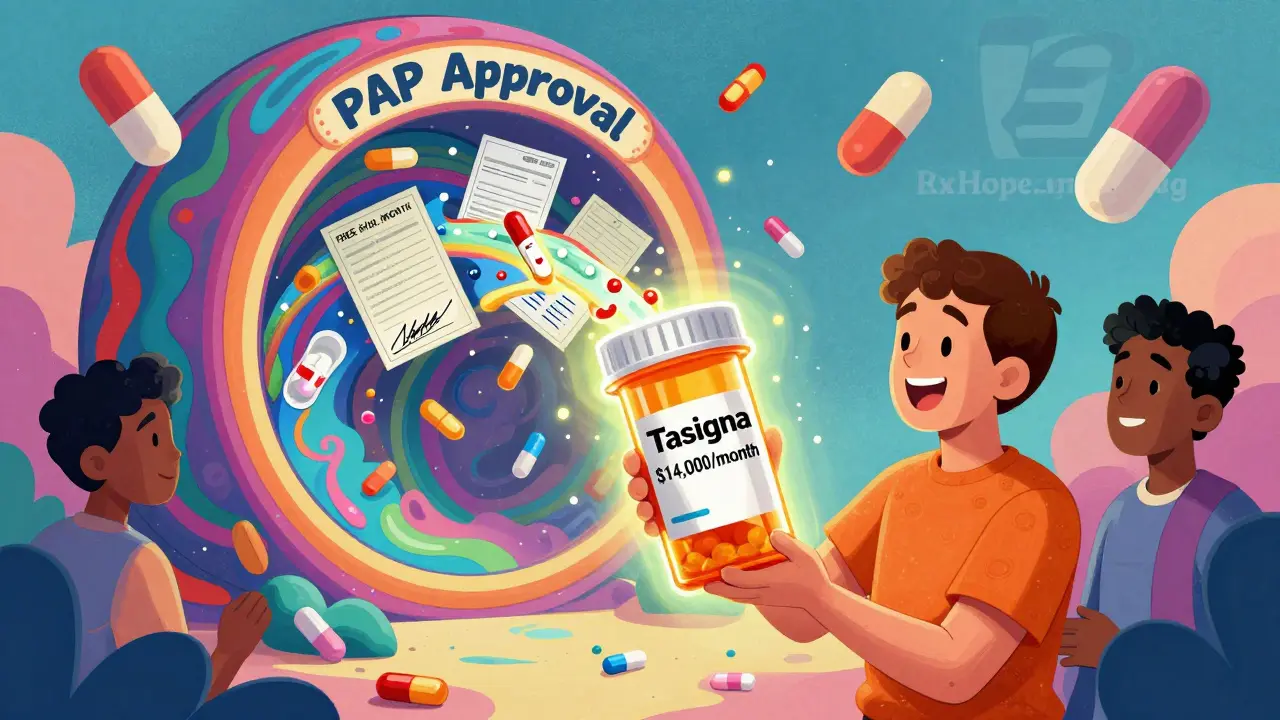
When a life-saving medication has no generic version, the price can feel impossible. Some drugs cost more than $10,000 a month. If you’re uninsured, underinsured, or stuck with a high-deductible plan, that’s not just expensive-it’s a threat to your health. But there’s a way out: patient assistance programs (PAPs). These aren’t charity handouts. They’re formal programs run by drugmakers, nonprofits, and sometimes states to help people get the medicines they need when there’s no cheaper alternative.
Why PAPs Matter When There’s No Generic
Generic drugs cut costs by 80% or more. But for many serious conditions-like rare diseases, certain cancers, or autoimmune disorders-there simply isn’t a generic version. Think of drugs like Soliris, Spinraza, or Tasigna. These aren’t old pills with expired patents. They’re complex biologics or specialty medications that take years to develop and can’t be easily copied. That means you’re stuck paying the brand-name price, often set at $500,000 a year or more. Without help, people choose between skipping doses, selling belongings, or going into debt. Research shows patients using PAPs for these kinds of drugs are 37% less likely to stop taking their medication because they can’t afford it. That’s not just money-it’s survival.How PAPs Actually Work
PAPs don’t work like coupons or discount cards. They’re not meant to give you 20% off. They’re designed to cover the full cost of the drug for eligible patients. Here’s how it breaks down:- 55% of programs give you the medication for free-zero out-of-pocket cost.
- 30% offer sliding-scale help based on income. Most set the max income at 400% of the Federal Poverty Level, which was $60,000 for one person in 2023.
- 15% provide fixed-dollar assistance, like $500 a month toward your drug.
Who Runs These Programs?
There are about 1,500 PAPs in the U.S. today. Most are run by drug companies-85% of them. Companies like Gilead, Novartis, and Eli Lilly have their own programs. But nonprofits and state agencies also play a big role:- Pharmaceutical companies (65%): Fastest approvals, but only help with their own drugs.
- Nonprofit foundations (25%): Like the Patient Access Network Foundation or Chronic Disease Fund. They help with multiple drugs and often don’t have income caps as strict as manufacturer programs.
- State programs (10%): Like PACE in Pennsylvania. These usually target seniors and have lower income limits but also lower maximum help-often capped at $400 a month per drug.
The Hidden Problem: Accumulator Adjustments
Here’s where things get ugly. Even if you get approved for a PAP that covers your $12,000 monthly drug, your insurance company might still make you pay thousands more. Why? Because of something called an “accumulator adjustment.” Most major pharmacy benefit managers-like Express Scripts and Optum-now block PAP money from counting toward your deductible or out-of-pocket maximum. So even though the PAP paid your $12,000, your insurance treats it like you didn’t pay anything. You still owe your full deductible, which could be $8,000 or more. This traps people. You think you’re getting help. You’re not. You’re just paying $20,000 out of pocket instead of $12,000. And you’re still not done until you hit your max. The fix? Look for foundation-based PAPs. They’re not tied to your insurance, so they don’t get caught in accumulator rules. Or ask your provider to help you switch to a plan without accumulator policies.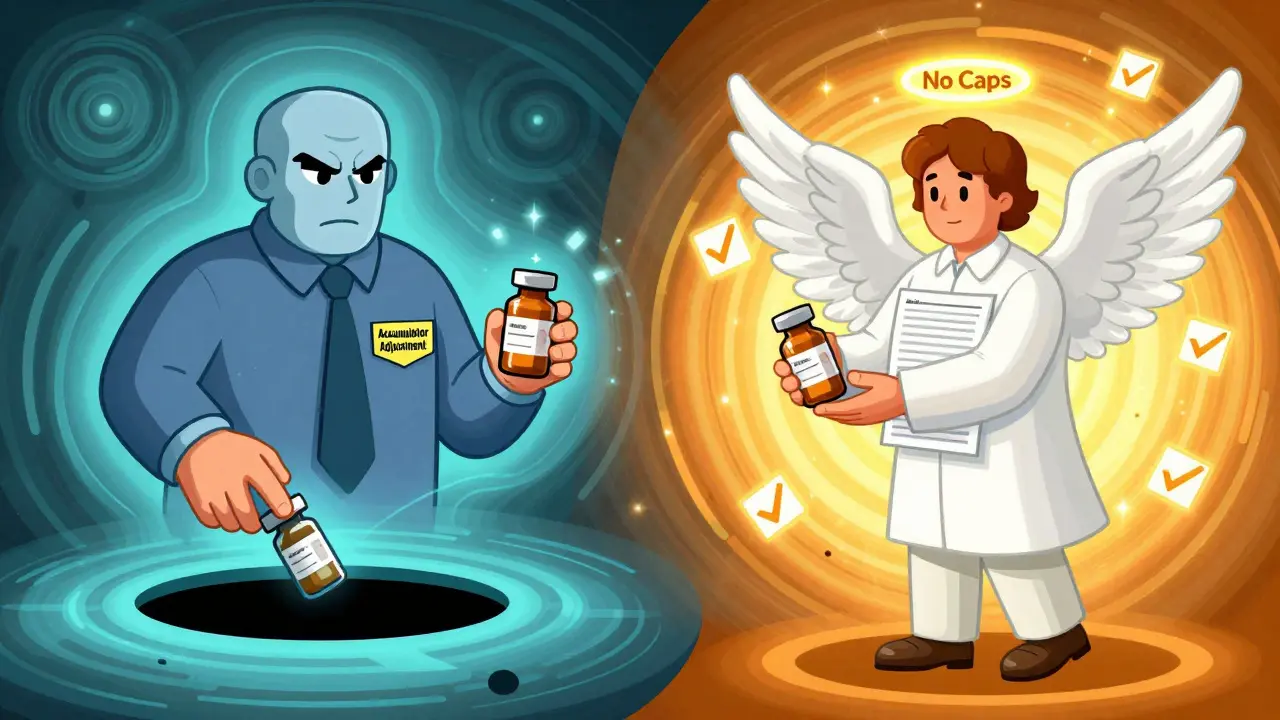
How to Apply-Step by Step
Applying for a PAP isn’t easy. The average application takes 45 minutes to fill out and requires three documents. But you don’t have to do it alone.- Find the right program. Use RxHope’s online screener-it checks 92% of manufacturer programs and tells you which ones you qualify for in under 5 minutes.
- Gather your documents. You’ll need: proof of income (W-2, tax return, or pay stubs), your prescription (on doctor’s letterhead), and proof of insurance status (or denial letter if you’re uninsured).
- Get your doctor involved. Most programs require a signed form from your provider. Many clinics now have medication access specialists who handle this for you. Ask if your office has one.
- Submit and follow up. Manufacturer PAPs usually approve in 7-10 business days. Nonprofits take 2-3 weeks. Call after 10 days if you haven’t heard back.
What If You’re on Medicare?
If you’re on Medicare Part D, you can’t use manufacturer PAPs for your drugs. That rule changed in 2020. But you’re not out of options. Nonprofit foundations still help Medicare patients. Programs like the Patient Access Network Foundation and the Chronic Disease Fund have separate applications for Medicare beneficiaries. They often require proof of income and a doctor’s note, but they don’t care if you’re on Medicare. Also, look into Extra Help (Low-Income Subsidy). If your income is below $21,000 as a single person, you may qualify for federal help that lowers your Part D costs. Apply through Social Security.PAPs vs. Discount Cards vs. State Programs
It’s easy to confuse PAPs with GoodRx or state programs. Here’s how they stack up:| Option | Average Savings | Eligibility | Best For |
|---|---|---|---|
| Patient Assistance Programs (PAPs) | Up to 100% off | Low income, uninsured or underinsured | Drugs with no generic, high cost ($10K+/month) |
| GoodRx / Pharmacy Discount Cards | 8.3% on average for brand-name drugs | Anyone with insurance or cash | Lower-cost generics or moderate brand-name prices |
| State Pharmaceutical Programs (SPAPs) | Up to $400/month per drug | Often seniors, low income | Fixed-income seniors needing long-term meds |
Real Stories, Real Impact
One man in Ohio had chronic myeloid leukemia. His drug, Tasigna, cost $14,000 a month. He was paying $1,400 out of pocket each month. He applied for Novartis’s PAP. After 3 weeks of paperwork, he got approved. His cost dropped to $0. He kept his job. He didn’t lose his home. Another woman in Texas had HIV. Her medication was $15,000 a month. She had no insurance. Without Gilead’s PAP, she said she’d have chosen homelessness over bankruptcy. But it’s not always smooth. One man on Medicare spent three months fighting UnitedHealthcare’s accumulator policy. Even though his PAP paid his $12,000 drug bill, his insurance didn’t count it toward his deductible. He ended up paying $20,700 out of pocket before his cap kicked in.What’s Changing in 2026?
The landscape is shifting. The Inflation Reduction Act banned manufacturer copay assistance for Medicare Part D drugs starting January 1, 2025. That means more pressure on nonprofit PAPs. Drugmakers are trying to simplify things. Eli Lilly’s “Simple Bridge” program cut its application from 17 steps to 5 for insulin. Approval now takes under 48 hours. Hospitals are hiring more medication access specialists. In 2020, only 76% of hospitals had them. Now, 98% do. That means if you’re seeing a doctor at a major hospital, ask if they have someone who helps with PAPs. And there’s a new tool: the Patient Access Simulator. It lets your provider plug in your drug, income, and insurance to estimate your PAP savings before writing the prescription. That’s huge.What to Do If You’re Struggling
If you’re on a drug with no generic and you can’t afford it:- Don’t wait until you’re behind on payments.
- Call your pharmacy and ask if they know about PAPs.
- Ask your doctor’s office if they have a medication access specialist.
- Go to RxHope.org and use their screener-it’s free and fast.
- If you’re on Medicare, contact the Patient Access Network Foundation or Chronic Disease Fund directly.
- If you’re denied, appeal. Don’t give up.
Use them. Fight for them. Don’t let complexity stop you. Your health depends on it.
Can I use a patient assistance program if I have insurance?
Yes-but only if your insurance doesn’t cover the drug or requires prior authorization that’s denied. Most PAPs require proof that your insurer won’t pay. If your plan covers the drug but you can’t afford the copay, you may still qualify if your income is low. However, if your insurer uses an accumulator adjustment policy, your PAP help won’t count toward your deductible, which can leave you paying more overall.
What if I’m on Medicare?
You cannot use manufacturer-sponsored PAPs for Medicare Part D drugs since January 1, 2020. But nonprofit foundations like the Patient Access Network Foundation and Chronic Disease Fund still help Medicare beneficiaries. You’ll need to apply directly through them and provide income documentation. Also check if you qualify for Extra Help (Low-Income Subsidy) from Social Security.
How long does it take to get approved for a PAP?
Manufacturer PAPs usually approve within 7-10 business days. Nonprofit foundations take longer-14 to 21 days-because they verify more documents. If you’re applying through your doctor’s office, they may speed things up. Always follow up after 10 days if you haven’t heard back.
Do I need to reapply every year?
Yes, most PAPs require annual recertification. You’ll need to submit updated income documents and a new prescription. Some programs send reminders, but don’t rely on them. Mark your calendar-missing a renewal can mean losing your drug for weeks while you reapply.
Can I apply for multiple PAPs at once?
Yes, and you should. If you take more than one brand-name drug with no generic, apply for each program separately. You can also apply to both a manufacturer PAP and a nonprofit foundation for the same drug. Some patients use manufacturer PAPs for one drug and a foundation for another to avoid accumulator issues.
What if my PAP application is denied?
Don’t stop. About 41% of initial applications are denied, often for minor reasons like missing signatures or outdated income proof. Call the program directly and ask why. Fix the issue and reapply. Many programs have an appeals process. You can also ask your doctor or a patient advocate to help you appeal.
Are there free tools to help me find PAPs?
Yes. RxHope.org has a free online screener that checks over 90% of manufacturer PAPs and tells you which ones you qualify for. NeedyMeds.org is another reliable, nonprofit site with searchable databases for PAPs, discount cards, and state programs. Both are free and don’t require registration.
Next Steps
If you’re taking a brand-name drug with no generic and you’re struggling to pay:- Go to RxHope.org right now and run your drug through their screener.
- Call your pharmacy and ask if they’ve helped other patients with PAPs.
- Ask your doctor’s office if they have a medication access specialist.
- If you’re on Medicare, contact the Patient Access Network Foundation at 1-866-316-7263.
- Keep copies of every form, email, and letter. You’ll need them for appeals.
Releted Post

Andy Dargon
Hi, I'm Aiden Lockhart, a pharmaceutical expert with a passion for writing about medications and diseases. With years of experience in the pharmaceutical industry, I enjoy sharing my knowledge with others to help them make informed decisions about their health. I love researching new developments in medication and staying up-to-date with the latest advancements in disease treatment. As a writer, I strive to provide accurate, comprehensive information to my readers and contribute to raising awareness about various health conditions.
Wow. This is one of the most thorough, practical guides I’ve ever read on PAPs. I’ve been helping my mom navigate this for her autoimmune meds, and honestly? I didn’t know about the accumulator trap until now. This needs to be shared everywhere. Thank you for laying it out so clearly.
They call it ‘assistance’ but it’s really just a band-aid on a gunshot wound. Pharma makes billions while we beg for scraps. And don’t get me started on how they design these programs to be confusing-like they want you to give up.
Let’s be real-this whole system is a scam. These ‘patient assistance programs’? They’re PR stunts. The same companies that charge $500k/year for a drug then give you free pills if you jump through 17 hoops? That’s not charity. That’s damage control. And don’t tell me they’re not lobbying to keep prices high while pretending to help.
Just… thank you. 🙏 I cried reading this. My sister’s on Spinraza. We applied for the PAP, got denied twice because of a typo in the pay stub. Third time? We had a nurse’s assistant help us. It took 3 weeks. But she’s getting her meds. This isn’t just info-it’s lifelines written in plain English. Please, share this with every clinic, every pharmacy, every social worker you know.
Stop accepting this. This isn’t ‘help’-it’s exploitation dressed up as compassion. If a drug costs $15K/month, the company is gouging you. The fact that we’ve normalized begging for life-saving medicine is the real crisis. We need price caps. We need public manufacturing. We need to burn this system down and rebuild it with human dignity at the center-not corporate profit margins.
Interesting how the article mentions ‘accumulators’ like it’s some new, obscure loophole. It’s been a known industry tactic since 2018. The only reason it’s ‘news’ now is because more people are dying from it. And yet, no one in Congress has acted. Why? Because they’re all funded by the same companies running these ‘assistance’ programs.
People who use these programs are just enabling the system. Why not just refuse to buy the drug? Go natural. Go holistic. There are herbs, fasting, meditation-why are you so dependent on Big Pharma’s expensive toys? If you can’t afford it, maybe you shouldn’t be taking it. Your life isn’t worth $10K a month.
Just wanted to add a practical tip: If you’re on Medicare and applying to nonprofit PAPs, always submit your SSA-1099 form. Some foundations reject applications because they think you’re making too much-but if you’re on SSDI, your ‘income’ is counted differently. I’ve seen this trip up 3 people in my support group. Also, call the foundation directly-email gets lost. Phone calls get answered.
OMG I just applied for my husband’s drug using RxHope… and it worked?? Like, first try?? I didn’t even think it was possible. I was so scared I’d mess it up. I printed everything, triple-checked the doctor’s signature, and… it got approved in 8 days. I’m still in shock. Thank you for the step-by-step. I almost gave up before reading this.
While your piece is technically accurate, it lacks critical global context. In countries with universal healthcare, such absurd pricing would be unthinkable. The fact that you treat this as a uniquely American problem to be navigated via bureaucratic gymnastics-rather than a systemic failure of capitalist medicine-is deeply troubling. This is not ‘help’; it is the symptom of a civilization that values profit over personhood.
Everyone’s missing the real point. These programs exist because the FDA and DEA allow these drugs to be monopolized for 20+ years under ‘biologics exclusivity.’ That’s not innovation-that’s legal cartels. And the ‘nonprofits’? Most are funded by the same pharma giants. They’re shills. You think Gilead don’t bankroll the Patient Access Network? Please. They’re playing 4D chess while you’re stuck in checkers.
You know what’s wild? The fact that we’ve normalized this. Imagine if you needed a car to get to work, and the only model available cost $150,000, and the manufacturer said, ‘Oh, here’s a free one if you fill out 12 forms and your boss signs a letter.’ We’d riot. We’d burn down the dealership. But when it’s medicine? We sigh, cry, and submit. We’ve been conditioned to accept medical apartheid as ‘the way things are.’ And that’s the real tragedy-not the price tag, but our quiet resignation.
I work in a clinic and see this every day. One woman came in with her drug bottle-empty. She’d been skipping doses to make it last. She didn’t say anything until I asked. Just looked at me and whispered, ‘I didn’t want to be a burden.’ We got her into a foundation program that week. She cried. So did I. This isn’t just policy. It’s people. Please don’t treat it like a checklist.
While the foregoing exposition is both comprehensive and commendable in its attention to detail, it remains fundamentally inadequate in addressing the structural root causes of pharmaceutical price inflation. One is compelled to observe that the reliance upon discretionary, non-statutory assistance mechanisms reflects a profound abdication of public policy responsibility. A just society does not outsource life-sustaining care to corporate goodwill.
Why are you all so surprised? Of course the system is rigged. The same people who wrote this article are the ones who profit from it. They want you to think you’re getting help so you don’t protest. They want you to think it’s ‘your fault’ if you can’t navigate the maze. Don’t be fooled. This isn’t a fix. It’s a trap wrapped in a ribbon.